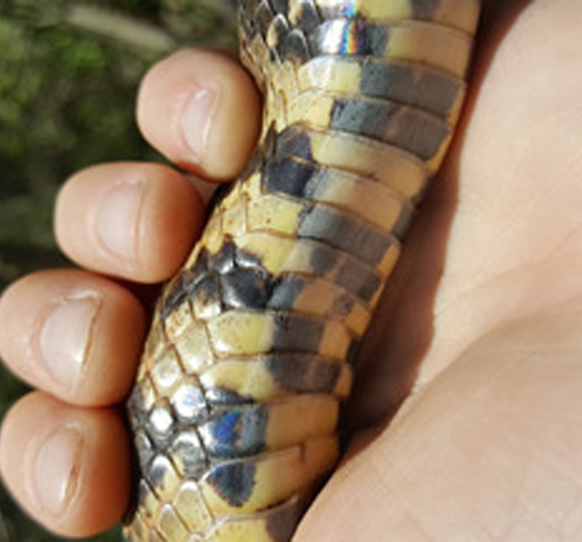
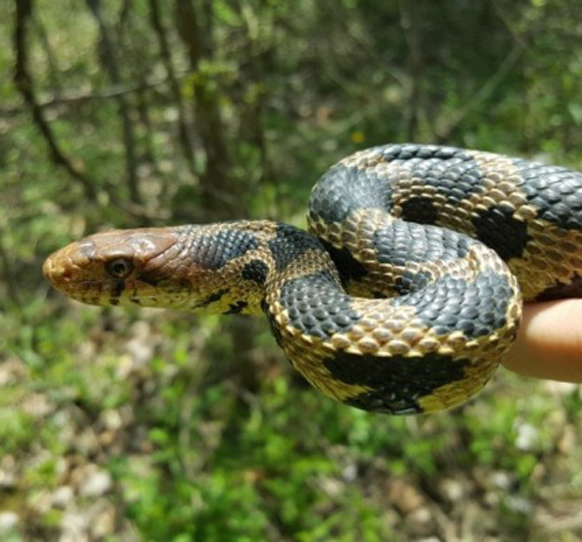
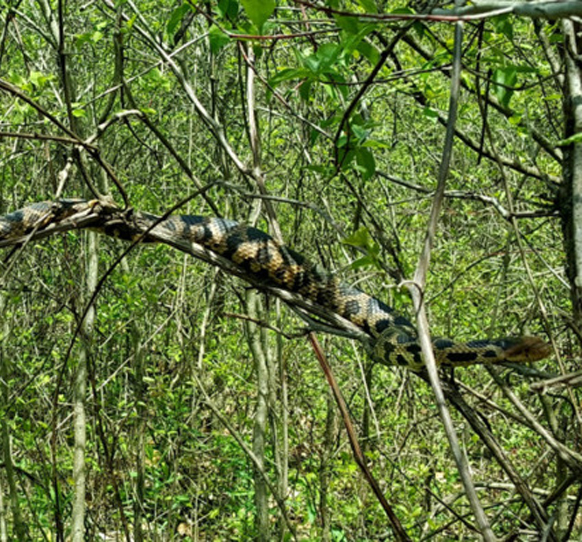
The eastern foxsnake is Ontario’s third largest snake and can reach a total length of 180 cm. They are usually spotted in open, unforested habitats like shorelines, marshes, sedge meadows, prairies, rock barrens, and wetland edges, where they patrol the ground searching for prey. They are distinguished by their yellow to light tan body dotted with large, dark brown and black blotches running down their backs.Their head is broader than the neck and displays a distinctive reddish-brown, and their underside is yellow marked with a bold checkered pattern of dark black/brown squares. When threatened, the snake rarely bites but instead vibrates its tail rapidly, which when moving through dry leaves or grass produces a sound startlingly similar to a rattlesnake’s rattle – a dangerous case of mistaken identity that often results in the snake being killed.
Both male and female look almost identical, however, hatchlings and juveniles display greyish or tan bodies with lighter, less defined blotches and a pale belly, lacking the vivid coloration that develops with maturity.
Age of sexual maturation is reached at 4 to 5 years and they will live for about 12 to 15 years in the wild. Mating occurs in the spring, typically from April through May. Females lay their eggs from June through August in secluded locations like decaying logs, rotting stumps, compost piles, sandy soils, or rich humus layers. A typical clutch contains 7 to 25 eggs, and after approximately 60 days of incubation, hatchlings emerge in late summer or early fall. Hatchlings occasionally remain together for up to a week after emergence before dispersing to find individual territories, and they receive absolutely no parental care.
The provincial Recovery Strategy calls for a number of conservation measures, including creating artificial nesting and hibernation sites, mapping habitat and corridors, monitoring eastern foxsnake populations and determining how much habitat is required to support a self-sustaining population in southwestern Ontario.
If you find an eastern foxsnake on a road, carefully move it across in the direction it was heading, don’t force it backward or to a random location. If you live in suitable habitat, protect shorelines and wetland edges from development and avoid disturbing basking snakes. Slow down while driving in snake habitat, particularly during spring and summer. Support habitat restoration efforts and local conservation organizations. Most importantly, don’t kill it – share what you’ve learned about the species with others, and help combat the misconceptions that lead to persecution.
Q: Why do people kill eastern foxsnakes thinking they’re rattlesnakes?
A: When an eastern foxsnake is startled, it vibrates its tail rapidly in a defensive display. If the snake is in dry leaves, grass, or other material that rustles, this tail vibration creates an unmistakable rattling sound exactly like a rattlesnake warning. Many people panic upon hearing this sound and kill the snake without looking closely. eastern foxsnakes are non-venomous and pose no real danger; the threat display is purely defensive.
Q: How do eastern foxsnakes hunt so successfully?
A: Eastern foxsnakes are active daytime hunters that patrol the ground and low vegetation searching for prey. When they locate a mouse, vole, rat, or other small mammal, they use their constrictor abilities wrapping their body around the prey to squeeze it. This hunting style makes them particularly valuable in agricultural areas where rodent populations can devastate crops or spread disease to livestock.