Purpose
We work to protect the massasauga rattlesnake from further impact by taking conservation actions that focus on monitoring, assessing and analyzing population recovery, as well as supporting our partners recovery efforts.
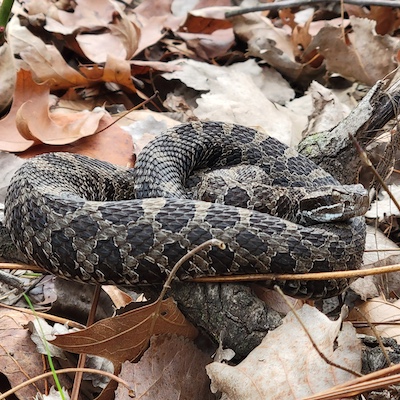
The Ojibway Prairie Complex and Greater Park Ecosystem (OPCGPE) in Ontario’s Windsor-LaSalle region is home to several reptile species threatened by urban development, habitat fragmentation and road mortality, including eastern foxsnakes, Butler’s gartersnakes, and a critically endangered population of massasauga rattlesnakes. This 24² km area was designated in 2016 as an “Important Amphibian and Reptile Area’” by the Canadian Herpetological Society (see Resources). The Massasauga rattlesnakes found here are isolated from other Canadian populations by over 300 km. As the only population in Canada to live in tallgrass prairie habitat, they represent an ecologically and genetically unique entity. Unfortunately, their range has plummeted 95% from 1975 to 2015, due to a history of habitat destruction, road mortality, intentional killing and illegal collection for the pet trade. Because so few individuals remain, the population is now on the brink of local extinction. We’re working to reverse that.
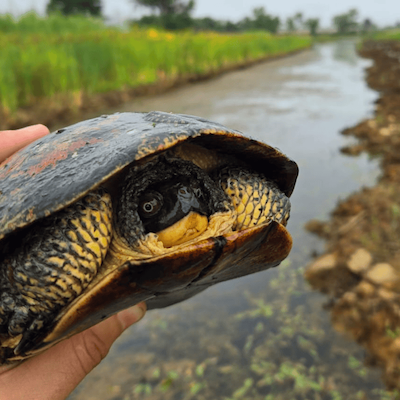
The Ojibway Prairie Complex and Greater Park Ecosystem (OPCGPE) in Ontario’s Windsor-LaSalle region is home to several reptile species threatened by urban development, habitat fragmentation and road mortality, including eastern foxsnakes, Butler’s gartersnakes, Blanding’s turtles and a critically endangered population of massasauga rattlesnakes. The Ojibway Prairie Reptile Recovery Team (OPRREC) works to protect, recover and monitor these species.
We work to protect the massasauga rattlesnake from further impact by taking conservation actions that focus on monitoring, assessing and analyzing population recovery, as well as supporting our partners recovery efforts.
In 2026 we plan to have:
In 5-10 years we plan to have:
In 10-20 years we plan to have:
We work to protect the Butler’s gartersnake from threat by supplementing wild populations and perfecting conservation techniques.
In 2026 we plan to have:
In 5-10 years we plan to have:
In 10-20 years we plan to have:
Project
In 2013 we began implementing conservation actions recommended in the Recovery Strategy for the Massasauga in Canada (see Resources). Our focus was on population monitoring, threat assessment, and an analysis of the feasibility of population recovery. In 2015 we launched the Ojibway Prairie Reptile Recovery program (OPRREC), in order to greatly expand our previous work, establish a reptile recovery working group (see Program Partners), and begin addressing important challenges identified in the feasibility study (see Resources). Since that time, we have been busy working with our partners to enhance critical habitat, mitigate threats, conduct public outreach, protect and connect habitat, and prepare for long-term population augmentation using techniques such as conservation breeding and translocation. A robust monitoring regime allows us to evaluate the success of our various recovery projects and to adapt techniques as required. In 2021, WPC was asked to lead the creation of a provincial recovery implementation team for the Massasauga.
Results
Some of the highlights of the OPRREC program during the 2015-2019 period include:
Impact
In Canada, massasauga rattlesnakes are limited to the Georgian Bay shoreline and only two isolated habitats in Ontario’s Carolinian Zone: the Ojibway Prairie Complex near Windsor and the Wainfleet Bog near Welland. Our major goal is to prevent the disappearance of the Ojibway population of Massasauga rattlesnakes, in order to maintain the geographic distribution, genetic diversity and ecological variation of this species in Canada. Our work is also designed to benefit several other species at risk, including the Butler’s gartersnake, eastern foxsnake and many species of plants unique to Ontario’s tallgrass prairies. If we are successful we will have stemmed the tide of extinction from one of the rarest ecosystems in Canada.
Publications
Choquette, J.D., T.E. Pitcher, A. Yagi, C. Fournier, R. Vos, and J.D. Litzgus. 2025. Reproductive traits of zoo-bred and wild-bred Eastern Massasaugas (Sistrurus catenatus) at Species Survival Plan® conservation breeding centres and other facilities. Zoo Biology 44(6): 572-588. doi.org/10.1002/zoo.70005
C. Fournier, J. Jundt, J.M. Elden, J.D. Choquette. 2025. Sistrurus catenatus (Eastern Massasauga): Facultative Parthenogenesis. Herpetological Review 56 (1), 28-30
Choquette, J.D., Savi, L.M., and C. Fournier. 2024. An inexpensive artificial snake hibernaculum built using readily available plumbing supplies. MethodsX 12, 102641. (https://doi.org/10.1016/j.mex.2024.102641)
Choquette, J.D., J. D. Litzgus, J. X. Y. Gui, and T. E. Pitcher. 2024. A systematic review of snake translocations to identify potential tactics for reducing post-release effects. Platform presentation. World Congress of Herpetology, Kuching, Malaysia (presented during symposium hosted by J. Choquette titled “Improving conservation and mitigation outcomes of snake translocations – Global lessons”)
Choquette, J. D., T. E. Pitcher, and J. D. Litzgus. 2024. Occupancy and detection of Eastern Massasauga Rattlesnakes (Sistrurus catenatus): Implications for evaluating population recovery efforts. Herpetologica 80 (3): 262–274. doi: https://doi.org/10.1655/Herpetologica-D-23-00055.
Trowbridge, C. and J. Choquette. 2023. Reptile road mortality at the Ojibway Prairie Complex, an ongoing threat at a future National Urban Park. Poster presentation, Sept 2023. Canadian Herpetological Society conference, Ottawa, ON.
Choquette, T. Pitcher, and J. Litzgus. 2023. Selection and validation of release sites for conservation translocations of a temperate-zone snake. Platform presentation, Sept 2023. Canadian Herpetological Society conference, Ottawa, ON
Choquette, J.; A.I. Mokdad, T. Pitcher, and J.D. Litzgus. 2023. Selection and validation of release sites for conservation translocations of temperate-zone snakes. Global Ecology and Conservation (https://doi.org/10.1016/j.gecco.2023.e02765).
Choquette, L. Savi, C. Fournier, and J. Litzgus. 2023. Home for a (Winter) rest: An inexpensive artificial snake hibernaculum built using readily available plumbing supplies. Poster presentation, Sept 2023. Canadian Herpetological Society conference, Ottawa, ON
Choquette, J. D., Litzgus, J. D., Gui, J. X. Y., & Pitcher, T. E. (2022). A systematic review of snake translocations to identify potential tactics for reducing postrelease effects. Conservation Biology, 00, e14016. https://doi.org/10.1111/cobi.14016
Choquette, Jonathan D. and Hand, Alexis V. (2021) “Informational Signage Increases Awareness of a Rattlesnake in a Canadian Urban Park System,” Human–Wildlife Interactions 15:1 https://doi.org/10.26077/9e24-0dc5
Winton S, Steiner J, Chabot A, McCurdy-Adams H, Traylor-Holzer K (Eds.). 2021. Integrated Collection Assessment and Planning Workshop for Canadian snakes. Canadian Species Initiative, ON, Canada and IUCN SSC Conservation Planning Specialist Group, MN, USA.
Choquette, J., M. Macpherson, and R. Corry. 2020. Identifying Potential Connectivity for an Urban Population of Rattlesnakes (Sistrurus catenatus) in a Canadian Park System. Land 9(9):313.https://doi.org/10.3390/land9090313
Winton, Stephanie, et al. ‘The Canadian Species Initiative: Bringing Global Tools to Species Recovery in Canada, Starting with Snakes!’ The Canadian Herpetologist, Vol. 10, no. No. 1, Fall 2020, https://canadianspeciesinitiative.ca/wp-content/uploads/2021/03/TCH-Volume-10-no-1-Fall-2020_WPC-Article.pdf
Choquette, J., and E. Jolin. 2018. Checklist and status of the amphibians and reptiles of Essex County, Ontario: a 35 year update. The Canadian Field-Naturalist 132 (2): 176-190.
Choquette, J., and L. Valliant. 2016. Road mortality of reptiles and other wildlife at the Ojibway Prairie Complex and Greater Park Ecosystem in southern Ontario. The Canadian Field-Naturalist 130 (1): 64-75.

Jonathan is based in Windsor, Ontario and manages the Ojibway Prairie Reptile Recovery Program, with the overall goal of recovering the Ojibway Prairie population of the Eastern Massasauga, while providing conservation benefits to other at-risk reptiles. Jonathan’s research interests include urban herpetology, human-snake conflict management, and conservation biology, having studied biology (BSc) and landscape architecture (MLA) at the University of Guelph, and conservation and restorative ecology (PhD) at Laurentian University. Jonathan has authored or co-authored numerous technical reports and peer-reviewed publications on the conservation of Canadian reptiles and amphibians. A list of his publications can be found here
We need your help