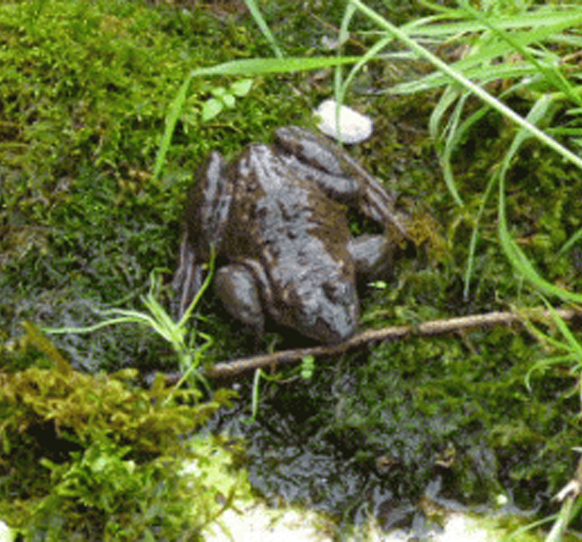
Oregon Spotted Frog

Rana pretiosa
Species Status: Endangered in Canada; Vulnerable globally (IUCN assessment)

Oregon Spotted Frog (Rana pretiosa)

The Oregon spotted frog’s scientific name “pretiosa” means “precious” in Latin — a fitting moniker considering that not many remain. With only a few hundred individuals left, the Oregon spotted frog is the most endangered frog in Canada.

Characteristics

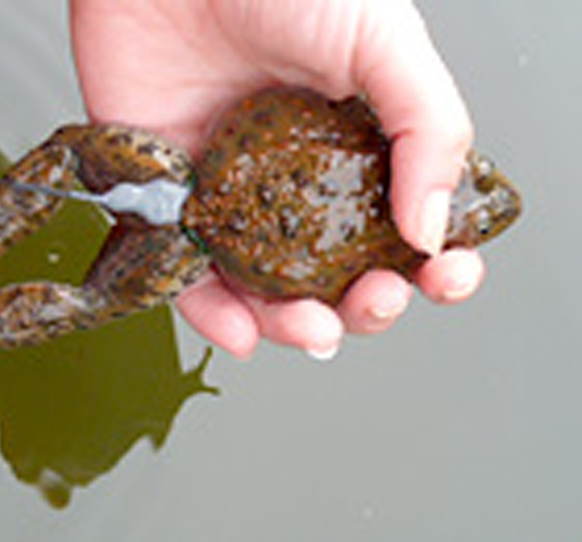
Oregon spotted frogs are well designed for aquatic living and seldom stray far from water. With webbing on their feet that goes all the way to the tip of their toes, these amphibians are expert swimmers. Meanwhile, their upward-turned eyes allow them to see things above the surface while keeping their heads almost completely submerged. They are distinguished by their reddish/brown colour with black spots featuring light colored bumps in the centers. They can be spotted in shallow, warm water wetlands, marshes, ponds, and lakes with abundant emergent vegetation that provides basking and refuge habitat. When disturbed, Oregon spotted frogs will dive to the bottom to hide for long periods of time, making them even trickier to find.

The male and female look almost identical, the main difference is their size. Females are noticeably larger, reaching up to 10 cm, while males max out at 7.5 cm.

Similar looking species

  • Columbia spotted frog (Rana luteiventris)
  • Northern red-legged frog (Rana aurora)
  • Cascades frog (Rana cascadae

Habitat

Adult Oregon spotted frogs are warm-water marsh specialists that prefer floodplain wetlands, side channels and swamps with a year-round water supply. They prefer habitat with a large amount of open water, as well as wetland grasses, rushes and sedges.
Range

Now on the brink of disappearing from Canada, this frog is found only in British Columbia’s Lower Fraser Valley, where only a few hundred breeding individuals are believed to remain in a few small, widely scattered populations.

Biology

Age of sexual maturation is reached within 1 to 2 years, while females mature by year 2 to 3. These short lived frogs live for about 2 to 5 years in the wild. Breeding occurs from February through April, triggered by snowmelt that fills shallow breeding ponds. Males will gather in shallow water and produce soft, low pitched calls resembling distant woodpecker taps. Females deposit approximately 600 eggs in communal clusters, with multiple females often laying eggs at the same location. Eggs hatch within 18 to 30 days, and tadpoles undergo metamorphosis over roughly 3 to 4 months, depending on water temperature and geographic location. There is no parental care, froglets are independent from the moment they complete metamorphosis. After transformation from tadpoles, juveniles often remain near breeding ponds for a period before dispersing to deeper water habitats for the drier months.

Threats

The biggest factor driving the decline of the Oregon spotted frog is likely habitat loss caused by development, agricultural land conversion, resource extraction and hydrological alterations. Other threats include invasive species and pollution. With just a handful of breeding populations left in Canada, this species could easily disappear without hands-on intervention.

Recovery

Recommended Recovery Actions

The federal and B.C. Recovery Strategies call for a number of measures, including maintaining conservation assurance populations to protect genetic diversity; breeding and releasing frogs to boost wild populations; restoring habitat; and refining headstarting and conservation breeding techniques.

What we are doing

What is the Fraser Valley Wetlands Programs?

Since 2010, WPC has been breeding and reintroducing thousands of Oregon spotted tadpoles and froglets back into wetlands in B.C.’s Fraser Valley. It takes years of careful observation, collaboration, ingenuity and sometimes a little luck to crack the code to breeding specific species. For several years, our progress was very limited. But our team persevered. Today, WPC has pioneered breeding techniques that are turning the tide for this species.

Purpose

We work to prevent the Oregon spotted frog from disappearing by building the wild populations in British Columbia, and studying the species to learn more about what is impacting these frogs.

Goals

In 2023 we plan to have:

  • 5000 tadpoles and young frogs released to the wild in the Fraser Valley of BC

Find out how Wildlife Preservation Canada helps save Canada’s reptiles and amphibians, including Oregon spotted frogs, and how you can make a difference.

What you can do

Support wetland protection initiatives and oppose development in remaining frog habitat. Don’t release pet bullfrogs or other exotic frogs into the wild. If you live near suitable habitat, avoid pesticide and fertilizer use near wetlands. Most importantly, support organizations working on species recovery through donations or volunteering. The Oregon spotted frog’s recovery depends on sustained commitment to protecting and restoring wetland ecosystems across the Pacific Northwest.

FAQs

A: American Bullfrogs are voracious predators that consume both Oregon spotted frog tadpoles and adults. Bullfrogs are larger, more aggressive, and reproduce prolifically in the same shallow wetlands where oregon spotted frogs breed. Removing bullfrogs from breeding sites is one of the most effective conservation actions.

A: Oregon spotted frogs synchronize their breeding with winter snowmelt. They need shallow, warm water to successfully breed and develop tadpoles. By breeding in late winter and early spring, tadpoles have maximum time to develop through metamorphosis before summer drought when ponds dry down. This strategy works perfectly in natural wetland complexes but becomes problematic when dams or water extraction prevent spring flooding.

A: The upturned eyes allow Oregon spotted frogs to remain almost entirely submerged while still monitoring activity at the water surface, perfect adaptation for a highly aquatic frog that spends nearly its entire life in water. They can detect prey, threats, and potential mates while remaining hidden from aerial predators like herons and eagles.

A: Water temperature triggers both breeding initiation and determines tadpole development speed. Warmer water accelerates development, tadpoles in Oregon’s warmer wetlands metamorphose in as few as 95 days, while those in cooler British Columbia wetlands take 110-130 days. Climate change and altered water management that changes thermal regimes directly impact reproductive success and survival rates.

Females come together to create floating mats with their egg masses to maximize warmth in the water on top of the eggs. This leads to rapid egg development! When the tadpoles hatch they hatch from the top down, creating a small patch of warm water on the top of the egg mass that acts like a greenhouse – helping the tadpoles stay warmer and develop faster. When they hatch, they eat their way through the jelly at the bottom where they then enter the water column.

Oregon Spotted Frog

Gallery

 
Oregon Spotted Frog

Oregon Spotted Frog

Oregon Spotted Frog

Oregon Spotted Frog

Oregon Spotted Frog

Oregon Spotted Frog