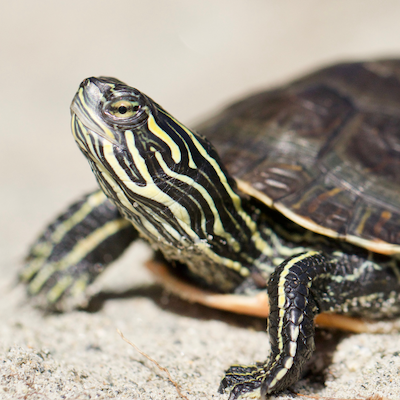

A tale of two turtles: western painted turtle vs the red-eared slider
Publié lejuillet 2, 2025parJenna Kissel|Les zones humides de la vallée Fraser, Tortues d'eau douce, Tortue peinte de l'OuestPhoto: P. Sardari
In the wetlands of B.C.’s Fraser Valley, western painted turtles face many challenges, especially as eggs and tiny hatchlings. With no shortage of hungry predators and no care from their parents once they’ve hatched, only a few young turtles survive to become adults. When you add human activity to the mix, the rate of survival can be so low that a population becomes unsustainable. Since 2012, we’ve been working to improve those odds. In addition to protecting nests, we collect eggs from vulnerable turtle nests, artificially incubate them and head-start new hatchlings before releasing them back into the wild.
If you’ve ever spotted a turtle sunbathing on a log in British Columbia, chances are it was either a western painted turtle – or a convincing lookalike. Western painted turtles are B.C.’s only native pond turtle, but they aren’t alone out there. An unexpected rival has quietly slipped into their habitat: the red-eared slider.
At first glance, the two species look pretty similar. But only one of them belongs.
In Canada, there are three subspecies of native painted turtle: the eastern, midland, and western painted turtle. The western painted turtle can be found in two populations in B.C.: the Intermountain/Rocky Mountain population and the Pacific Coast population. The Pacific Coast population has been red-listed as endangered, and that’s where we have focused our conservation efforts here at WPC. Since 2012, we have been working to prevent this species from disappearing – using conservation techniques including nest monitoring, artificial incubation, and head-starting young turtles.
The Pacific Coast population ranges from the Fraser Valley to the Sunshine Coast, all the way up to Squamish, and into Southeastern Vancouver and the Gulf Islands. Western painted turtles prefer to live in shallow ponds, marshes, and lakes, or slow-moving streams with soft, muddy bottoms.
In contrast, the red-eared slider’s native range stretches from the Southeastern United States through Central America to Brazil. These turtles are popular pets and have been introduced through illegal pet releases (where owners dump their pets in the wild).
Red-eared sliders can be found in ponds, lakes and other wetland habitats on southern Vancouver Island, Gulf Islands, the Lower Mainland, and parts of the southern interior. This overlaps with the Pacific Coastal population of western painted turtles, and although theses species look similar, we’ve got some tips to help tell them apart!
While both western painted and red-eared sliders have yellow stripes on their heads and legs, red-eared sliders have a distinct red stripe on the sides of their head, just behind the eyes.

See the distinct red stripe on the red-eared slider on the left (photo: Fraser Valley Invasive Species Society), versus the lack of one on the western painted turtle on the right (photo: J. Kissel).
Red-eared sliders have a yellow plastron, or belly, with dark spots while painted turtles have a much brighter red belly with yellow and black patterns.

See the more dull, yellow plastron with spots on the red-eared slider on the left (photo: Fraser Valley Invasive Species Society), versus the vibrant red belly on the western painted turtle on the right (photo: J. Kissel).
You can also use this guide to help identify western painted turtles!
Red-eared sliders are considered invasive in B.C. and are harmful to the ecosystems they’re released into. With no natural predators their populations can grow out of control, allowing them to outcompete native species and overeat plants and animals. Red-eared sliders threaten the already endangered western painted turtle because they compete with painted turtles for food, habitat, and basking and nesting sites. They may carry diseases that can spread to painted turtles, such as respiratory diseases and salmonella.
If you spot a turtle in the wild in B.C., see if you can identify it using the tips above! Even if you’re not sure, it’s helpful to report your sightings so biologists can track turtle populations and impacts. Make sure to take photos!
You can report a sighting of red-eared sliders to the Invasive Species Council of B.C.
If you see a western painted turtle, you can report your sighting to the Coastal Painted Turtle Project via Facebook messenger.
Jenna s'est jointe à CFC en tant qu'assistante aux programmes de conservation, soutenant les programmes de tortue peinte de l'Ouest, de grenouille maculée de l'Oregon et de papillon damier de Taylor. Elle a obtenu son diplôme de l'Université de Guelph avec un B.Sc. en biologie faunique et conservation et possède une expérience en élevage et propagation d'oiseaux. Elle a passé plusieurs années dans la conservation de la chouette tachetée et a hâte de continuer son travail dans le rétablissement des espèces en danger en tant que membre de l'équipe des projets de la Colombie-Britannique.

Nous avons besoin de votre aide