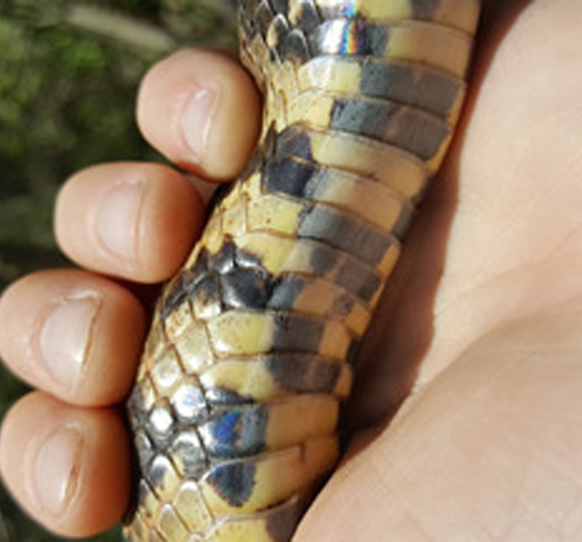
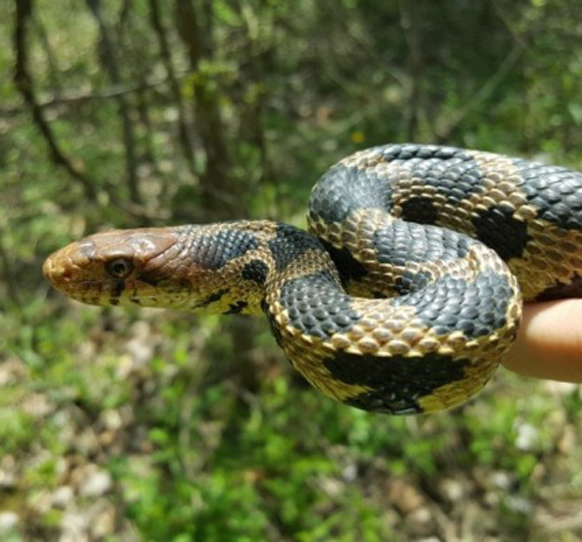
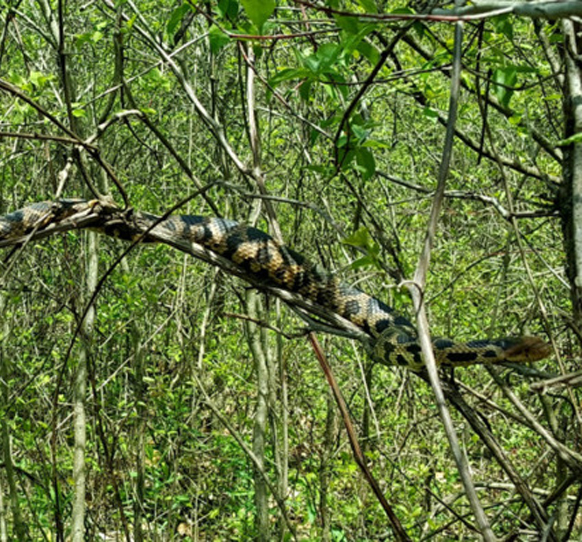
La couleuvre fauve de l'Est est le troisième plus grand serpent de l'Ontario et peut atteindre une longueur totale de 180 cm. On la repère généralement dans des habitats ouverts et non forestiers comme les rivages, les marécages, les prairies à laîche, les prairies herbeuses, les landes rocheuses et les lisières de zones humides, où elle patrouille le sol à la recherche de proies. Elle se distingue par son corps jaune à beige clair parsemé de grandes taches brun foncé et noires qui courent le long de son dos. Sa tête est plus large que son cou et affiche une couleur brun rougeâtre distinctive, et son dessous est jaune marqué d'un motif en damier audacieux de carrés noir foncé/brun. Quand elle est menacée, le serpent mord rarement mais fait plutôt vibrer rapidement sa queue, ce qui, en se déplaçant dans des feuilles sèches ou de l'herbe, produit un son étonnamment similaire au hochet d'un serpent à sonnettes — un cas dangereux d'erreur d'identité qui entraîne souvent la mort du serpent.
Le mâle et la femelle sont presque identique, cependant, les nouveau-nés et les juvéniles affichent des corps grisâtres ou beiges avec des taches plus claires et moins définies et un ventre pâle, ne présentant pas la coloration vive qui se développe avec la maturité.
L'âge de maturité sexuelle est atteint à 4 à 5 ans et ils vivront environ 12 à 15 ans dans la nature. L'accouplement se produit au printemps, généralement d'avril à mai. Les femelles pondent leurs œufs de juin à août dans des endroits isolés comme des bûches en décomposition, des souches pourries, des tas de compost, des sols sablonneux ou des couches riches en humus. Une couvée typique contient 7 à 25 œufs, et après environ 60 jours d'incubation, les nouveau-nés émergent à la fin de l'été ou au début de l'automne. Les nouveau-nés restent parfois ensemble pendant jusqu'à une semaine après l'émergence avant de se disperser pour trouver des territoires individuels, et ils ne reçoivent absolument aucun soin parental.
La stratégie provinciale de rétablissement prévoit un certain nombre de mesures de conservation, notamment la création de sites artificiels de nidification et d'hibernation, la cartographie des habitats et des corridors, la surveillance des populations de couleuvres fauve de l'Est et la détermination de la quantité d'habitat nécessaire pour soutenir une population autosuffisante dans le sud-ouest de l'Ontario.
Si vous trouvez une couleuvre fauve de l'Est sur une route, déplacez-la doucement de l'autre côté dans la direction où elle se dirigeait — ne la forcez pas à reculer ou vers un endroit aléatoire. Si vous vivez dans un habitat approprié, protégez les rivages et les lisières des zones humides du développement et évitez de déranger les serpents en train de se prélasser. Ralentissez en conduisant dans l'habitat des serpents, particulièrement au printemps et en été. Soutenez les efforts de restauration de l'habitat et les organisations de conservation locales. Surtout, ne la tuez pas — partagez ce que vous avez appris sur l'espèce avec les autres et aidez à combattre les idées fausses qui mènent à la persécution.
Q : Pourquoi les gens tuent-ils les couleuvres fauves de l'Est en les prenant pour des serpent à sonnettes ?
R : Quand une couleuvre fauve de l'Est est surprise, elle fait vibrer rapidement sa queue de façon défensif. Si le serpent se trouve dans des feuilles sèches, de l'herbe ou d'autres matières qui bruissent, cette vibration de la queue crée un son de cliquetis indiscernable exactement comme l'avertissement d'un serpent à sonnettes. Beaucoup de gens paniquent en entendant ce son et tuent le serpent sans regarder de près. Les couleuvres fauves de l'Est ne sont pas venimeuses et ne représentent aucun danger réel ; l'affichage de menace est purement défensif.
Q : Comment la couleuvre fauve de l'Est parvient-elle à chasser avec autant de succès?
R : Les couleuvres fauves de l'Est sont des chasseurs diurnes actifs qui patrouillent le sol et la végétation basse à la recherche de proies. Quand elles localisent une souris, un campagnol, un rat ou un autre petit mammifère, elles utilisent leurs capacités de constricteur en enroulant leur corps autour de la proie pour l'étouffer. Ce style de chasse les rend particulièrement précieuses dans les zones agricoles où les populations de rongeurs peuvent dévaster les cultures ou propager des maladies au bétail.