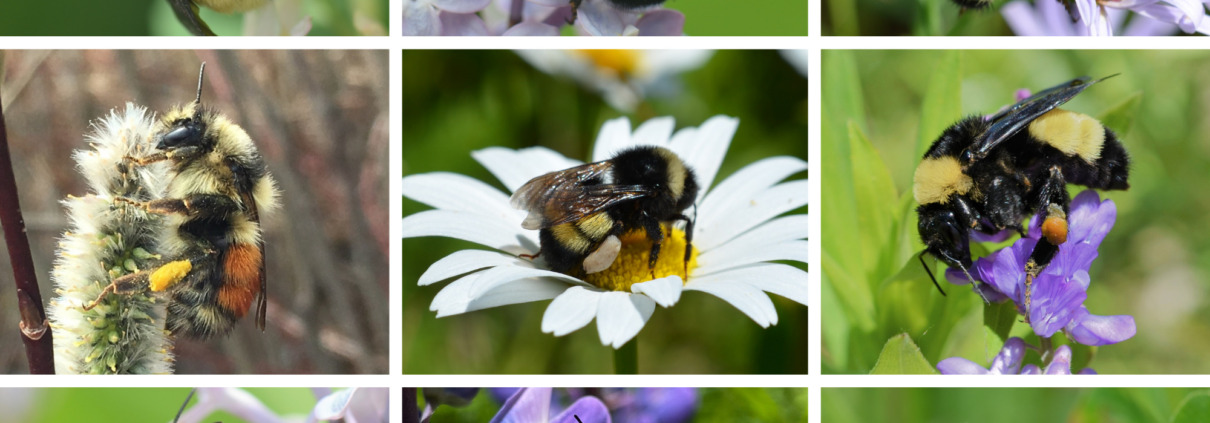

An ‘American bumble bee’ (Bombus pensylvanicus) queen. Photo: T. Harrison.
An ‘American bumble bee’ (Bombus pensylvanicus) queen. Photo: T. Harrison.
Qu'est-ce que le Programme de rétablissement des bourdons? Depuis les années 1990, les populations de bourdons sont en chute libre, ce qui représente une véritable catastrophe écologique. Quatre-vingt-dix pour cent de toutes les plantes à fleurs — y compris la plupart des fruits et légumes dans votre réfrigérateur — ont besoin de ces pollinisateurs pour se reproduire.
Jusqu'à ce que les causes de ces déclins puissent être inversées, l'élevage de conservation et la réintroduction sont la seule façon de protéger les bourdons en péril. Aujourd'hui, CFC est la seule organisation au Canada à reconstruire les populations d'abeilles sauvages grâce à l'élevage de conservation. Grâce à des percées récentes, nous avons trouvé comment augmenter considérablement le nombre de reines que nous produisons. Une fois relâchées dans la nature, elles peuvent établir leurs propres colonies, produisant des centaines de pollinisateurs pour soutenir les écosystèmes qui les entourent.
Within the bee world, the most well-known species is undoubtedly the European honey bee (Apis mellifera). However, many aspects of our terrestrial ecosystems – namely the pollination of wild and agricultural plants – rely on the humble bumble bee (genus Bombus). To combat the unfortunate decline of our vital native bumble bee species, Wildlife Preservation Canada’s Native Pollinator Initiative implements a variety of conservation techniques that require on-the-ground fieldwork.
Élevage de conservation is a crucial component in understanding species-at-risk and boosting their populations, and is also a technique we focus on with the ‘Special Concern’ yellow-banded bumble bee (Bourdon terricola) (you can learn more about our bumble bee breeding lab ici). Of course, our breeding efforts can’t begin if we don’t have bees in the lab, so capturing yellow-banded bumble bee queens is one of our top priorities during spring surveys!


Black and gold bumble bee (B. auricomus) queens. A species dear to my heart! Photo: T. Harrison.
Cole’s time with WPC began as a graduate student at the University of Toronto, where he researched harmful parasites in bumble bees (he looked at a LOT of bee poop). He has since played a supporting role as a technician in both the field and in our bumble bee Conservation Breeding Lab. As the Ontario Program Coordinator, Cole hopes to demonstrate to others that any conservation engagement – no matter how big or small – can go a long way.

Nous avons besoin de votre aide