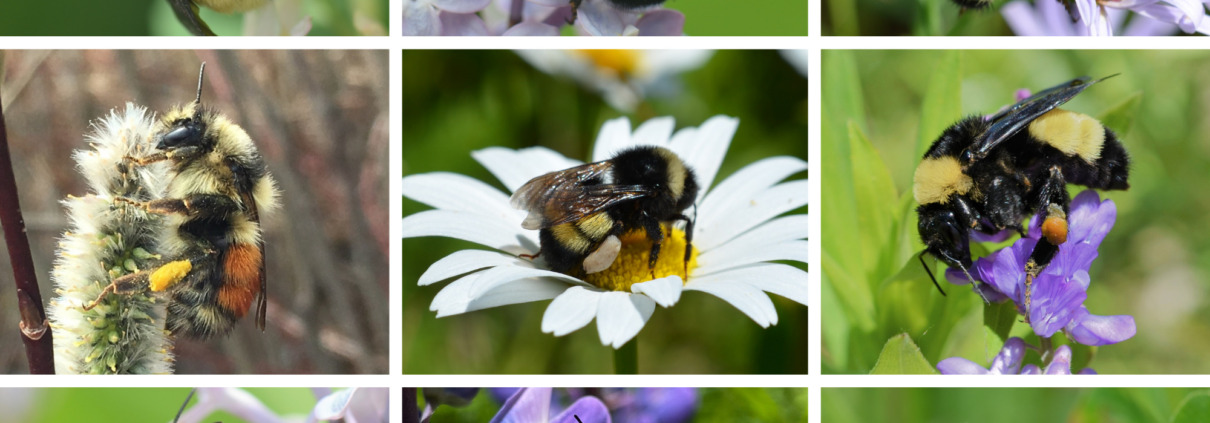
Qu'est-ce que le Programme de rétablissement des bourdons? Depuis les années 1990, les populations de bourdons sont en chute libre, ce qui représente une véritable catastrophe écologique. Quatre-vingt-dix pour cent de toutes les plantes à fleurs — y compris la plupart des fruits et légumes dans votre réfrigérateur — ont besoin de ces pollinisateurs pour se reproduire.

Until the causes of these declines can be reversed, conservation breeding and reintroduction is the only way to safeguard at-risk bumble bees. Today, WPC is the only organization in Canada rebuilding wild bee populations through conservation breeding. Thanks to recent breakthroughs, we’ve figured out how to dramatically increase the number of queens we produce. Once they’re released into the wild, they can establish their own colonies, producing hundreds of pollinators to sustain the ecosystems around them.

When people think of pollinators, honey bees often steal the spotlight (much to the chagrin of native pollinator biologists!).  But Ontario is home to a rich and diverse cast of native pollinators that play vital roles in sustaining ecosystems and our food supply.  From solitary bees to moths, butterflies, beetles, flies, birds, and even bats, each group contributes in its own way to the transfer of pollen that makes plant reproduction – and ultimately life as we know it – possible.

Leaf cutter bee.  Photo by A. Wilcox.

Among Ontario’s most important yet underappreciated pollinators are solitary bees, which make up over 80% of the native bee species in the province.  These include mining bees, leafcutter bees, et mason bees – no hive, no honey, just one bee and a dream!  Many are floral specialists, foraging from a small number of plant species.  This makes them incredibly efficient pollinators of those chosen flowers, but also highly vulnerable to habitat loss and climate change.

Bad-wing moth.  Photo by A. Wilcox.

While most other pollinators go to sleep, moths take the night shift, pollinating a whole suite of night-blooming plants.  Their furry little bodies are perfect for getting a good dusting of pollen as they feed from the flowers’ nectar.  Some plants are so reliant on moths that their blooms only open and become fragrant at night, specifically to attract these nocturnal visitors.

Globetail hoverfly.  Photo by A. Wilcox.

Oiseaux join the lineup too – especially the Ruby-throated Hummingbird, Ontario’s only native hummingbird species.  They’re the go-to pollinators for long, tubular wildflowers like columbine and cardinal flower.  And while bats don’t pollinate very much here in Ontario (our native bats are insectivores), they are pollination powerhouses in the tropics.  If you’ve eaten a banana, mango, or guava lately, you have a bat to thank!

But if I had to pick one all-time MVP of pollination?  It’s the bumble bees, hands down.

Bumble bees are native, adorable, and built for the job.  They’re fuzzy, active in cool weather, and come equipped with a variety of tongue lengths to feed from different flowers.  They’re also one of the few bees that perform buzz pollination – vibrating flowers to shake out hard-to-reach pollen – a special skill that honey bees just don’t have.

Best of all, they’re generalists.  While many pollinators are picky eaters, bumble bees forage from a wide range of native plants and have evolved alongside Ontario’s flora for thousands of years.  Honey bees, by contrast, are European imports – they’re useful for agriculture, but are not nearly as in tune with local ecosystems.  There’s even some evidence that they can compete with sensitive bumble bee populations for limited floral resources (Wojcik et al. 2018).

So sure, honey bees put honey in our cupboards.  But bumble bees keep our ecosystems blooming, and I think that’s even sweeter.

Sources:

Wojcik, V. A., Morandin, L. A., Adams, L. D., & Rourke, K. E. (2018). Floral Resource Competition Between Honey Bees and Wild Bees: Is There Clear Evidence and Can We Guide Management and Conservation? Environmental Entomology, 47(4), 822–833. https://doi.org/10.1093/ee/nvy077

Annika Wilcox

Ontario Programs Coordinator – Bumble Bee Recovery Program

Annika a rejoint l'équipe de CFC de la Pie-grièche migratrice en tant que biologiste en recherche en 2025 avant de passer à l'Initiative pour les pollinisateurs indigènes en tant que coordonnatrice des programmes en Ontario. Elle possède une vaste expérience en sensibilisation environnementale, réhabilitation de la faune, et surveillance écologique des oiseaux, des amphibiens, des reptiles et des insectes à risque. Annika est titulaire d'une maîtrise en biologie intégrative de l'Université de Guelph, où elle a mené des recherches sur les facteurs limitants des zones humides agricoles restaurées comme habitat de reproduction pour les oiseaux, en mettant l'accent sur les espèces en péril.

Nous avons besoin de votre aide

Faites un don pour sauver les espèces menacées