
Cours accéléré : l'identification des bourdons du centre-sud de l'Ontario
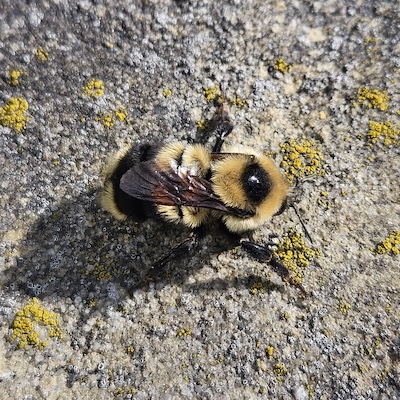
Publié le18 août 2026parAnnika WilcoxPhoto: T. Harrison.
Qu'est-ce que le Programme de rétablissement des bourdons? Depuis les années 1990, le nombre de bourdons a chuté de façon spectaculaire, ce qui représente un désastre écologique. Ici, à Conservation de la faune au Canada, nous travaillons à prévenir la disparition des espèces de bourdons en péril en les surveillant à l'état sauvage, en les élevant pour les relâcher dans notre laboratoire de conservation en Ontario, et en étudiant leurs excréments pour y trouver des parasites ! Nous organisons même des événements spéciaux de science citoyenne à travers la province pour suivre la taille des populations, localiser les populations en déclin et offrir des programmes de formation pratiques dans le but d'élargir nos efforts à travers le Canada. Nous sommes la seule organisation au pays à travailler à rétablir les populations de bourdons en péril grâce à l'élevage de conservation.
Ma porte d'entrée dans la conservation de la faune, c'était les oiseaux. Ici en Ontario, apprendre à connaître nos oiseaux locaux est une tâche assez gérable. Il existe des dizaines d'excellents guides de terrain, la plupart des oiseaux sont assez grands pour voir facilement leurs marques distinctives, et j'ai eu la chance d'avoir beaucoup de mentors qui pouvaient répondre à mes questions d'identification les plus difficiles.
À l'époque, pendant que j'apprenais petit à petit à distinguer les moineaux, je n'avais aucune idée du cauchemar d'identification qui m'attendait : les bourdons.
Tout bien considéré, les bourdons devraient être assez simples. Ici dans le centre-sud de l'Ontario, nous n'avons qu'une treizaine d'espèces régulièrement rencontrées, comparé à quelques centaines d'oiseaux. Mais le problème avec les bourdons, c'est qu'ils sont minuscules, et à première vue ils semblent tous se ressembler exactement. Et, apparemment, les experts en bourdons ne poussent pas dans les arbres. Lors de nos programmes de sensibilisation, nous passons un bon moment à expliquer aux gens qu'il existe plus d'une seule espèce de bourdons !
Je trouve maintenant les cartes d'identification des bourdons de CFC incroyablement utiles, mais avant de commencer à travailler pour le programme, je me souviens de les regarder en me demandant ce que, exactement, je cherchais. Qu'est-ce qui rend un bourdon confus, confus ? Où se trouvent exactement les deux points sur un bourdon à deux points ?
Alors voilà, voici un recueil des marques de terrain les plus rapides et, à mon avis, les plus utiles pour chaque espèce régulièrement présente ici dans le centre-sud de l'Ontario. Pensez-y comme une fiche aide-mémoire à utiliser en combinaison avec les cartes d'identification de CFC..
Avant de commencer : petite leçon d'anatomie
Il n'y a que quelques parties d'une abeille que vous devez connaître :
Le corps d'une abeille est composé de trois parties : la tête, le thorax et l'abdomen. La tête est à l'avant (évidemment !), suivie du thorax. Cette section centrale est là où s'attachent les ailes et les pattes. La dernière section, ou le « derrière » de l'abeille, est l'abdomen, qui est divisé en six segments (ou sept, chez les mâles), aussi appelés « terga ». Je trouve que le motif sur ces segments est la chose la plus utile à rechercher pour déterminer l'espèce que vous avez. Les segments sont numérotés : T1 est le plus proche du thorax, suivi de T2, T3, et ainsi de suite.
Nous voulons également regarder ce qu'il y a sur le visage, les poils sous les bases des ailes (que j'appellerai affectueusement leurs « aisselles »), et le panier à pollen brillant et sans poils (appelé corbicula) sur les pattes postérieures de la plupart des femelles bourdons.
Si vous savez où se trouvent ces caractéristiques, alors nous sommes prêts à commencer !
Avertissement rapide : ces raccourcis, et les cartes d'identification des bourdons de CFC, sont basés sur les bourdons femelles (ouvrières et reines). Les mâles ont souvent des motifs de couleur différents et peuvent être beaucoup plus variables. Si votre abeille ne semble correspondre à aucune des descriptions ci-dessous, essayez de prendre des photos sous plusieurs angles et de les télécharger sur BumbleBeeWatch.org, où un expert l'identifiera pour vous.
Les abeilles à derrière noir
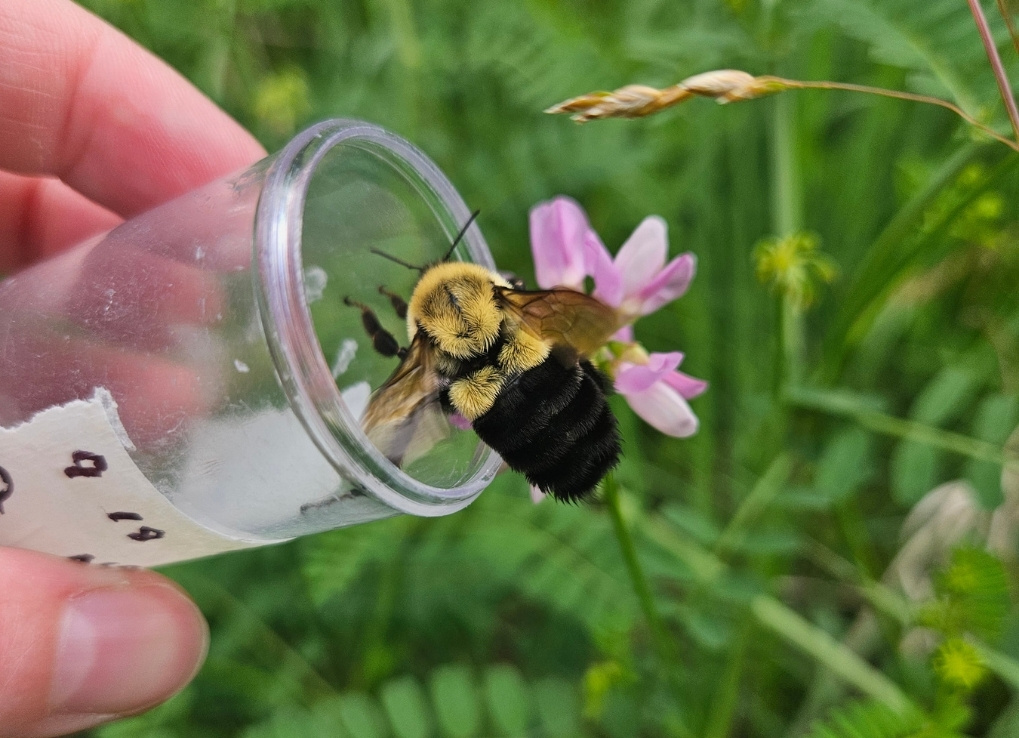
Bourdon commun de l'Est (Bombus impatiens)
Les bourdons communs de l'Est sont à la hauteur de leur nom — ils sont incroyablement abondants ici dans le centre-sud de l'Ontario, et sont heureusement une abeille facile à identifier. Leur premier segment abdominal (T1) est jaune, et tous les autres sont noirs! Photo par A. Wilcox.

Bourdon à deux points (Bombus bimaculatus)
L'abdomen d'un bourdon à deux points ressemble à celui d'un bourdon commun de l'Est, mais aura une petite tache jaune au centre du deuxième segment abdominal (T2). Parfois, ça ressemble à deux points clairs de jaune formant un W, et d'autres fois ils fusionnent en une petite tache. Photo : A. Wilcox.
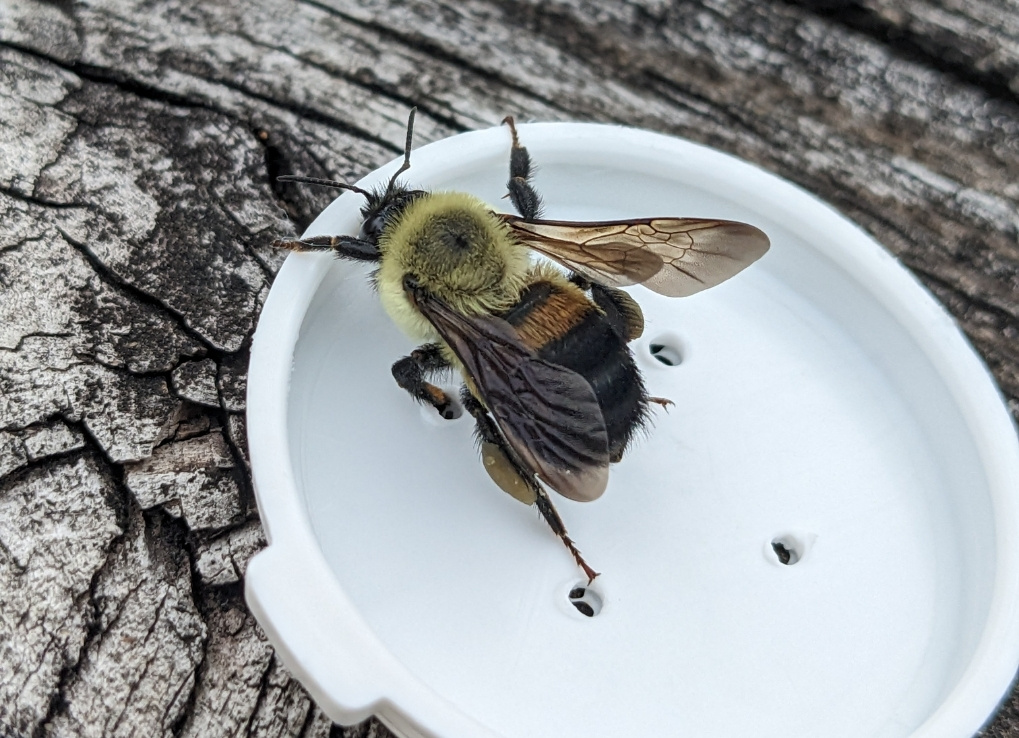
Bourdon à ceinture brune (Bombus griseocollis)
Au lieu d'une petite tache jaune sur T2, les bourdons à ceinture brune ont un croissant de poils jaunes ou bruns sur T2 qui s'étend jusqu'aux bords du segment. Leurs poils sont également très courts, leur donnant l'apparence d'une abeille avec une coupe en brosse ! Photo: C. Woo-Durand.

Bourdon trompeur (Bombus perplexus)
À mon avis, mal nommé ! Les bourdons trompeurs sont jaunes sur T1 et T2, avec du noir en dessous, et n'ont aucun poil noir sur leur thorax . Peu importe l'angle sous lequel vous regardez leur thorax, il n'a que des poils jaune doré ! Photo : A. Wilcox.
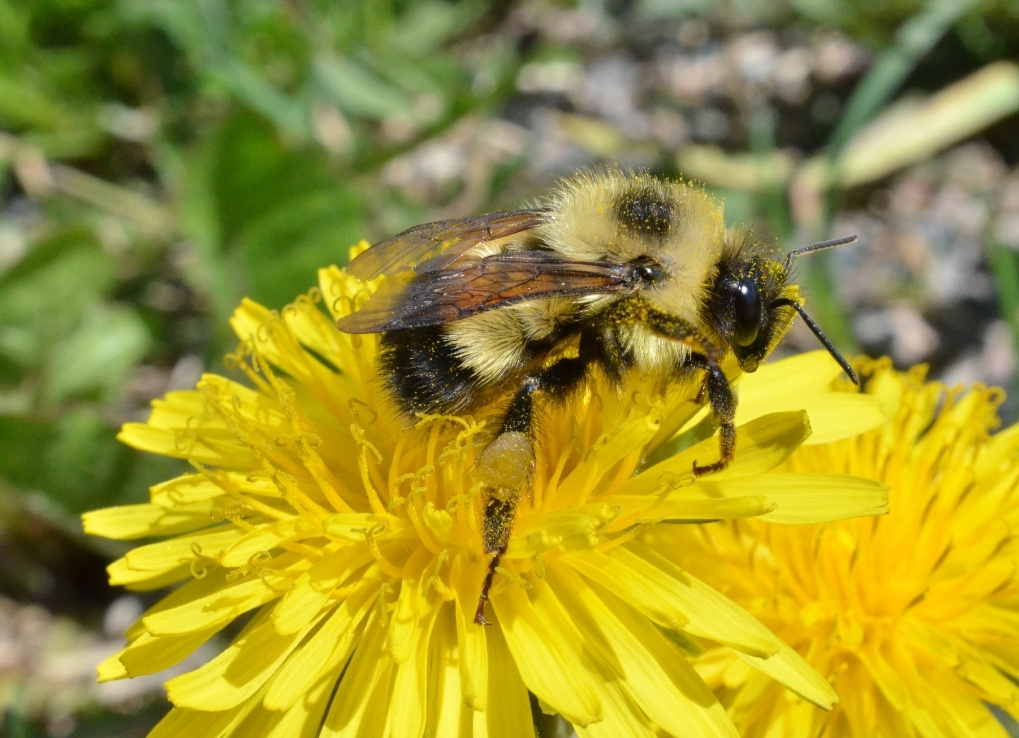
Bourdon mi-noir (Bombus vagans)
Ces abeilles ressemblent beaucoup aux bourdons trompeur, mais ont une tache de poils noirs sur leur thorax. Ils ont aussi un visage très long et « chevalin », ce qui aide à différencier cette espèce des espèces similaires comme le bourdon de Sanderson et, parfois, le bourdon à ceinture rouge. Photo: T. Harrison.
Les abeilles à bandes orangées

Red-belted bumble bee (Bombus rufocinctus)
Cette espèce est le filou des bourdons en Ontario — parfois ils ne sont que jaunes et noirs, mais parfois ils ont de belles bandes rouges ou orangées ! Un bon indicateur est un croissant jaune sur T2, un peu comme un bourdon à ceinture brune, qui se fond ensuite dans du noir ou de l'orange/rouge en dessous. Les bourdons à ceinture rouge ont aussi souvent une tache en forme d'œil de poils noirs sur leur thorax (nous l'appelons « l'Œil de Sauron »). Photo : A. Wilcox.
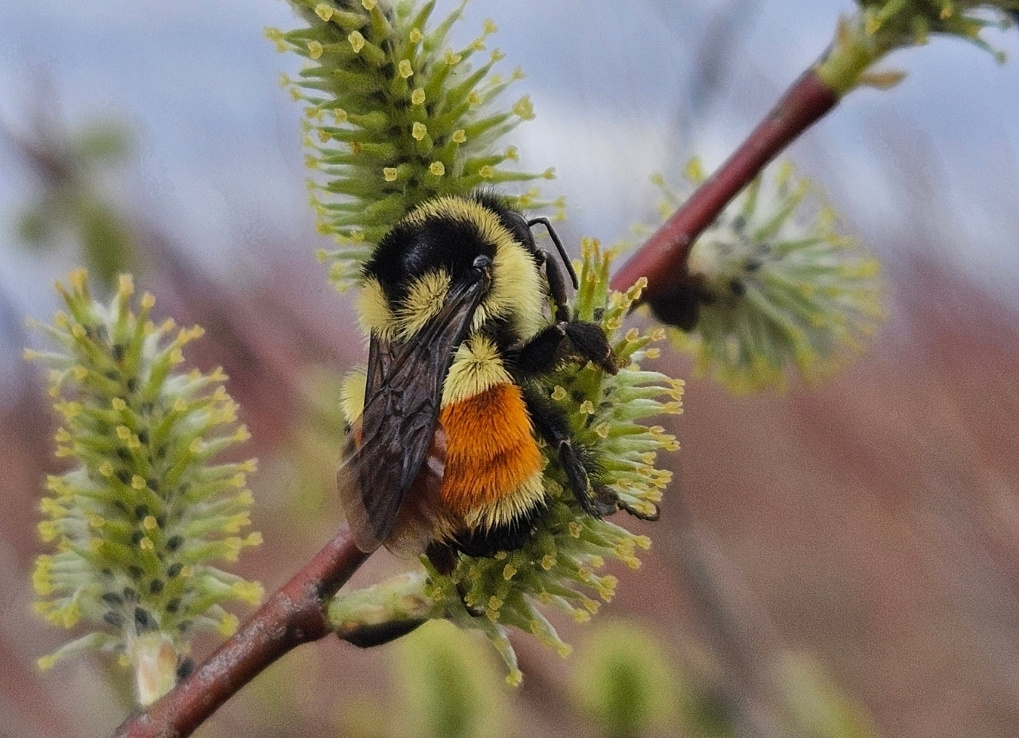
Bourdon tricolore (Bombus ternarius)
Peut-être le plus beau bourdon de l'Ontario ! Leur abdomen présente une séquence frappante de couleurs :
T1 : jaune
T2-T3 : orange ou rouge
T4 : jaune
T5 et suivants : noir
Leur thorax a également une tache distinctive en forme de punaise de poils noirs. Photo : A. Wilcox.
Les abeilles jaunes

Bourdon ardent (Bombus fervidus)
Cette abeille est à la hauteur de son nom — elle est exceptionnellement jaune ! Elle peut être facilement distinguée de son espèce similaire, le bourdon boréal, par son visage noir et ses aisselles jaunes. Si ses aisselles sont jaunes, vous regardez un bourdon jaune ! Photo : A. Wilcox.
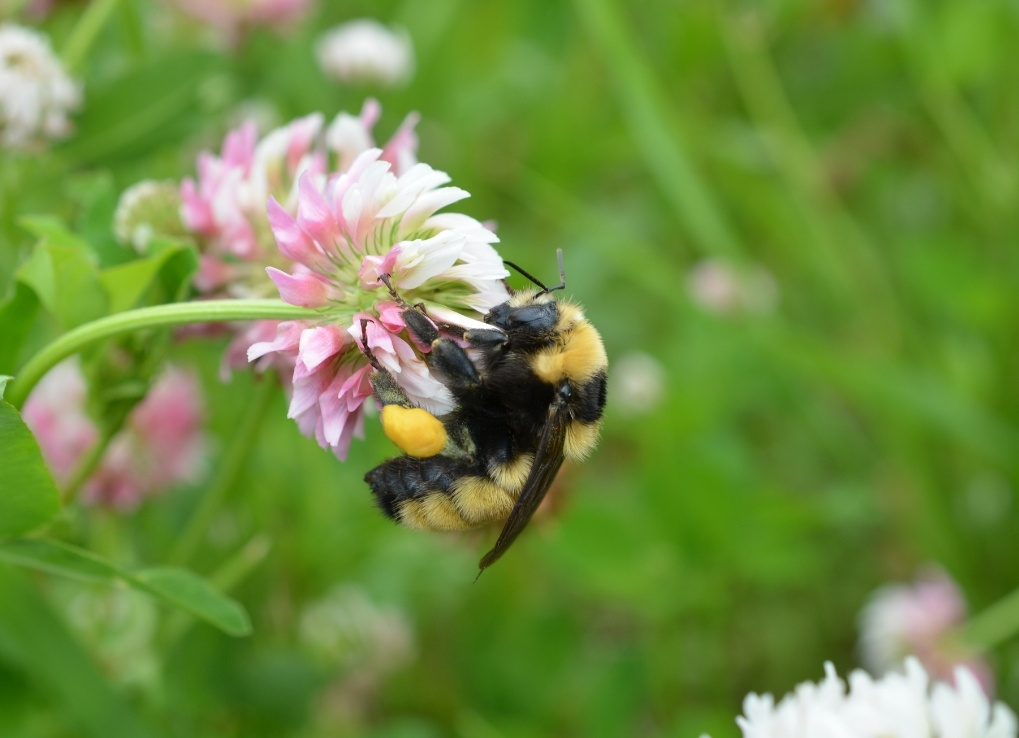
Bourdon boréal (Bombus borealis)
Cette espèce ressemble au bourdon jaune, et est également presque entièrement jaune. Cependant, un bourdon boralé a un visage jaune et des aisselles noires. Il est également d'un beau jaune profond, comme son nom le suggère. Photo: T. Harrison.
Les abeilles à bandes jaunes
Les trois espèces de cette catégorie ont le même motif abdominal de base :
T1 : noir
T2-T3 : jaune
T4 et suivants : noir

Bourdon américain (Bombus pensylvanicus)
Les bourdons américains ont des ailes noires, un visage noir et des poils noirs sur le dessus de leur tête. La bande jaune sur leur abdomen remonte aussi fréquemment dans T1, de sorte que leur motif est légèrement modifié en :
T1 : moitié noir, moitié jaune
T2-T3 : jaune
T4 et suivants : noir
Photo : A. Wilcox.

Bourdon noir et doré (Bombus auricomus)
Cette abeille ressemble presque identiquement au bourdon américain, mais si vous jetez un coup d'œil au sommet de leur tête, ils ont de petits « sourcils » jaunes ! Tout simplement adorable. Ils n'auront également pas de jaune sur la moitié inférieure de T1 — le premier segment devrait être entièrement noir. Photo : A. Wilcox.
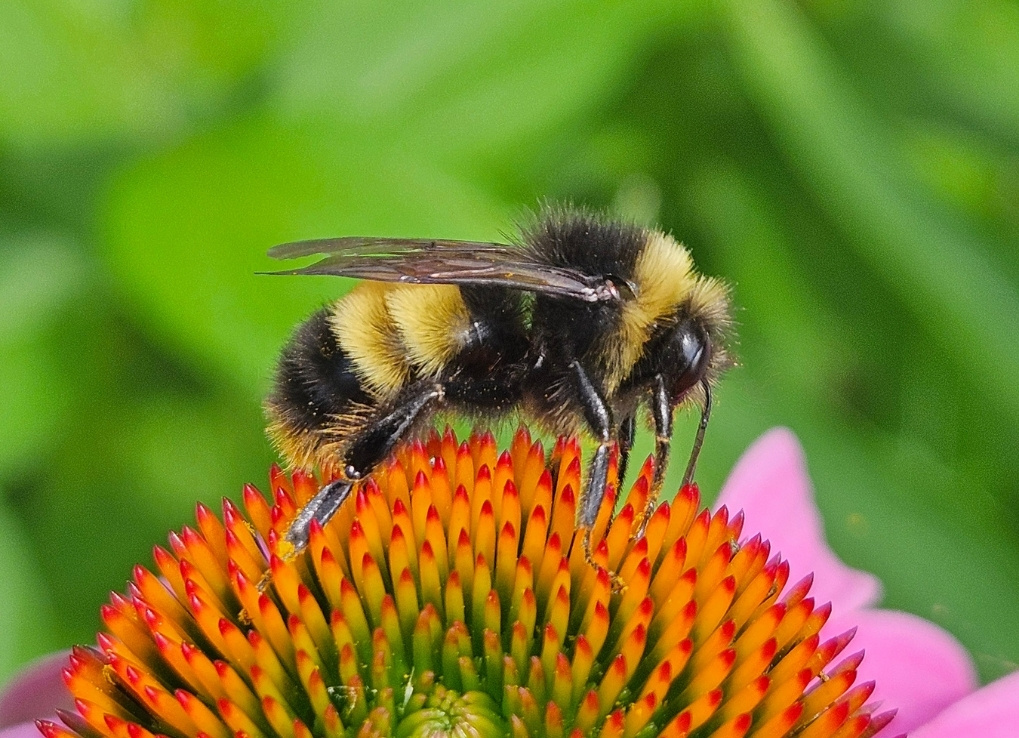
Bourdon terricole (Bourdon terricola)
Bien que cette abeille partage le même motif abdominal général que les bourdons américains et noirs et doré, ses ailes ne sont pas aussi sombres que ces espèces, et ils ont également une « jupe » de poils jaunes au bas de T5. Plutôt mignon ! Photo : A. Wilcox.
Le bourdon coucou
Une petite leçon sur l'histoire de vie des bourdons coucous aidera à comprendre et à identifier les coucous : les bourdons coucous ont développé un mode de vie très différent des autres bourdons. Au lieu de fonder leurs propres colonies et de collecter du pollen, une femelle coucou envahit le nid d'une autre espèce, tue ou évince la reine résidente, et utilise ses ouvrières pour élever la progéniture du coucou. Comme les femelles coucous ne collectent pas de pollen elles-mêmes, elles ont perdu le panier à pollen brillant (corbicula) que l'on trouve sur les pattes postérieures des autres femelles bourdons.
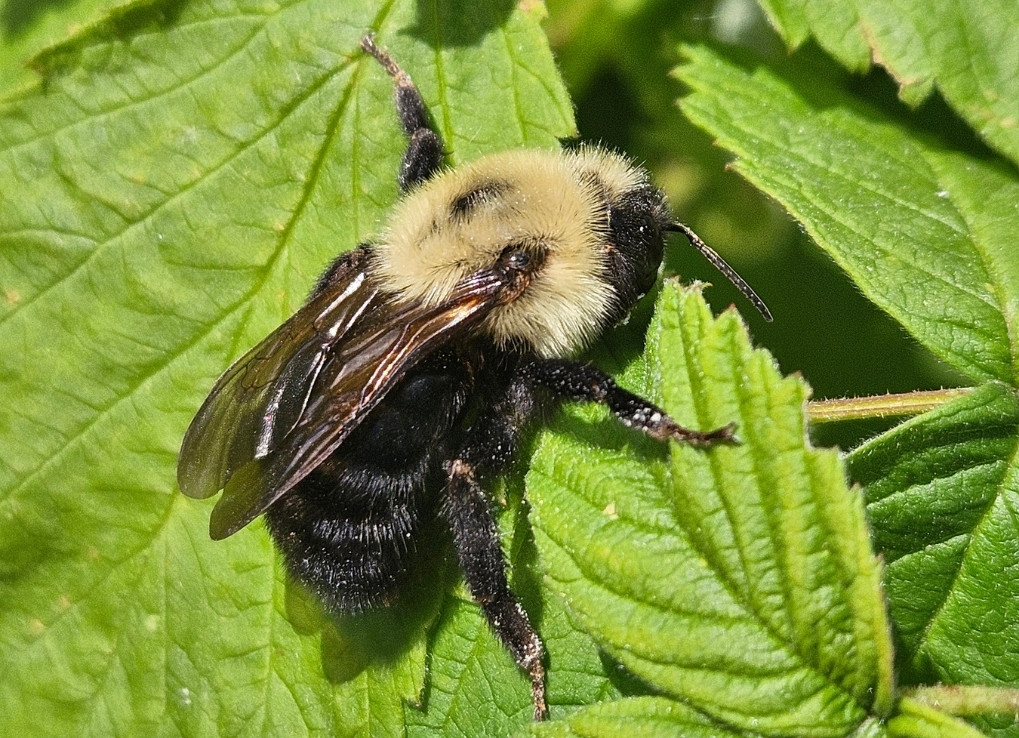
Bourdon coucou jaune-citron (Bombus citrinus)
L'espèce de bourdon coucou la plus commune dans cette partie de la province est le coucou jaune-citron, qui a un thorax jaune uni (sans tache noire) et un abdomen très variable. En tant que coucou, il n'a également pas de corbicula. Certains individus ont un abdomen entièrement noir, tandis que d'autres ont une bande jaune à mi-chemin, et d'autres encore ont les premiers segments abdominaux jaunes et les derniers noirs. C'est peut-être lui qu'on devrait appeler le bourdon confus ! Photo : A. Wilcox.
Pas sûr ? Demandez à votre expert en bourdons du quartier !
Bien que ce guide soit (espérons-le !) assez utile en combinaison avec les cartes d'identification, vous rencontrerez presque certainement des abeilles qui ne semblent correspondre à rien de ce que vous avez appris — j'ai regardé des milliers de bourdons au cours des dernières années, et je vois encore parfois des abeilles étranges ! Une excellente façon d'avoir l'avis d'un pro sur votre identification de bourdon est de télécharger des photos sur BumbleBeeWatch.org, une plateforme qui recueille et vérifie les observations de bourdons à travers le Canada et les États-Unis. Les données recueillies ont été utilisées par des biologistes de la conservation pour évaluer comment se portent les populations d'abeilles, et quelles espèces pourraient avoir besoin d'un peu d'aide supplémentaire — en fait, les données de Bumble Bee Watch ont directement contribué à faire inscrire le bourdon américain comme espèce en péril !
Lorsqu'une observation est téléchargée, une équipe d'experts examinera vos images et proposera une identification. C'est un outil que j'utilisais même avant de commencer à faire de la surveillance des bourdons pour le travail, et c'était formidable pour m'aider à affiner mes compétences d'identification.
À vos bourdons !
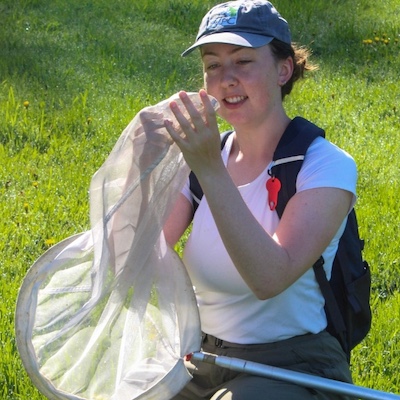
Apprendre à connaître vos bourdons locaux peut sembler écrasant au début — croyez-moi, je parle d'expérience personnelle. Mais comme tout, plus vous le pratiquez, plus ce sera facile. À ce stade, je sais normalement quelle espèce j'ai avant même de la sortir du filet.
Ce cours accéléré ne sera pas utile pour chaque abeille que vous trouverez, car je suis convaincue que les bourdons adorent me prouver que j'ai tort, mais il vous aidera à réduire vos options. Alors si vous êtes prêt pour le défi, allez trouver une belle parcelle de fleurs près de chez vous, prenez beaucoup de photos, et commencez à les télécharger sur Bumble Bee Watch. J'espère vous y voir !
Annika a rejoint l'équipe de CFC de la pie-grièche migratrice en tant que biologiste en recherche en 2025 avant de passer à l'Initiative pour les pollinisateurs indigènes en tant que coordonnatrice des programmes en Ontario. Elle possède une vaste expérience en sensibilisation environnementale, réhabilitation de la faune, et surveillance écologique des oiseaux, des amphibiens, des reptiles et des insectes à risque. Annika est titulaire d'une maîtrise en biologie intégrative de l'Université de Guelph, où elle a mené des recherches sur les facteurs limitants des zones humides agricoles restaurées comme habitat de reproduction pour les oiseaux, en mettant l'accent sur les espèces en péril.

Nous avons besoin de votre aide