
Qu'est-ce que le Programme de rétablissement de la pie-grièche migratrice de l'Est? Après une chute précipitée de la population sauvage de pie-grièche migratrice de l'Est dans les années 1990, Environnement Canada a invité Conservation de la faune au Canada à se joindre à l'effort de rétablissement multi-partenaires en 2001. Depuis, la taille de la population sauvage a fluctué. Des études ont montré que bien que l'effort de rétablissement ait empêché l'espèce de disparaître du Canada, plus de travail est nécessaire pour identifier et aborder les causes du déclin de l'espèce. CFC travaille pour empêcher la pie-grièche migratrice de l'Est de disparaître en renforçant la population sauvage en Ontario, et en étudiant l'espèce pour en apprendre davantage sur les menaces qu'elle fait face.
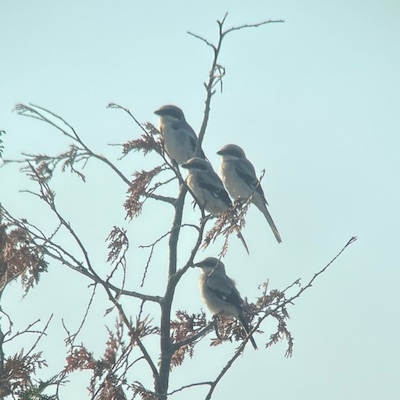
Loggerhead shrike season is well underway in the Napanee plain, Ontario! Through the month of May, WPC’s endangered shrike recovery team has been hard at work surveying for shrikes to determine occupied territories, identify the unique combination of colour bands on any previously banded birds, and to assess breeding status of all shrikes found. Due to their “sit and wait” hunting style, usually from a high perch, an effective way to search for shrikes is to visually scan the tops of trees, wires, or fenceposts for these birds’ white and grey plumage. Doing so, however, does occasionally produce some false leads.

Northern mockingbird. Photo: Tyson S.
One common lookalike in the Napanee area is the northern mockingbird. From afar, and even at first glance through a scope, this vocal bird may have some shrike-like qualities with its light grey colour and dark wings, but it is always worth a second look to be sure. Another bird that can be tricky from a distance is the eastern kingbird. It will often perch in similar areas as shrikes and has a bright white underside which will easily catch your eye while scanning. These birds may require a closer look with a scope but can easily be distinguished if you know what to look for. The most common fake out actually isn’t even a bird at all, but an insect! How can that be?

Eastern tent caterpillar web on a bnush. Photo: Tyson S.
The eastern tent caterpillar is a species of moth which, as larvae, will envelop forked branches in a thick webbing or “tent”. These tents are quite reflective and are a heavy contrast from the green of the limestone plain. They may not look like a shrike at all once you get them in your scope, but to the naked eye, a bright white patch 100m away on the end of a low shrub looks quite appealing during a shrike survey! It is important to check any potential lead, and anything that looks at all “shrikey”. If you don’t stop to check out that white patch, you may just be missing…

A colour-banded loggerhead shrike on a fence post. Photo: Tyson S.
A shrike!! Locating any individual of this endangered species is of great importance, but identifying a member with a unique combination of colour bands such as the one shown above is even better! WPC uses bands like these so that individual shrikes can be recognized from a distance in the wild. By doing this, our team can gain insight into things like the return rate of banded shrikes to our study area from year-to-year. Finding a detail like this always makes for an exciting day in the field, but it could be easily missed if we don’t stop to take a quick look at every Eastern Kingbird, Tent Caterpillar web, broken branch, or anything else suspicious to confirm whether is it a shrike, or just a psyche!
Tyson Shank
Napanee Shrike Biologist – Eastern Loggerhead Shrike Recovery Program
Tyson graduated with a Diploma in Conservation Biology from the Northern Alberta Institute of Technology and is working towards a certificate in Applied Digital Geography and GIS from Toronto Metropolitan University. His experience working with birds includes performing various types of surveys, monitoring nests, banding, and rehabilitation. In his spare time, Tyson enjoys getting outside by hiking, camping, kayaking, and birding recreationally.

Articles récents sur le projet

Nous avons besoin de votre aide