
Pleins feux sur les espèces printanières : le bourdon à deux taches
Publié le18 mars 2026parAnnika WilcoxPhoto: A. Wilcox
Qu'est-ce que le Programme de rétablissement des bourdons? Depuis les années 1990, le nombre de bourdons a chuté de façon spectaculaire, ce qui représente un désastre écologique. Ici, à Conservation de la faune au Canada, nous travaillons à prévenir la disparition des espèces de bourdons en péril en les surveillant à l'état sauvage, en les élevant pour les relâcher dans notre laboratoire de conservation en Ontario, et en étudiant leurs excréments pour y trouver des parasites ! Nous organisons même des événements spéciaux de science citoyenne à travers la province pour suivre la taille des populations, localiser les populations en déclin et offrir des programmes de formation pratiques dans le but d'élargir nos efforts à travers le Canada. Nous sommes la seule organisation au pays à travailler à rétablir les populations de bourdons en péril grâce à l'élevage de conservation.
Ça y est enfin — la neige fond, mes bottes sont couvertes de boue et le chant des oiseaux emplit l'air. C'est le printemps, et ça ne veut dire qu'une chose : les abeilles reviennent ! Après un long sommeil hivernal dans un terrier douillet ou une bûche pourrie, les reines des bourdons se réveillent et partent à la recherche de l'endroit parfait pour faire leur nid. Pendant que j'attends avec impatience ma première observation de bourdon de l'année, j'ai une assez bonne idée de l'espèce à surveiller en premier ; même en mars, quand les températures sont encore glaciales, les bourdons à deux points (Bombus bimaculatus) ne se laissent pas décourager !
Le bourdon à deux points est l'une des espèces les plus répandues en Amérique du Nord. Présents de l'île du Cap-Breton en Nouvelle-Écosse jusqu'au Montana, ces bourdons prospèrent dans une grande variété d'habitats. On les aperçoit le plus souvent au début du printemps, lorsque les reines émergent de la diapause — la version insecte de l'hibernation — et commencent leur recherche de sites de nidification appropriés. Si vous espérez en apercevoir un (ce que vous devriez !), gardez un œil sur les fleurs à floraison hâtive dans les jardins, les parcs et les lisières des boisés, où les reines s'arrêteront pour refaire le plein entre les vols de reconnaissance.

Carte de répartition du bourdon à deux points, basée sur les observations de scientifiques citoyens sur BumbleBeeWatch. Soumettre des photos des bourdons que vous voyez à la plateforme est utile pour déterminer les aires de répartition des espèces et suivre les populations, et c'est une excellente façon de contribuer au travail de conservation des bourdons ! Carte via bumblebeewatch.org.
Comme les autres bourdons, une seule reine à deux points fonde toute une colonie. Après avoir sélectionné un bon endroit pour nicher, peut-être une bûche creuse ou un terrier de rongeur abandonné, elle pond des œufs et recueille du nectar et du pollen pour nourrir sa première couvée de larves. Une fois que ces jeunes se développent en abeilles ouvrières, la colonie croît rapidement — même les bourdons à deux points, qui ont généralement des tailles de colonie assez petites, peuvent avoir des nids florissants avec des dizaines d'ouvrières en été. Mais dans ces premières semaines du printemps, chaque bourdon à deux points que vous voyez est une reine, travaillant dur pour lancer sa nouvelle colonie.

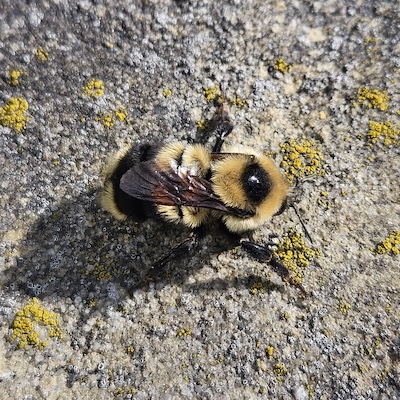
(Gauche) : Bourdon à deux points rencontré lors d'un relevé de bourdons de Conservation de la faune au Canada, avec son motif abdominal distinctif visible. Photo de A. Wilcox. (Droite) : Illustration du motif typique que l'on voit sur un bourdon à deux points. Les « deux points » sont clairement visibles sur le deuxième segment abdominal.
Comme vous l'avez peut-être anticipé, cette espèce tire son nom d'une marque de terrain distinctive : les bourdons à deux points ont deux petites taches jaunes au centre de leur deuxième segment abdominal, apparaissant parfois comme un W jaune sous la bande de jaune de leur premier segment. Cette abeille a un thorax jaune chaud avec une petite tache noire au centre, et un abdomen par ailleurs noir. Une fois que vous savez quoi chercher, cette espèce est relativement facile à reconnaître. Cela dit, les bourdons du début du printemps restent rarement immobiles longtemps — ils ont tendance à se déplacer rapidement de fleur en fleur, s'arrêtant juste assez longtemps pour que vous puissiez les apercevoir brièvement avant qu'ils ne s'envolent.
En plus de signaler que le printemps est enfin arrivé, l'émergence des bourdons au printemps est importante pour une autre raison. Comme les reines du bourdon à deux points sont si tolérantes au temps froid, elles font partie des premiers pollinisateurs actifs chaque année, visitant des plantes qui fleurissent bien avant que la plupart des insectes n'émergent. La sanguinaire du Canada, l'hépatique et le lis truite, toutes de belles fleurs sauvages à floraison hâtive, comptent sur des espèces comme le bourdon à deux points pour déplacer le pollen de fleur en fleur, lançant toute la saison de croissance.
Et des plantes florissantes signifient des insectes florissants, qui soutiennent toutes sortes d'autres animaux. Les fleurs visitées par les premiers bourdons soutiendront plus tard les chenilles, les coléoptères et autres insectes dont les oiseaux dépendent pour élever leurs petits. Les petits mammifères comme les musaraignes et les chauves-souris comptent également sur l'abondance des insectes pour alimenter leur vie bien remplie. En ce sens, le retour du bourdon à deux points est bien plus qu'un signe du printemps ; c'est le début d'une réaction en chaîne saisonnière bien plus grande et interconnectée.

Mâle de bourdon à deux points, montrant à quoi ressemblent les « points » sur l'abdomen vus de côté. Photo de Sharon Nethercott sur Bumble Bee Watch.
Alors que de nombreux pollinisateurs indigènes font face à de sérieux défis liés à la perte d'habitat, aux pesticides et aux changements climatiques, le bourdon à deux points reste une présence familière et résiliente dans une grande partie de son aire de répartition. Cette résilience offre un petit réconfort — alors que nous travaillons à assurer l'existence de communautés diversifiées de bourdons pour les générations à venir, il est rassurant de savoir que ces précieux lève-tôt seront probablement encore parmi les premières abeilles à nous accueillir chaque printemps.
Alors la prochaine fois que vous sortez par un frais après-midi de mars, gardez un œil (et une oreille) ouvert pour les bourdons. Ce pourrait bien être une reine à deux points — la preuve que même après un long hiver, le printemps est déjà en marche.
Annika a rejoint l'équipe de CFC de la pie-grièche migratrice en tant que biologiste en recherche en 2025 avant de passer à l'Initiative pour les pollinisateurs indigènes en tant que coordonnatrice des programmes en Ontario. Elle possède une vaste expérience en sensibilisation environnementale, réhabilitation de la faune, et surveillance écologique des oiseaux, des amphibiens, des reptiles et des insectes à risque. Annika est titulaire d'une maîtrise en biologie intégrative de l'Université de Guelph, où elle a mené des recherches sur les facteurs limitants des zones humides agricoles restaurées comme habitat de reproduction pour les oiseaux, en mettant l'accent sur les espèces en péril.

Nous avons besoin de votre aide