Maritime Swallow Research
The species
From the 1970s to the 2000s, the four species of swallows found in Canada’s Maritime provinces — bank, cliff, tree and barn swallows — have suffered serious declines. In the case of bank swallows, populations have plummeted an astounding 98 per cent. Find out more about these species.
The project
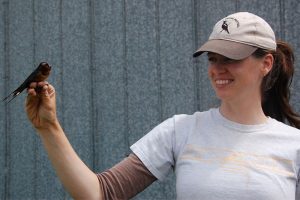
Wildlife Preservation Canada is funding research by former Canada’s New Noah Tara Imlay to identify the causes for swallow declines in the Maritimes. The two main culprits being investigated are changes in the availability of the insects that swallows feed on and threats on migration routes and wintering grounds. Tara and her team have set up nest boxes for tree swallows and established a nest monitoring and banding program for all four species across sites in New Brunswick and Nova Scotia. This enables the researchers to closely monitor breeding success and survival and relate it to information on food availability. Meanwhile, geolocators are being used to track the birds’ behaviour and migration routes. In addition, blood and feather samples are collected from returning birds. These samples are analyzed to identify wintering areas and provide insights into wintering ground conditions and their impact on return rates and reproductive success.
Results
In 2014, Tara and her team monitored nests at 18 sites in New Brunswick and Nova Scotia, checking for timing and success of breeding. The team banded 696 swallows and retrieved 11 geolocators from returning birds for analysis at Dalhousie University. In 2015, they banded over 700 chicks, captured over 450 adult swallows and recovered three geolocators from recaptured birds. To date, research suggests that three of the four swallow species have begun breeding earlier than usual in recent years. Pairs that breed later in the season face a shortage of insects during nestling development that can negatively impact young birds.
Impact
The data collected in this project will help us to understand why steep declines in swallow populations are occurring, giving us the information we need to plan conservation efforts for these species. It also has broad implications for the conservation and recovery of other aerial insectivores across North America. For more details about this project, check out our field blog. Help us save maritime swallows! Contribute to Wildlife Preservation Canada today. Want to do more? Find out how you can help birds at risk.
The People
Tara Imlay’s work with Wildlife Preservation Canada began in 2008, when she was contracted to study the behaviour and movements of eastern loggerhead shrikes released from our conservation breeding program. The following year, she became our 20th Canada’s New Noah and conducted research on kestrel productivity and breeding success during her time in Mauritius. Her experience with birds continued in 2010 and 2011, when Virginia Tech hired her to document the potential impacts of the Deepwater Horizon oil spill on overwintering populations of piping plovers. In 2011, Tara returned to work for Wildlife Preservation Canada as a species recovery biologist, coordinating the Eastern Loggerhead Shrike Recovery Program.
Today, Tara is a PhD candidate with Dalhousie University, conducting field research into the causes of rapid population declines of swallows in the Maritimes. Tara holds a Bachelor of Science degree in Zoology from the University of Guelph and a Master of Science in Biology from Acadia University.
Supported by
- CICan Clean Tech Internship
- The Government of Canada — Canada Summer Jobs
Program partners
Resources
- Right Bird, Right House: Download nest box plans for your region and habitat from the Cornell Lab of Ornithology with this interactive tool
- Bird Studies Canada: Swifts and Swallows Citizen Science Program – report your observations