Beecoming a conservation biologist
Posted onAugust 5, 2026byGrace Tiessen| Photo: B. Smith (Acting Regulations and Communications Administrator with Sault Ste. Marie Region Conservation Authority)
What is the Bumble Bee Recovery Program? Since the 1990s, bumble bee numbers have been plummeting and that spells ecological disaster. Here at Wildlife Preservation Canada, we work to save at risk species of bumble bee from disappearing by monitoring them in the wild, breeding them for release at our conservation lab in Ontario, and studying their poop for parasites! We even host special community science events across the province to track population sizes, locate declining populations and provide hands-on training programs with the goal of expanding our efforts across Canada. We are the only organization in the country working to rebuild at risk bumble bee populations through conservation breeding.
University of Guelph Master of Wildlife Biology Student Grace Tiessen spent the summer with Wildlife Preservation Canada’s Bumble Bee Recovery Team, as part of the program’s hands-on training and skill development. WPC provides opportunities for Canadian biologists to increase their expertise, helping to build to this country’s conservation capacity, and is excited to provide a space for these students.
Most of my professional experience working in conservation has been alongside Wildlife Preservation Canada. I’ve worked with Butler’s gartersnakes on the Ojibway Prairie Reptile Recovery Team in 2023, and with mottled duskywing butterflies as part of the Ontario Butterfly Species at Risk Recovery Team in 2024. Now, I’m working as a Bumble Bee Conservation Technician in Sudbury with WPC’s Native Pollinator Initiative. But this time, my job is also contributing to my completion of the Master of Wildlife Biology program at the University of Guelph.
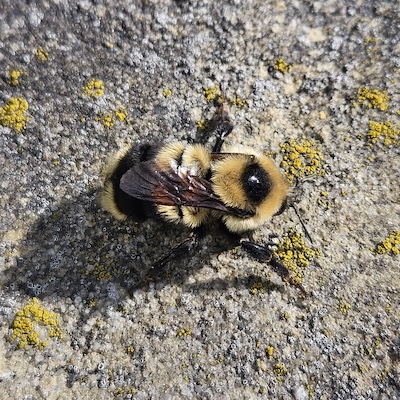
Working with pollinators is awesome, and getting to spend my summer outdoors searching for bees as part of my Master’s degree feels like a pretty good deal. A typical day out in the field when you’re surveying for bumble bees consists of walking around and identifying flowers, hoping to catch a bee on one of them. It’s a lot of bumbling about, if you will. The bees we’re hoping to catch in Sudbury are yellow-banded bumble bee (Bombus terricola) queens. This species is in steep decline in Ontario – particularly in the south – so when we find them, they’re sent back to our lab for captive study and breeding to help restore their wild populations. Any other bumble bee species we catch are released after we’re done surveying. Sometimes they like to hang out with us for a bit before flying off, but we always try to make sure they get back home safely.
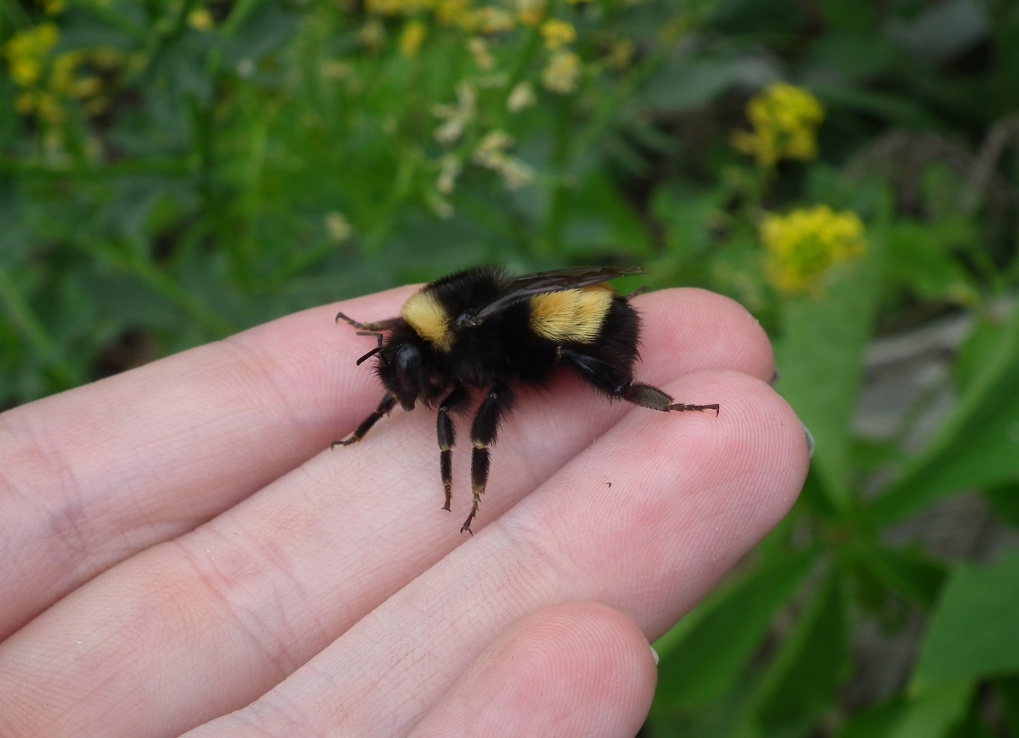
A yellow-banded bumble bee resting on Grace’s hand. Photo: G. Tiessen.
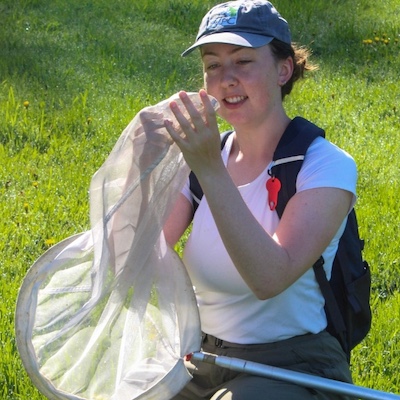
As an experienced butterfly catcher, I thought I’d automatically be a pro at scooping up bumble bees in my net, but it wasn’t as easy as I thought. Despite their cute, clumsy appearance, bumble bees are quick, agile, and they always seem to know what you’re thinking. At least, that has been the experience of myself and my teammate Mariel, the Regional Field Biologist for the Sudbury team. I’ve lost track of the number of times that Mariel and I have messaged each other about seeing a lack of bees at a site, and not ten seconds after hitting send, had a bumble bee appear right in front of our face. These gentle giants can also easily evade the reach of our telescopic nets, foraging from the highest flower on an apple tree or flying in tight circles around our heads, as if they are taunting us.
As amusing as these experiences are, they also highlight one of the biggest challenges in conservation: finding rare species.
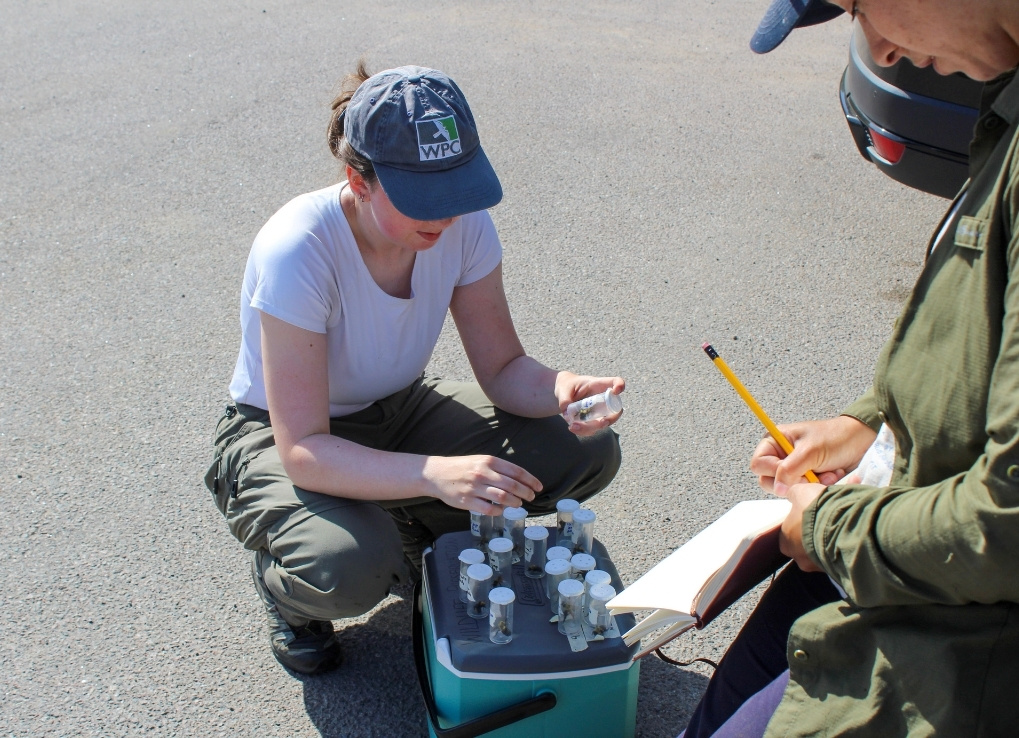
Monitoring bumble bee populations is about more than just catching bees. As surveyors, we need to follow standardized protocols to ensure that the data we collect across different sites and years can be compared accurately. Weather conditions, time of day, abundance of floral resources, and even wind speed can all influence bee activity, meaning that a species may be present at a site but go totally undetected during a survey. Learning these protocols has shown me how important consistency and attention to detail are in wildlife biology. Every bee we identify, every survey we complete, and every data point we record contributes to a larger effort to understand population trends and guide conservation actions for species at risk like the yellow-banded bumble bee. While spending the day searching for pollinators can seem simple, effective monitoring requires careful observation, accurate species identification, and rigorous data collection methods.
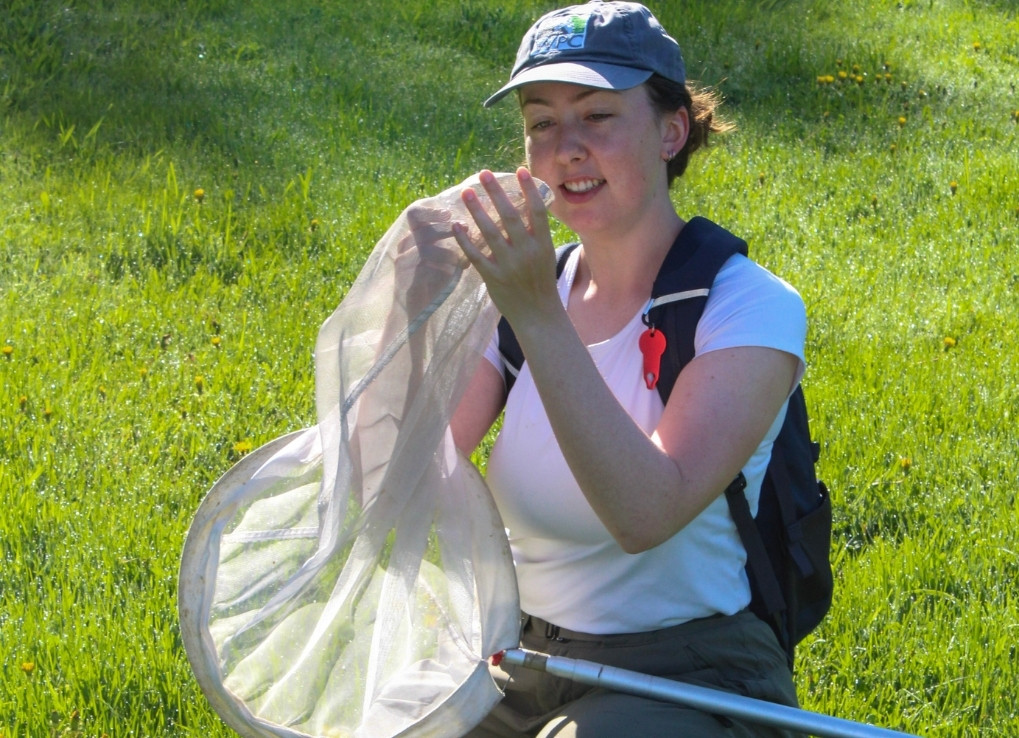
Transferring a bumble bee from Grace’s net into a vial in the field. Photo: B. Smith (Acting Regulations and Communications Administrator with Sault Ste. Marie Region Conservation Authority).
One of the most rewarding skills I’ve developed during this job has been learning to identify bumble bee species in the field. A lot of people think that all bumble bees look the same, but south and central Ontario is home to 16 different species, all with subtle differences in colour patterns and morphology. Distinguishing between these species often requires close attention to detail, and developing these skills has improved my confidence as a field biologist, even though I still get it wrong sometimes. It’s also very rewarding just to be able to look at an animal that I wouldn’t have recognized two months ago and know its name.
This job has served as an amazing capstone to my Master’s program, and has reminded me why I chose a career in wildlife conservation. While the days can be long and sweaty, and finding a target species can sometimes feel like searching for a needle in a haystack, every survey contributes valuable information that helps guide conservation decisions. Through this experience, I’ve been able to put what I’ve learned during my Master’s into practice and become a better conservation biologist with the skills I’ve learned with WPC. I have strengthened my field surveying, species identification, and data collection skills, all while gaining a much deeper appreciation for the challenges involved in protecting species at risk. Most importantly, I’ve learned that successful conservation is built on patience, persistence, and a willingness to keep searching, even when the bees seem determined to stay out of your net.
Grace first joined WPC in 2023 as a Reptile Recovery Field Technician Intern on the OPPREC team. In 2024, she worked as a Crew Member for the Mottled Duskywing Reintroduction Program at Pinery, and is excited to be returning again this year as a Bumble Bee Conservation Technician with the Native Pollinator Initiative. Grace studied Biological Sciences at the University of Windsor, and is currently completing her Master’s of Wildlife Biology at the University of Guelph. She is eager to continue learning more about the natural world and contributing to hands-on conservation work.
We need your help