A most precious cargo
Posted onAugust 27, 2026byDaryn Farrant
What is the Canada’s New Noah Program? Since 1988, the Canada’s New Noah program has provided conservation biologists in Canada the opportunity of a lifetime. Each year, WPC selects a dedicated biologist from applicants across Canada to undertake a 3-month course at the Durrell Conservation Academy in the U.K. followed by a 6-month internship on the island of Mauritius in the Indian Ocean. This is an opportunity unlike any other for young Canadians to learn firsthand how the world’s most successful conservation recovery programs are managed and to bring this knowledge and experience back to improve Canada’s conservation capacity.
For the first time ever, WPC is offering this placement to two biologists. Our 2026 New Noahs are Jenna Kissel – WPC’s 35th Canada’s New Noah, and Daryn Farrant – WPC’s 36th Canada’s New Noah. Both report on their experiences and how they will apply them upon return to Canada. Thank you to the Alan & Patricia Koval Foundation for their many years supporting the Canada’s New Noah Program and for going above and beyond supporting two Koval Foundation New Noah Internships in 2026.
Due to a delay in approval in my Mauritian work Visa, I was able to spend some time exploring other conservation projects on my way to Mauritius. Thank you Pat and Alan Koval for supporting my journey and helping me see the amazing projects we talked about in the DESMAN course.
When most people think about conservation work, they probably do not picture a group of students nervously transporting tiny juniper cuttings through the Scottish Highlands like they are carrying priceless artifacts, continuously saying “keep left!” every time they come to a roundabout.
But that is exactly what we are doing.
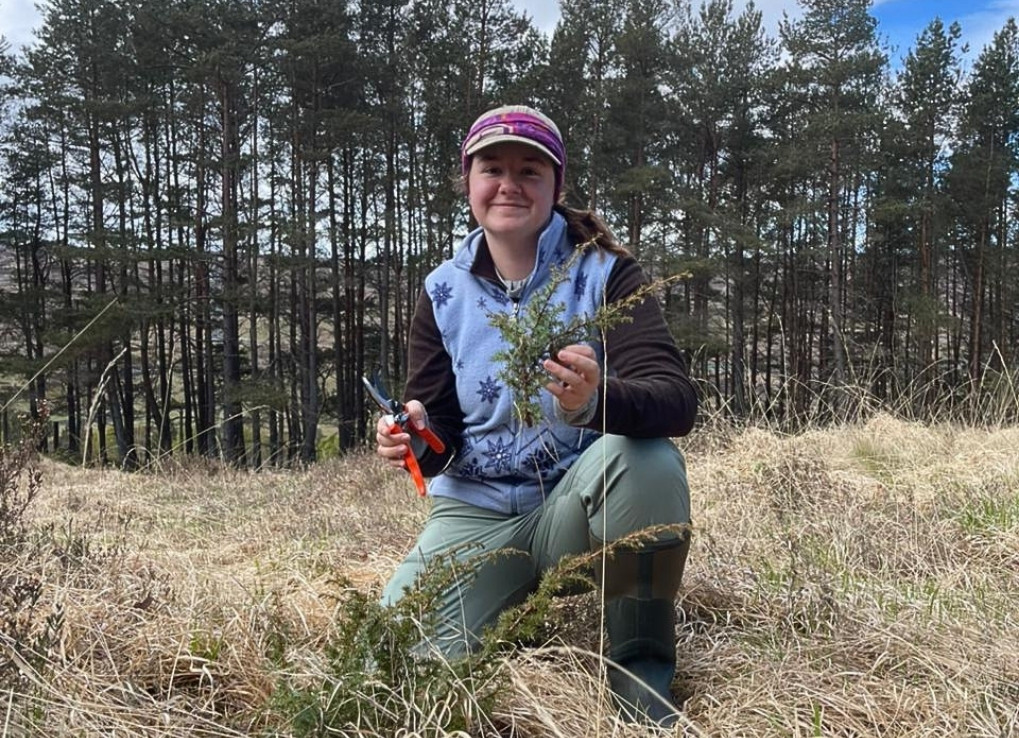
The cuttings are headed for the nursery at Dundreggan Rewilding Centre where they will spend years being carefully grown before eventually making their way back to the Dalnacardoch Estate.
Five years.
That is how long it may take before these small clippings are sturdy enough to return home.
And considering there are only around four juniper plants currently left on the estate, those cuttings suddenly feel very important.
Our visit to Dalnacardoch was peak Scottish weather. The morning started bright and sunny, giving us false confidence. By the time we reached the survey site, the Highlands had changed their mind completely. Rain and hail blasted us for most of the day while we carried out tree regeneration surveys across the estate.
Honestly, it felt very Scottish.
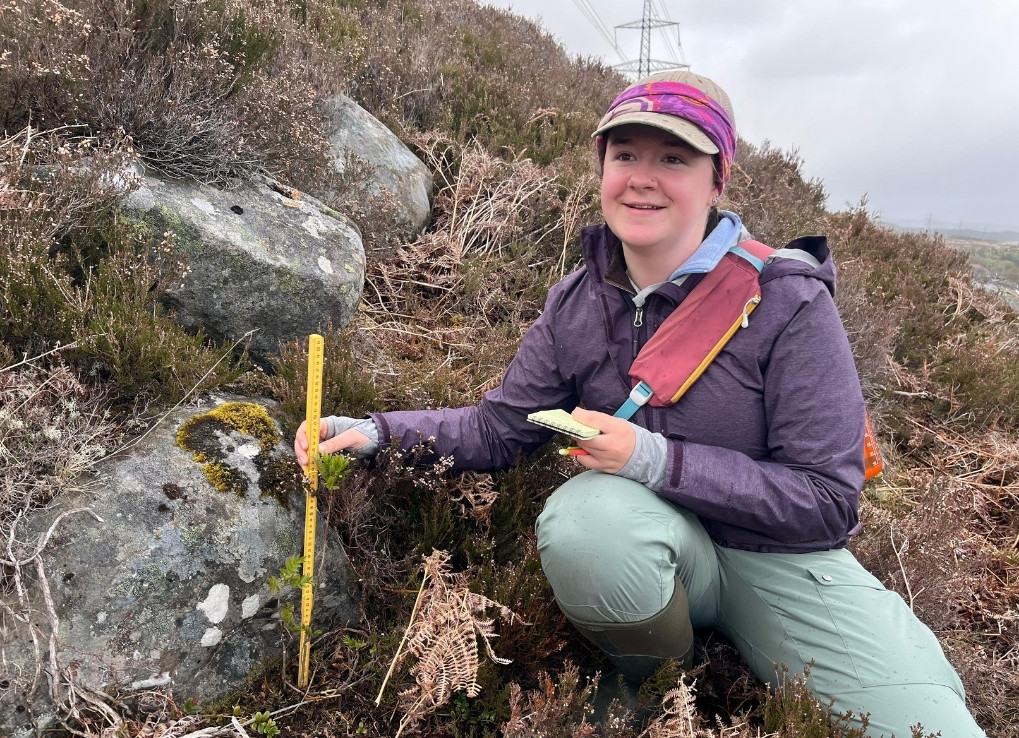
Daryn uses a tape measure to measure the height of a small juniper shrub. Photo: D. Farrant.
But underneath the sideways rain was a fascinating restoration project already beginning to take shape.
The estate sits across two watersheds and forms part of a larger connectivity effort between neighbouring landscapes. Rather than heavily planting every area, much of the focus is on creating conditions where forests can regenerate naturally. The trees grow where they want, allowing natural selection to choose the right genetics for the area. The biggest obstacle is not whether trees want to grow there. It is whether they can survive long enough to do so.
Which brings us back to deer.
At Dalnacardoch, deer management plays a major role in giving young trees the opportunity to establish themselves. Instead of forcing the landscape into a rigid design, the goal is to let regeneration happen where the environment naturally supports it.
In some areas, tiny seedlings were already beginning to appear among the heather.
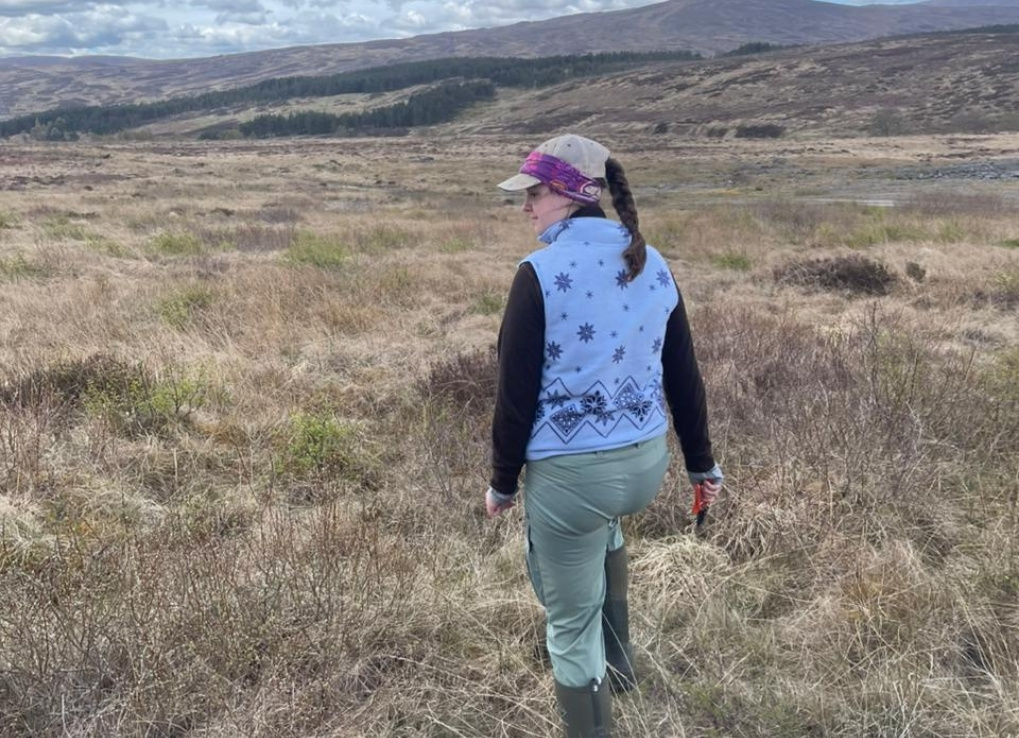
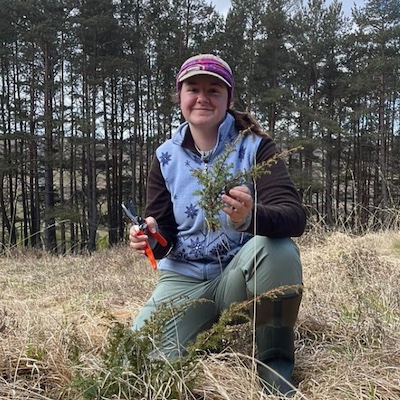
Daryn looks for more junipers. Photo: D. Farrant.
We also learned about the estate’s use of camera traps to monitor wildlife movement and how Highland ponies are being incorporated into land management work. Everything felt connected. Hydrology, grazing pressure, woodland recovery, and species movement are all part of the same system.
It felt really special to be there at the beginning of something special.
Unlike more established restoration sites, Dalnacardoch still has a kind of bare-bones energy to it. A few staff, hiding away in an estate house with big dreams. Baseline surveys are ongoing, making sure to take the right steps. Infrastructure is still being developed. Plans for nurseries, education spaces, and future tourism opportunities are still taking shape.
And honestly, that made it more exciting to visit.
It felt less like touring a finished project and more like standing at the beginning of something ambitious.
Us DESMAN students even made a presentation on how we could use Dalnacordoch as a learning center to design the course. With hopes of sending future desmen there to train.
Now we are heading to visit Dundreggan to see what decades of restoration knowledge and infrastructure can grow into. At Dalnacardoch, you can see the first pieces of that future being assembled. The tiny juniper cuttings we carried are now part of that story too.
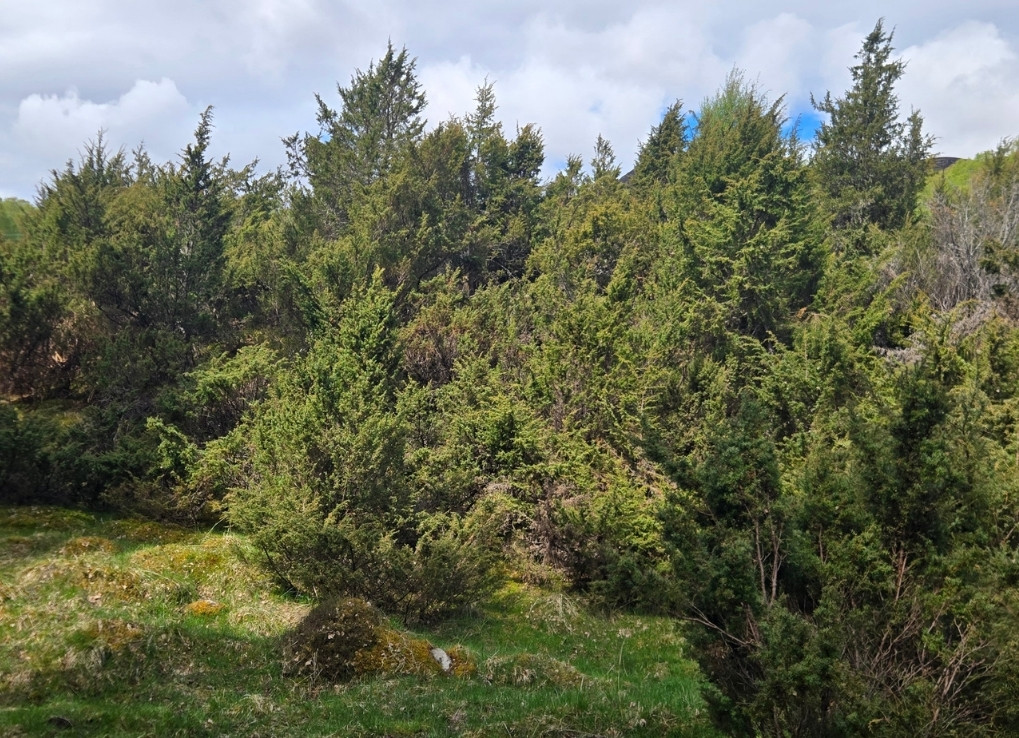
The junipers at Dundreggan Rewinding Centre. Photo: D. Farrant.
I hope the Junipers like pop punk music.
Our very small, very precious cargo.
Daryn is a conservation biologist and the 36th Canada’s New Noah. She holds an Honours Bachelor of Science in Biological Sciences from the University of Manitoba, where she focused on restoration ecology and prairie ecosystem recovery. Prior to joining WPC, Daryn worked with Parks Canada at Grasslands National Park, leading monitoring programs for Burrowing Owls and riparian health, and coordinating fieldwork, data management, and species-at-risk surveys. She brings a range of field experience in invasive species management and ecological monitoring, and is passionate about long-term stewardship and making science accessible to diverse audiences. Daryn is bilingual in English and French and is excited to contribute to endangered species recovery in Canada through her work with WPC.
We need your help