
What is the Canada’s New Noah Program? Since 1988, the Canada’s New Noah program has provided conservation biologists in Canada the opportunity of a lifetime. Each year, WPC selects a dedicated biologist from applicants across Canada to undertake a 3-month course at the Durrell Conservation Academy in the U.K. followed by a 6-month internship on the island of Mauritius in the Indian Ocean. This is an opportunity unlike any other for young Canadians to learn firsthand how the world’s most successful conservation recovery programs are managed and to bring this knowledge and experience back to improve Canada’s conservation capacity.
For the first time ever, WPC is offering this placement to two biologists. Our 2026 New Noahs are Jenna Kissel – WPC’s 35th Canada’s New Noah, and Daryn Farrant – WPC’s 36th Canada’s New Noah. Both report on their experiences and how they will apply them upon return to Canada. Thank you to the Alan & Patricia Koval Foundation for their many years supporting the Canada’s New Noah Program and for going above and beyond supporting two Koval Foundation New Noah Internships in 2026.
Due to a delay in the approval of my Mauritian work visa, I unexpectedly had some time to explore other conservation projects on my way to Mauritius. Thank you to Pat and Alan Koval for supporting my journey and helping me see some of these amazing conservation projects along the way!
Level 0: My Least Favourite Part of Zoboomafoo
Every young biologist has that one nature show that helped brainwash them into becoming a biologist.
For me, that show was Zoboomafoo.
I loved the animals, the adventures, the conservation messages… but there was one problem.
Zabu.
I have always been a little scared of primates. Not just a little, actually. I mean specifically the kind of fear I have for Jack the monkey from Pirates of the Caribbean. You know the one. The one that looks like it knows exactly what you did last summer.
As an ecologist, I know that every species has a role in an ecosystem. I care deeply about wildlife, and I’m a vegetarian because I care about living things.
Ok so I know it’s kinda silly, me being scared of primates when I think prairie rattlesnakes are just the cutest lil guys ever.
But lemurs?
They are so scary.
Of course, there’s a problem with being afraid of wildlife when you want to work in conservation. Fear of an animal can easily become discomfort, discomfort can become apathy, and apathy can eventually become persecution.
So, if I wanted to work in conservation, I figured I probably needed to get over my fear.
Enter: the lemur training arc.
Level 1: The Lemurs of Jersey Zoo
My first step was Jersey Zoo.
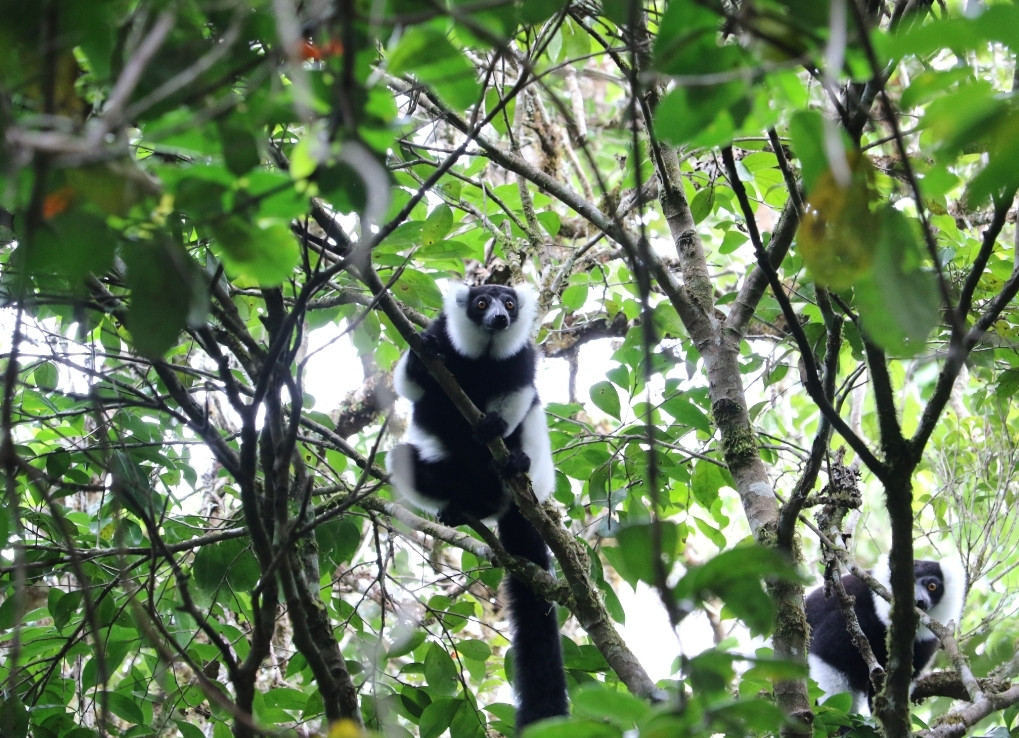
During my time at the Durrell Endangered Species Management course, I quickly became very familiar with the black-and-white ruffed lemurs.
Mostly because they screamed.
Every night. Right outside our hostel.
I could hear them calling as I was trying to fall asleep, which was perhaps not the relaxing bedtime soundtrack I had imagined for my conservation training.
But overtime, I got used to it. The calling lemurs became part of my nightly routine.
I saw the ring-tailed lemurs at Lemur Lake during our lunch breaks. My fellow classmates would rave about how they were so cute and how much they loved the lemurs. Even having a movie night in the hostel living room one night as a break from our studying. Even my friends back home on the prairies love King Julian and would listen to the sound track all summer long while we were spraying invasive weeds. Seemingly everyone I know loves lemures.
But Me?
It’s going to take more than a catchy song and nightly serenades to convince me.
But after being screamed to sleep by lemurs for long enough, I figured I gained enough experience points for level 2.
A video of a black and white ruffed lemur eating at the Jersey Zoo, don’t worry he can’t come out of the screen to hurt you. Video by D. Farrant.
Level 2: Madagascar
My next stop was Madagascar, where I volunteered with GERP — Groupe d’Étude et de Recherche sur les Primates.
This time, I wasn’t looking at lemurs from behind a zoo barrier.
I was in the forest looking for them.
Our job was to walk through the forest and record the different lemur species we encountered, helping build an inventory of the species present in the area.
Everything felt different.
I was in a forest I had never been in, in a country very different from the environments I was used to working in. I was relying on my friend and our local guide to navigate us through the forest.
Usually, I’m the person who wants to look at the map, plan the route and figure out where we are going.
Here, I was completely out of my element. And somewhere in the distance, I could hear them.
Standing on the edge of a mountain, looking out over the forest and villages below, I could hear indri calling in the distance.
It was a little chilling.
But it was also incredible.
For once, I wasn’t the person who knew exactly where we were going.
I was the person learning from someone else.
And that turned out to be an important part of the experience.
A video of Daryn out on the lookout hearing the call of indri indri (lemurs). Video by D. Farrant.
Final Boss: Seven Lemurs
The next challenge was a little more intimidating.
We were going to follow a group of lemurs and record their behaviour every minute for 30 minutes.
Our guide got word that there was a group of four black-and-white ruffed lemurs nearby.
Except…
There weren’t four. There were seven.
Four quickly became seven as more lemurs appeared, and at one point they all piled together into one giant ball of fluffy lemur.
They jumped around. They lounged around. They groomed each other. For a few minutes, everything was peaceful.
And then suddenly…
ALERT.
A mouse lemur appeared.
The entire group immediately went from relaxed to:
EVERYONE PANIC! SCREAMING COMMENCES!
My heart started racing.
Seven black-and-white ruffed lemurs began vocalizing together, creating this incredibly loud, rough chorus of calls.
It was, subjectively, terrifying.
But standing there watching them was also fascinating.
I wasn’t just looking at “scary lemurs” anymore.
I was watching a social group respond to another animal entering their space. I was watching communication, vigilance, social behaviour and relationships play out in front of me.
And somewhere along the way, I realized that I wasn’t really scared anymore.
Well that’s a lie…
Not as scared as before.
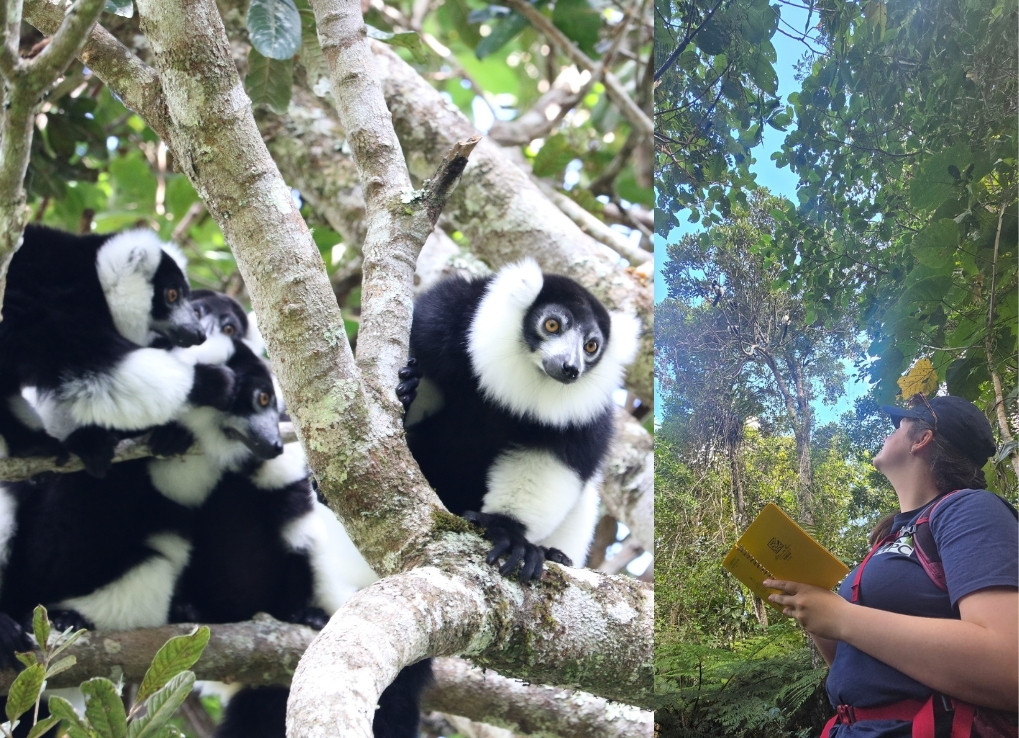
(Left) A ball of black and white ruffed lemurs. (Right) Daryn looking up at a bunch of black and white ruffed lemurs. Photos by D. Farrant.
Fade to black…
As I sit on the plane outbound to Mauritius and the end credits roll on my time in Madagascar what advice can I give to you?
Face Your Fears
Things are scary.
The world is big, and sometimes the places we find ourselves in are completely different from the ones where we grew up.
Conservation is a strange career in that way. We are constantly put into situations where we don’t know everything. We work with unfamiliar species, unfamiliar ecosystems, unfamiliar people and unfamiliar problems.
And that’s okay.
In fact, I think it’s important.
One of the most valuable things I have learned through my conservation experiences is to stay humble and ask for help.
None of us can be experts at everything.
Conservation needs engineers, biologists, communicators, educators, managers, researchers and people who can do a little bit of everything. Being a jack-of-all-trades can be incredibly valuable in a field where the world is so diverse and dynamic that no one person can ever master all of it.
I’m not going to pretend that my heart doesn’t race every time I see a primate.
But lemurs have definitely become the least scary members of that category for me.
And when I look at them now, I don’t just see an unfamiliar animal. I can see intelligence, curiosity, social relationships and a life that matters just as much as any other.
It’s okay to be scared sometimes.
What isn’t okay is allowing fear of something unfamiliar to stop us from treating it with respect and integrity.
So:
Go for it.
Face your fears.
Apply for that job.
Ask for help when you don’t know something.
Step outside the environment you know.
And, if necessary…
Go out into a forest full of lemurs.
Daryn Farrant
36th Canada’s New Noah
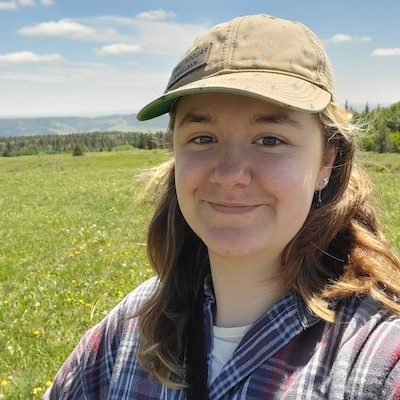
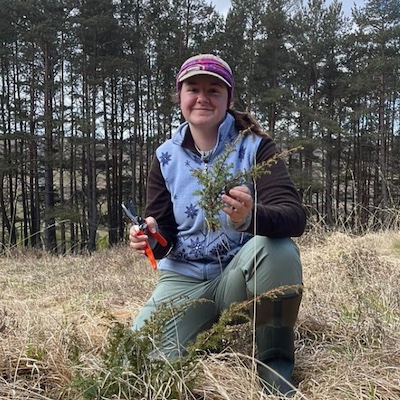
Daryn is a conservation biologist and the 36th Canada’s New Noah. She holds an Honours Bachelor of Science in Biological Sciences from the University of Manitoba, where she focused on restoration ecology and prairie ecosystem recovery. Prior to joining WPC, Daryn worked with Parks Canada at Grasslands National Park, leading monitoring programs for Burrowing Owls and riparian health, and coordinating fieldwork, data management, and species-at-risk surveys. She brings a range of field experience in invasive species management and ecological monitoring, and is passionate about long-term stewardship and making science accessible to diverse audiences. Daryn is bilingual in English and French and is excited to contribute to endangered species recovery in Canada through her work with WPC.
Recent articles on the project
We need your help