
Nothing Found
Sorry, no posts matched your criteria
What is the Canada’s New Noah Program? Since 1988, the Canada’s New Noah program has provided conservation biologists in Canada the opportunity of a lifetime. Each year, WPC selects a dedicated biologist from applicants across Canada to undertake a 3-month course at the Durrell Conservation Academy in the U.K. followed by a 6-month internship on the island of Mauritius in the Indian Ocean. This is an opportunity unlike any other for young Canadians to learn firsthand how the world’s most successful conservation recovery programs are managed and to bring this knowledge and experience back to improve Canada’s conservation capacity.
For the first time ever, WPC is offering this placement to two biologists. Our 2026 New Noahs are Jenna Kissel – WPC’s 35th Canada’s New Noah, and Daryn Farrant – WPC’s 36th Canada’s New Noah. Both report on their experiences and how they will apply them upon return to Canada. Thank you to the Alan & Patricia Koval Foundation for their many years supporting the Canada’s New Noah Program and for going above and beyond supporting two Koval Foundation New Noah Internships in 2026.
The dodo is one of the most famous examples of a species driven to extinction by humans. Lost from the island of Mauritius in the 1600s, the dodo was a large, flightless species of pigeon. Dodos were hunted to extinction within 100 years of the arrival of Dutch sailors to Mauritius, both by the sailors and the invasive mammalian predators they brought with them.
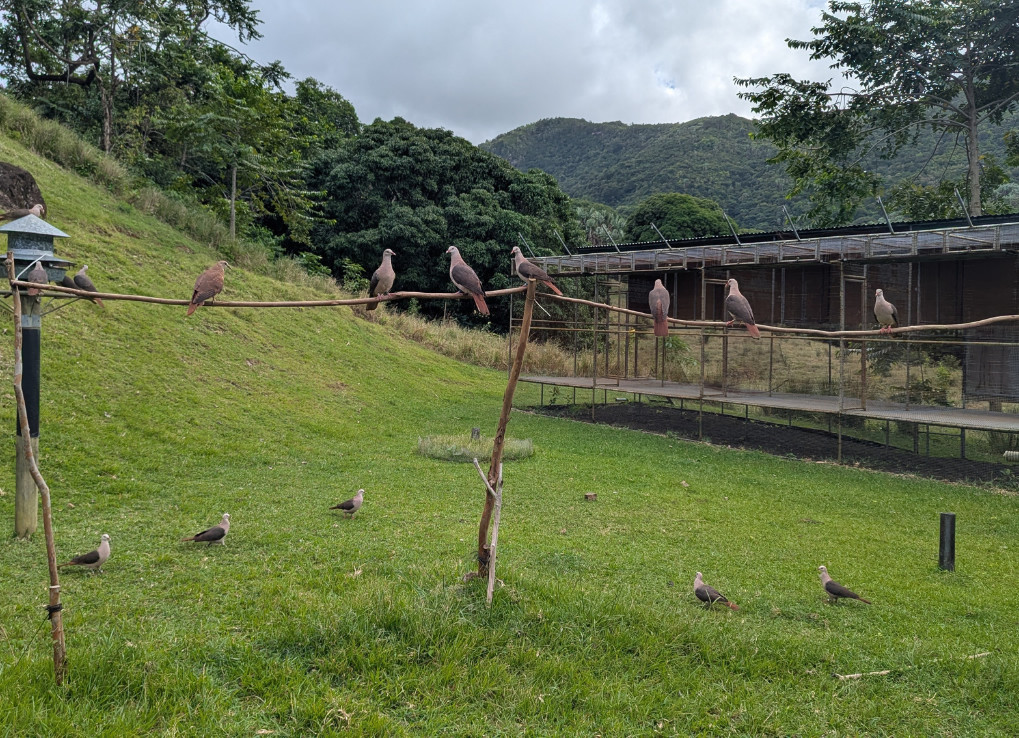
The pink pigeon (Nesoenas mayeri), another endemic species to Mauritius, almost followed the same fate as its larger cousin. Down to fewer than 10 known individuals in the wild by the 1990s, the pink pigeon population is now more than 600 birds thanks to captive breeding, reintroduction, and wild population management. Despite being a conservation success story, the species is still considered conservation-reliant, requiring constant management for them to survive.
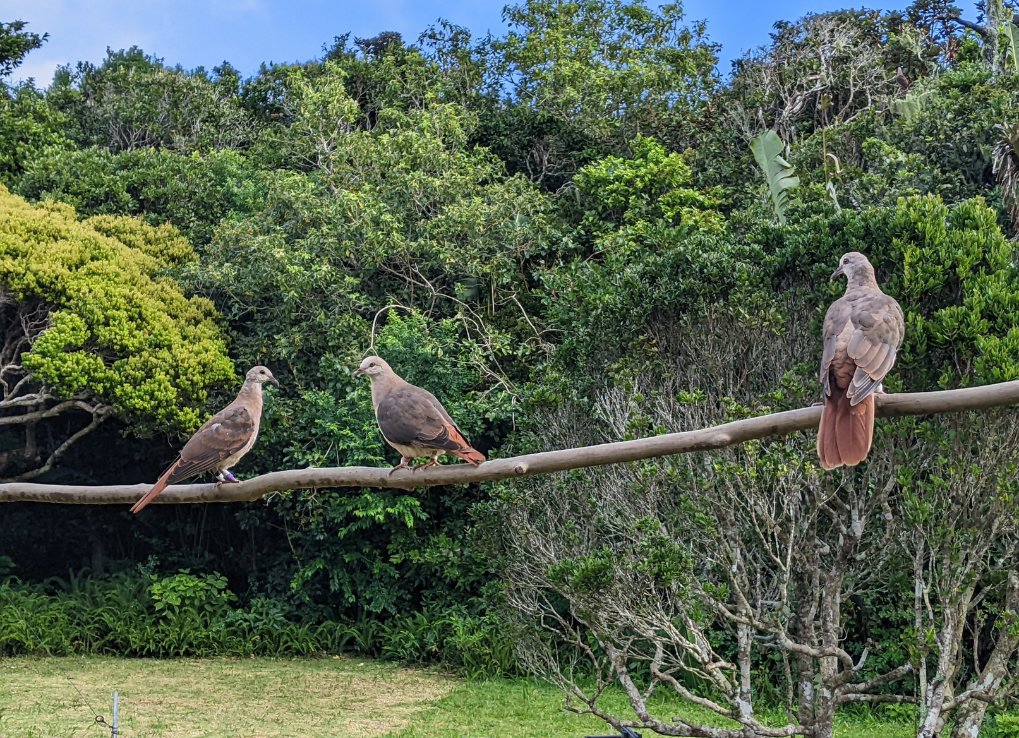
Three pink pigeons on a branch between hoppers at Camp. Photo by J. Kissel.
Since my arrival in Mauritius, I’ve been volunteering with the Mauritian Wildlife Foundation’s (MWF) pink pigeon team. During the week I’m living at a field site in the Black River Gorges National Park, where most of the pink pigeon population remains. Captive breeding of pink pigeons was a major factor in bringing this species back from the brink, but MWF now focuses on wild population management. Part of that management includes searching for pigeon pair territories and monitoring nests in a Conservation Management Area called Brise Fer. Once a pigeon nest is found, it’s monitored daily until the pair either successfully fledges offspring… or it fails. While pigeons won’t win any awards for their parenting skills, they are not solely to blame for low reproductive success when they are facing threats they have not evolved to handle, namely, invasive mammalian predators.
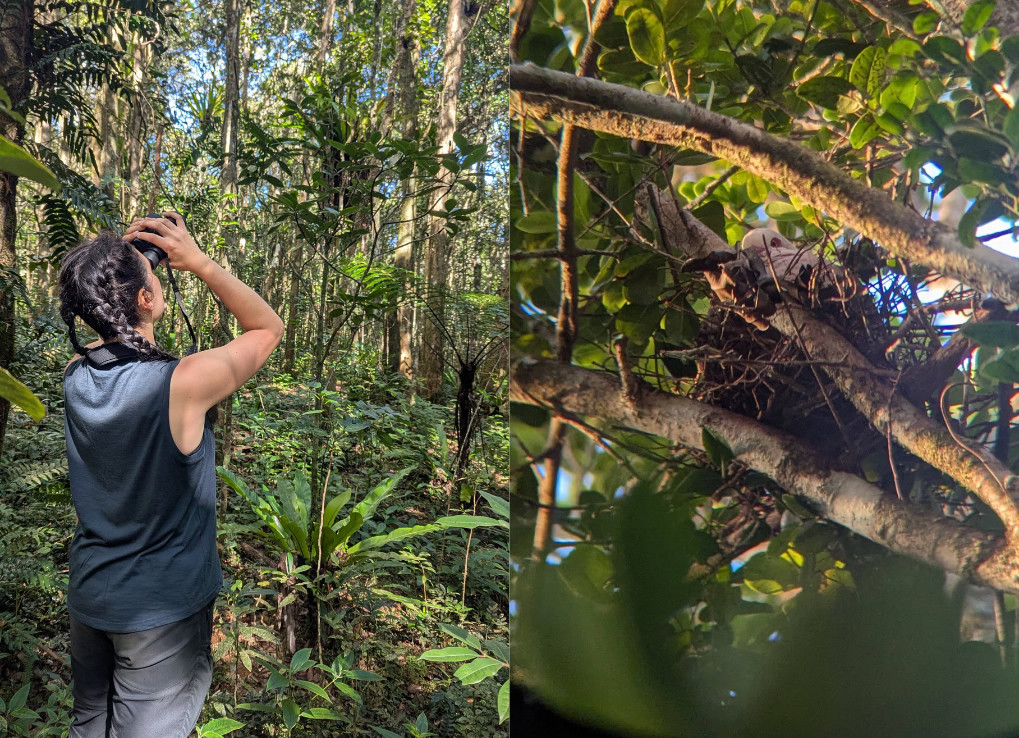
Jenna monitoring a pink pigeon nest (left) and a pink pigeon on a nest (photo taken through binoculars). Photo by V. Ramsamy.
Predator control is also a major part of pink pigeon population management. Invasive predators, predominantly rats, still threaten pink pigeons as they raid pigeon nests for eggs and chicks. A “rat index” is also conducted monthly, where chew cubes made of chocolate and wax are placed. They’re collected the following day and checked for bite marks to learn more about the presence of rats.
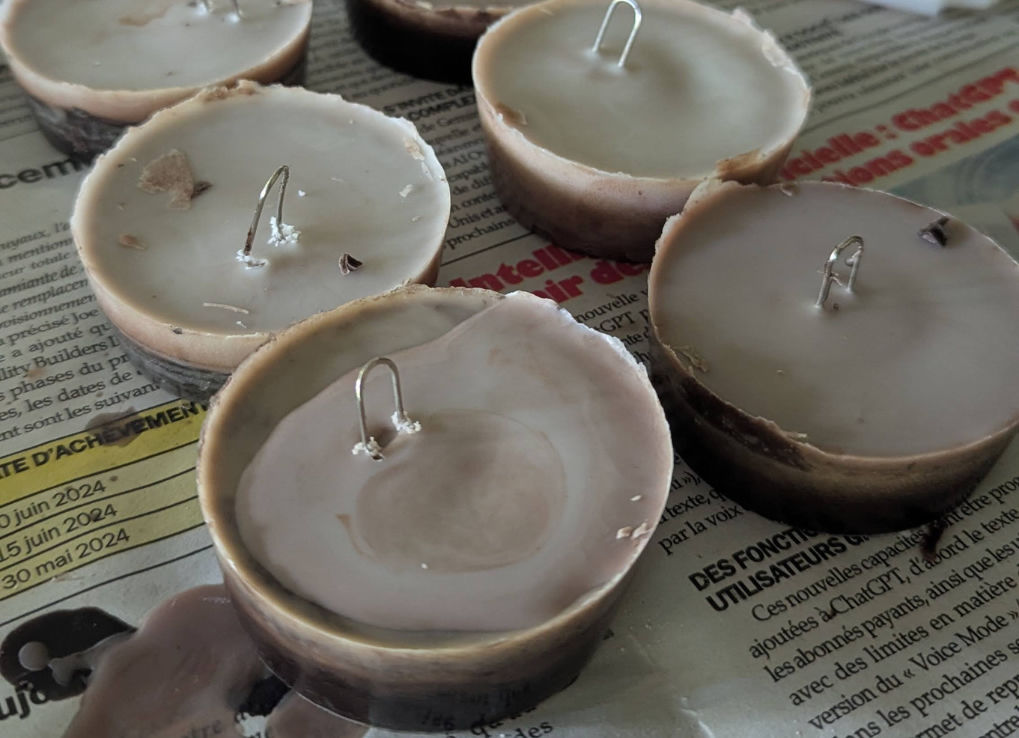
The chew cubes used to determine rat presence. Photo J. Kissel.
Monitoring the pink pigeon population also involves maintaining supplemental feeding stations and observing the feeders to record which pigeons show up. At each field site pigeons are banded (or “ringed” as they say here) with a metal ID band and a unique colour band combination so they can be identified individually. The supplemental feeding stations are crucial not only for monitoring the population, but to provide the pigeons with a much-needed food source. Less than 2% of Mauritius’ native forest is left, and without supplemental food the remaining forest wouldn’t be able to sustain the recovering pigeon population.
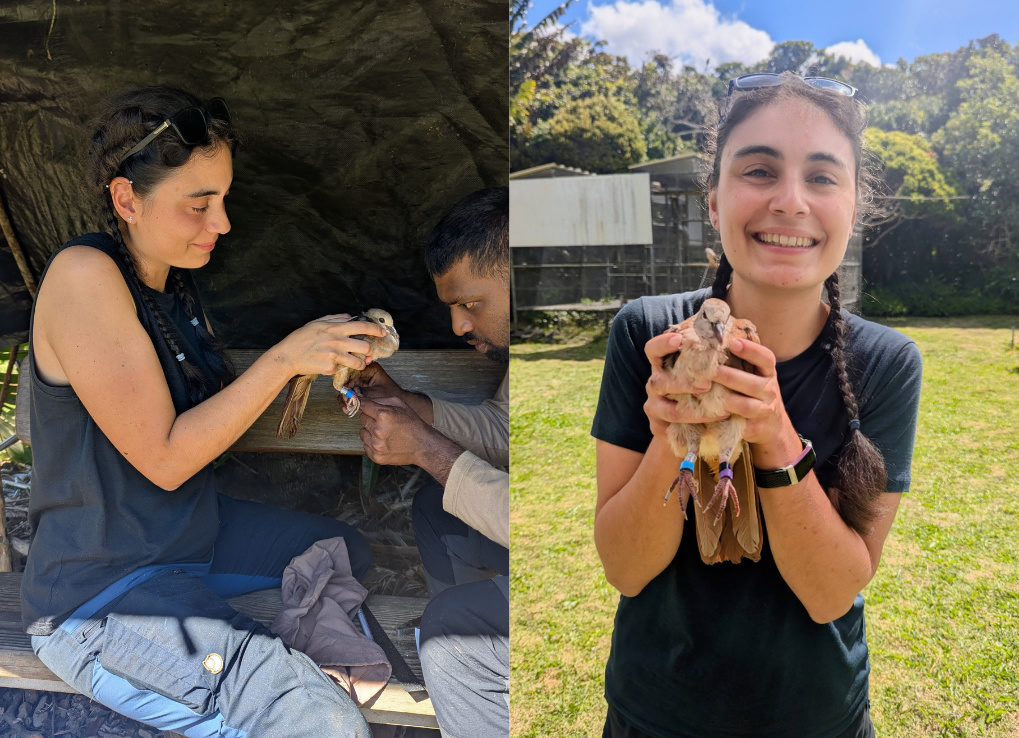
Jenna handling a pink pigeon (left) and Jenna with a pink pigeon before releasing it after being banded. Photos by UNK and V. Ramsamy.
The conservation success stories out of Mauritius, including the pink pigeon and Mauritius kestrel, are reminders to never give up on endangered species recovery, even when it seems all hope is lost. Though I’ve only been here for a small chapter in the story, it is rewarding to be a part of the team working to keep the pink pigeon from going the way of the dodo.
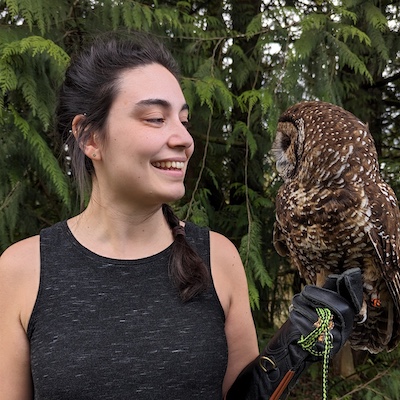
Jenna is a zookeeper and wildlife conservationist who is passionate about endangered species recovery. She graduated with a BSc in Wildlife Biology & Conservation from the University of Guelph before moving to British Columbia to work with northern spotted owls. Her background is in raptor conservation, specializing in husbandry and conservation breeding. She has been fortunate to work with many different species and conservation programs over the last 8+ years and can’t wait to continue this work with the skills she’ll gain from the New Noah Program.
Sorry, no posts matched your criteria
We need your help