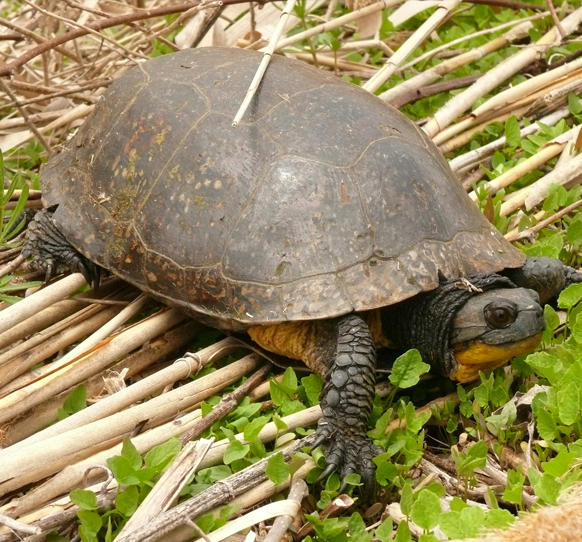
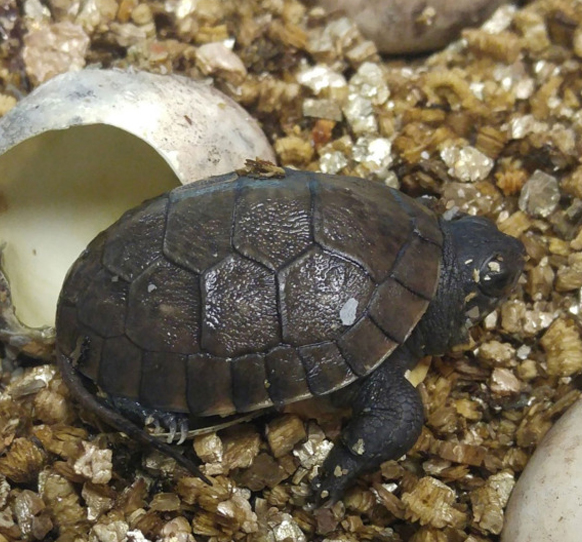
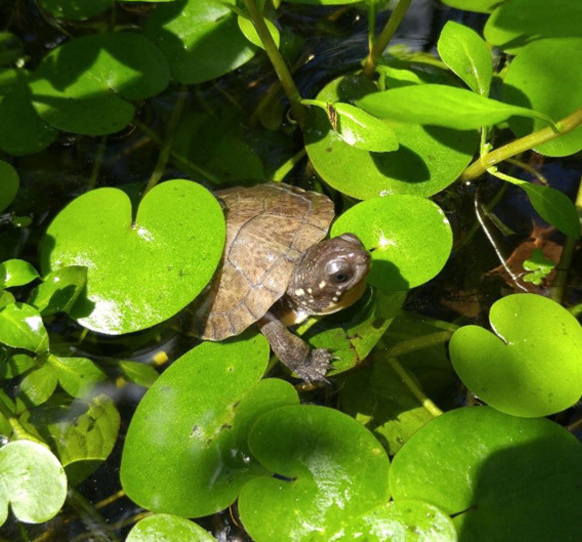
Blanding’s turtles (Emydoidea blandingii) are a medium sized turtle species that measure 18 to 28 cm in shell length. They are easily distinguished by their bright yellow chin and a mouth that curves up into what appears to be a smile. The carapace is high domed, smooth, and entirely black with small irregular yellow spots and streaks scattered across the surface. They are usually spotted in shallow wetlands where clean, slow-moving water and abundant aquatic vegetation provide ideal hunting grounds, though these turtles travel surprisingly long distances overland in search of new ponds or suitable nesting sites.
The male and female both have the bright yellow underchin, however, males are distinctly smaller than females and possess slightly concave plastrons, whereas females have completely flat undersides. Males also have thicker, longer tails compared to females.
A proposed federal Recovery Strategy for the Great Lakes/St. Lawrence populations of Blanding’s turtles calls for a number of measures, including conserving and restoring critical habitat, protecting nests, curbing illegal collection and co-operating with landowners, interest groups and other stakeholders to reduce threats.
The federal recovery strategy for Blanding’s turtles in Nova Scotia calls for a number of measures, including conserving critical habitat, protecting nests, assessing the effectiveness of incubation and headstarting, and moving vulnerable adults, hatchlings and nests if they are at immediate risk.
If you own land near wetlands or on migration corridors, maintain clean ponds with abundant aquatic vegetation. Avoid pesticide use that reduces food availability. Watch for nesting females in late May to June and protect nesting sites from predators and disturbance. If you encounter a turtle crossing a road, help it across in the direction it was heading (scoop it gently and move it forward). Most importantly, slow down while driving in turtle habitat, particularly in spring and early summer. Report sightings to your local wildlife agency to help track population distribution and recovery progress.
Q: Why are road deaths so catastrophic for Blanding’s turtle?
A: Because Blanding’s turtles don’t mature until 14 to 26 years old, losing even a handful of adults through vehicle strikes is devastating to population recovery. An adult that dies on a road may have taken two decades to develop and could have contributed 50+ more years of potential reproduction. A single female killed while crossing to a nesting site represents decades of lost offspring. For a slow-growing, slow-reproducing species, adult mortality is far more damaging than loss of eggs or hatchlings.
Q: What makes nesting site fidelity problematic for Blanding’s turtle?
A: Female Blanding’s turtles have high nesting site fidelity, meaning they return to the same nesting areas year after year. While this seems like a survival advantage, it becomes dangerous when nesting habitat is surrounded by roads or threatened by development. Females will continue returning to degraded sites even when they’re unsafe, increasing mortality and decreasing reproductive success.
Q: How does temperature determine sex?
A: Unlike mammals, which have genetic sex determination (XX for females, XY for males), many turtles use environmental sex determination. During egg incubation, the temperature of the surrounding soil directly influences hormones that determine whether the developing embryo becomes male or female. Warmer temperatures produce more females, cooler temperatures produce more males. Climate change and altered precipitation patterns may shift incubation temperatures dramatically, potentially producing skewed sex ratios where populations become predominantly one sex.