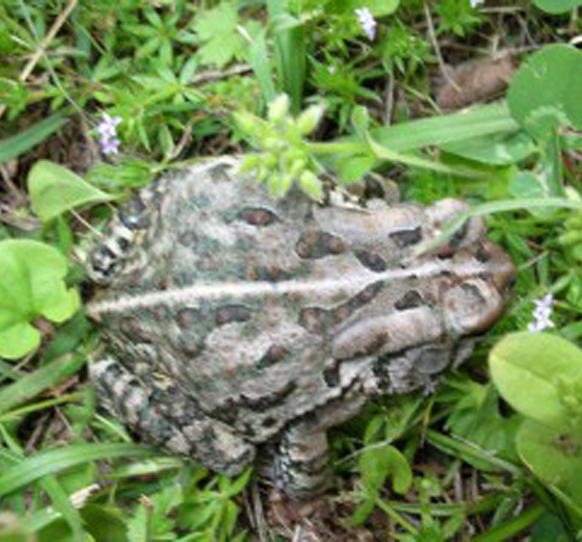
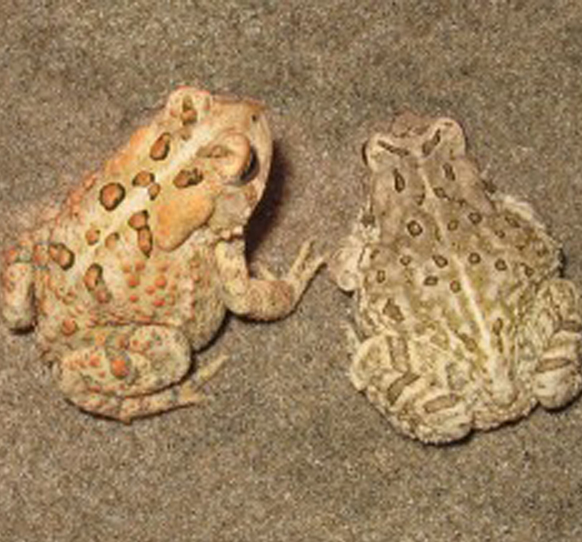
Fowler’s toad (Anaxyrus fowleri) is a small to medium sized toad measuring between 5 to 9.5 cm. It can be spotted on warm, humid nights during spring and summer as it emerges from underground burrows to hunt insects near light sources or in moist areas. Its most distinctive feature is its smell, reminiscent of unroasted peanuts. Its body has dark, black-edged spots covering the back, and a yellowish stripe that runs down the center of the back. The most reliable field mark is the presence of three or more warts within each dark spot. The belly is pale cream or white and remains almost completely unspotted.
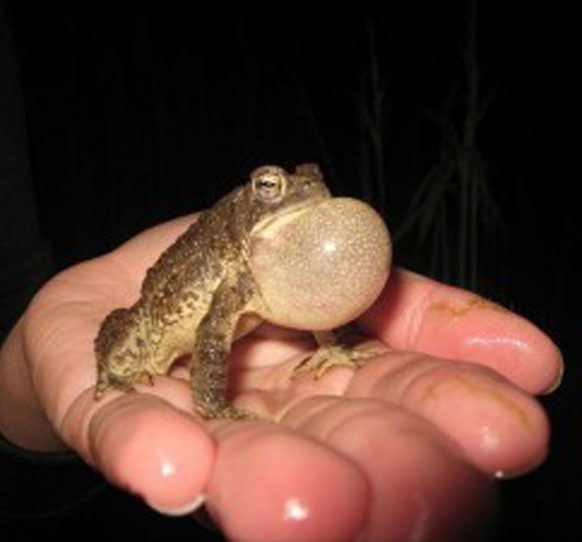
Males are noticeably smaller than females and are typically darker overall with a black throat, particularly visible during breeding season when they’re calling. Females remain lighter in tone and lack the distinctive black throat. You can also identify the males by their uniquely shrill mating call when they gather at aquatic breeding sites in late spring.
Age of sexual maturation is reached within 1 to 3 years and Fowler’s toad will live for about 5 years in the wild. Breeding occurs from May to August when males migrate to shallow wetlands and produce their distinctive call, a sound resembling a distressed sheep’s wail. When a male locates a female, he grasps her from behind in an amplexus (mating position) and fertilizes up to 10,000 eggs as they’re released. Females deposit their eggs in long jelly-like strings, which remain attached to aquatic vegetation in shallow water. Eggs hatch in 3 to 4 days, producing tiny tadpoles who undergo rapid metamorphosis 5 to 10 weeks after hatching, transforming into adult-sized froglets between late July and early September. There is no parental care, froglets are independent from the moment they metamorphosis.
In Canada, Fowler’s toads are in serious risk of being completely wiped out. Their biggest threat is the loss and degradation of shoreline beaches and dune habitat. One of the biggest problems is the spread of the invasive common reed Phragmites australis. It forms dense stands and lowers water levels, eventually drying out wetlands.
Other culprits include shore development and artificial coastline stabilization projects, including the construction of breakwalls, roads, parking lots, piers and groynes. Beach maintenance activities such as grading, grooming and clearing algae with grooming machines or bulldozers are also major problems, while traffic and recreational use of the beaches and dunes add to the habitat loss. Finally, agricultural runoff, industrial pollution and other invasive species such as zebra mussels represent significant threats.
The Ontario Recovery Strategy recommends a number of measures, including improving habitat, determining the feasibility of reintroducing Fowler’s toads to suitable areas, and re-establishing populations where feasible. One of the keys to reintroducing Fowler’s toads is understanding how to increase toadlet populations from existing breeding sites.
Protect and restore wetland habitats, especially temporary and semi-permanent ponds that serve as breeding grounds. Maintain vegetation around water bodies. Slow down while driving at night during breeding season (April-August), particularly after heavy rains—many toads are killed crossing roads to reach breeding sites. Create small shallow water basins in your yard if you live in suitable habitat. Avoid pesticide use, which eliminates their insect food source. Most importantly, never intentionally harm a toad and educate others about their ecological importance in controlling insect populations.
Q: Why do Fowler’s toads produce so many eggs?
A: It’s a remarkable reproductive strategy. By producing enormous numbers of eggs, even if predation and disease kill 99% of them, the female still contributes thousands of offspring to the population. This high-fecundity strategy compensates for the species’ short five year lifespan: toads must reproduce successfully within their brief adult window or fail to contribute to the next generation.
Q: Why do Fowler’s toads burrow underground?
A: During dry periods, burrowing allows them to remain in moist soil below the surface where water availability is higher. During winter, they burrow well below the frost line where temperatures remain stable enough to survive.
Q: Why do male frogs sometimes try to mate with other male frogs?
A: The male’s calling displays attract both females and other males. When a male accidentally grasps another male, the second male immediately produces a distinctive “release call”, a chirping sound that communicates his male status and prompts the first male to let go.