Flies in disguise
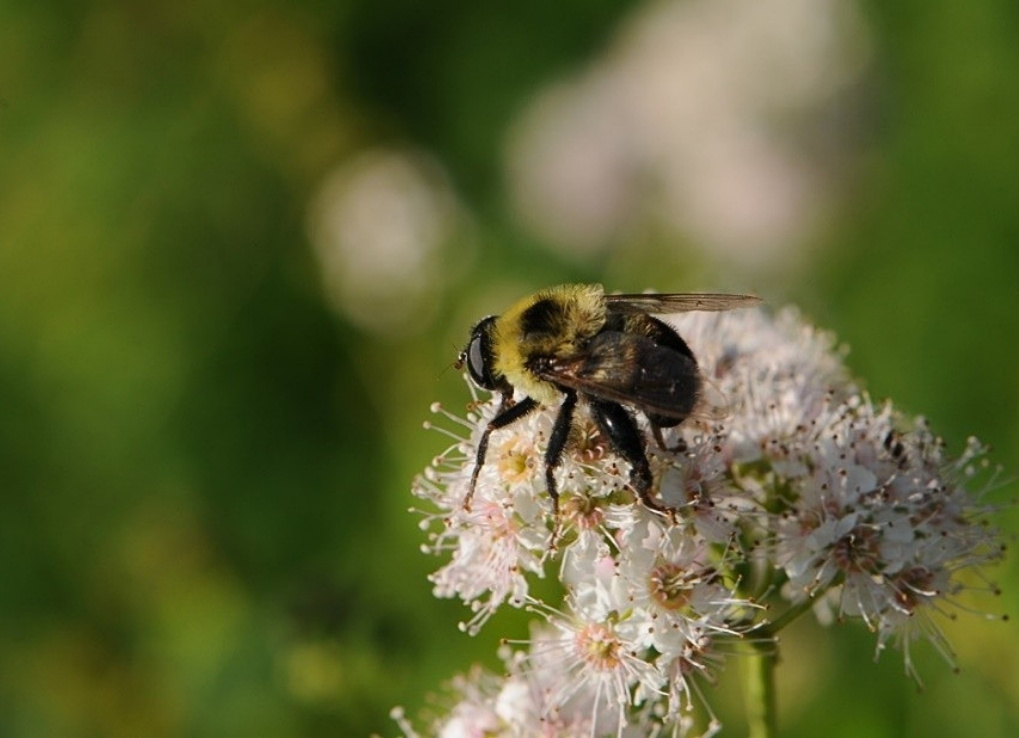
Posted onMay 20, 2026byEmily Forrester| Photo: a hairy-eyed bee mimic flower fly by John Klymko
What is the Bumble Bee Recovery Program? Since the 1990s, bumble bee numbers have been plummeting and that spells ecological disaster. Here at Wildlife Preservation Canada, we work to save at risk species of bumble bee from disappearing by monitoring them in the wild, breeding them for release at our conservation lab in Ontario, and studying their poop for parasites! We even host special community science events across the province to track population sizes, locate declining populations and provide hands-on training programs with the goal of expanding our efforts across Canada. We are the only organization in the country working to rebuild at risk bumble bee populations through conservation breeding.
Spotting bees can be trickier than you may think because some insects strongly resemble bees at first glance. Some of the most commonly found bee-mimicking insects are flower flies (Family Syrphidae), also called hoverflies. They are abundant in Canada, and many species can be easily mistaken for bees or wasps unless you know what to look for to distinguish the two. There are a few telltale characteristics that will help you know with more certainty what you’re looking at when you see an insect that looks like a bee or wasp.
First, what are flower flies? Flower flies, as their name suggests, are a type of fly (Order Diptera). There are over 500 species of flower flies in Canada, found in every province and territory, even as far north as Ellesmere Island. They are most often found around flowering plants on warm, sunny days, like bees. Flower flies play a role in pollinating natural vegetation, gardens, and various crops. Adult flower flies feed on nectar, pollen, and honeydew. As larvae, many species are voracious predators of aphids, a common pest. Some genera you’re likely to see include the calligraphers (Toxomerus), the aphid eaters (Eupeodes), and the globetails (Sphaerophoria).
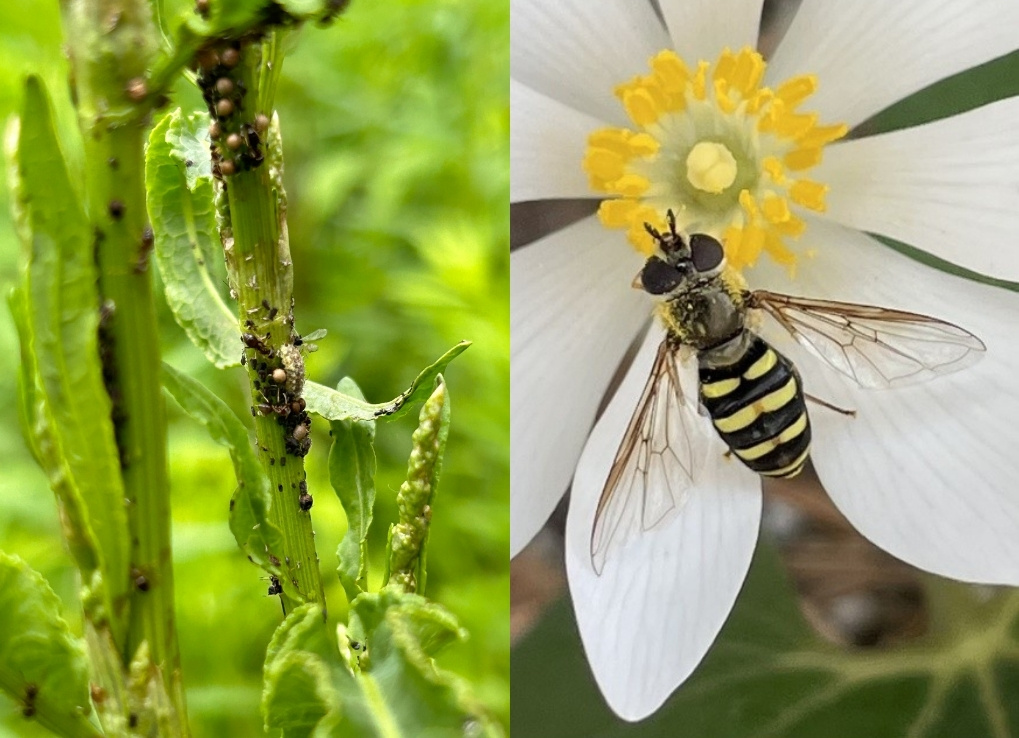
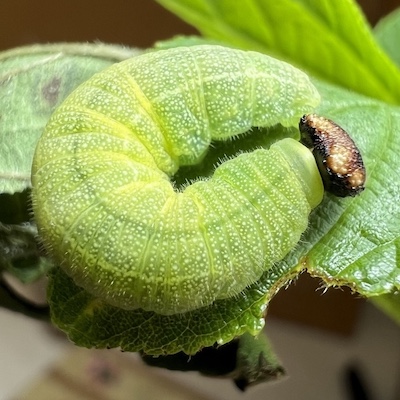
(Left) A flower fly larva (the green and brown maggot) in the middle of a colony of aphids looking for lunch (Photo by E. Forrester). (Right) A long-tailed aphid eater (Eupeodes americanus), which is a commonly found flower fly in Canada (Photo by Paul Marcum).
Mimicry is a method through which an organism has evolved to resemble another organism. For example, many flower flies have black, yellow, and white coloration resembling bees and wasps, making them easy to misidentify. Flower flies do not have stingers like female bees and wasps, so they use mimicry as a defence mechanism to avoid predation. Some species even move their forelegs in front of their body to resemble the long antennae of wasps as a form of behavioural mimicry.
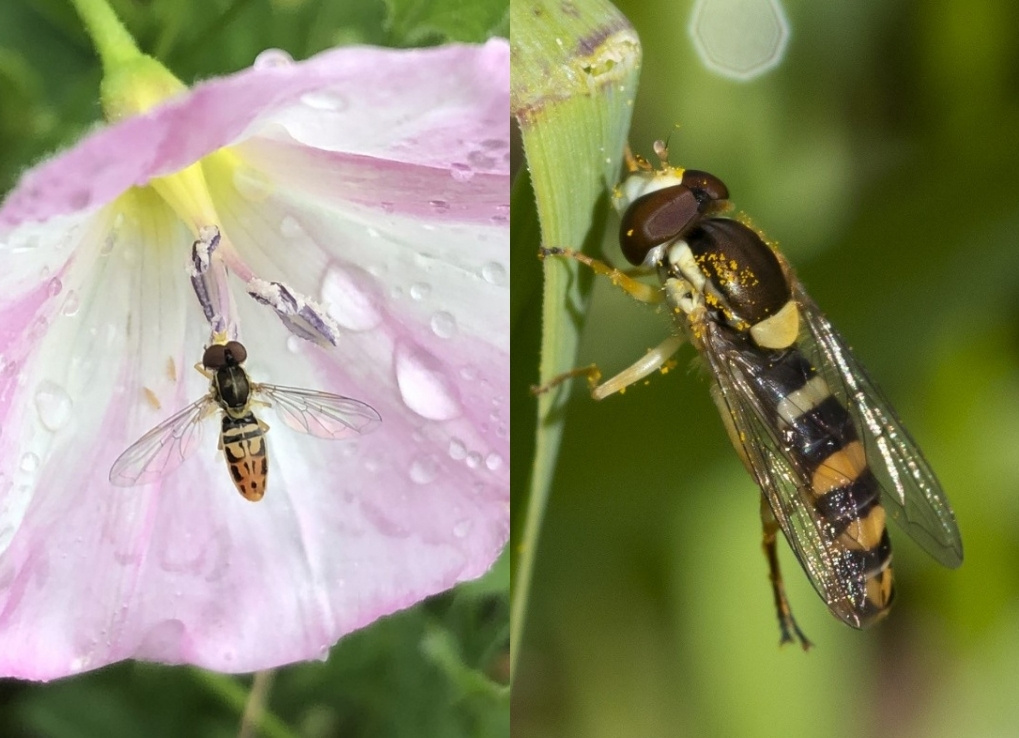
(Left) A margined calligrapher (Toxomerus marginatus), one of the smallest and most common species of flower fly found in Canada (Photo by E. Forrester). (Right) The black-footed globetail (Sphaerophoria philanthus) is abundant across Canada; this group can be difficult to identify to species (Photo by D. Doucet).
An introduced species commonly found across Canada is the drone fly (Eristalis tenax), which is a mimic of honey bee drones (male honey bees, Apis mellifera), as pictured below – can you tell which is the real bee?
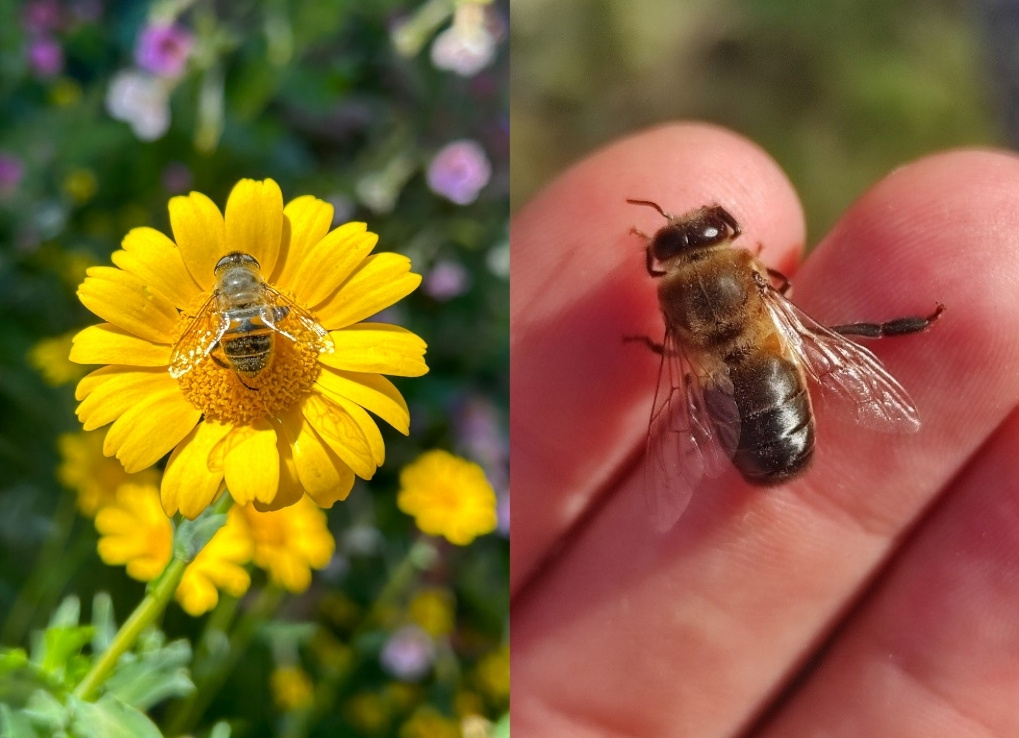
(Left) Photo of a drone fly (Eristalis tenax) (Photo by E. Forrester). (Right) Photo of a honey bee drone (Apis mellifera) (Photo by B. Le Mort).
So, how do we tell apart bees and wasps from flower flies when we see them outdoors? The first clue is to look at their flight pattern. Flower flies have a peculiar ability to hover in place midair (hence their other common name ‘hoverfly’). These next few traits are easier to see if you’re able to observe the insect when it lands. The surest way to tell between flies and bees is by looking at the number of wings. Flies will always have 1 pair of wings, while bees and wasps have two pairs of wings. Flies also have bigger, rounder eyes and shorter antennae compared to bees. Additionally, bees tend to be covered in denser hair, but this varies among species. A final clue to look for is large yellow or orange lumps of packed pollen on the specimen’s back leg, as pictured below. Some female bees have what is called a pollen basket (the corbicula) used to transport pollen, which flies do not have.
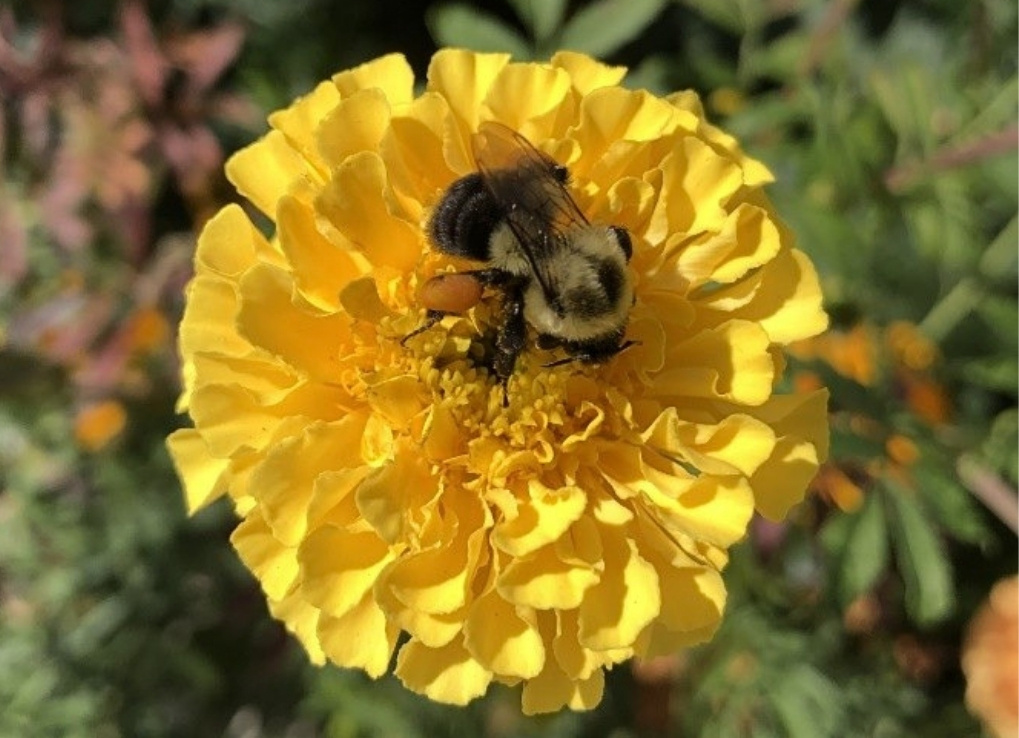
A female bumble bee collecting pollen on a flower with visible pollen baskets (photo by E. Forrester).
Many flower fly species in Canada can be identified by sight in the field with some practice. If you’re interested in learning more about how to identify the flower flies you see, there are many online resources for help identifying species. For the eastern half of Canada, a great resource is the field guide “Field Guide to the Flower Flies of Northeastern North America” by Jeffrey Skevington et al.
Emily has joined the WPC Pollinator Initiative Program as a Bumble Bee Lab Technician. She holds a MSc in Environmental Science from the University of Guelph where she studied native pollinator diversity in Ontario agroecosystems with a focus on bees and flower flies. Prior to this, she attained her BSc in Wildlife Biology and Conservation. Emily has worked previously in pollinator research labs and has experience in entomological teaching, outreach, and pollinator surveying.

We need your help