Take cover! Are salamanders indirectly affected by insecticides used to manage an invasive insect?
Posted onJuly 10, 2026byEmily Doherty and Mathilde Christjansen| Photo: M. Christjansen
What is the Reptile and Amphibian Initiative? No other class of wildlife in Canada faces greater risk of extinction than reptile and amphibians. According to the Committee on the Status of Endangered Wildlife in Canada (COSEWIC), more than 40 amphibian and reptile species are currently threatened or endangered. More than a third of these species need some form of hands-on intervention to survive. Our national reptile and amphibian program develops and promotes best practices for four key conservation techniques: translocation, headstarting, conservation breeding and in-situ interventions. We will maximize the impact of groups across the continent that are working to protect these highly threatened species.
Since being detected in 2017, a silent but deadly foe to hemlock trees has been making its way through the forests of southern Nova Scotia. The hemlock woolly adelgid (Adelges tsugae), also known simply as HWA, is a sap-sucking insect that can cause extensive damage and death to hemlock trees within 5-10 years. In an attempt to slow the spread of the invasive HWA and protect hemlock forests, insecticides are being applied to trees. Now, after a series of treatments have been done, there are questions on whether the insecticides will affect more than just the target species. One group of animals that could potentially be affected are amphibians, and one common species in eastern Canada that may be likely to indicate these effects for salamanders more generally, is the eastern red-backed salamander, Plethodon cinereus. The Riley Integrative Ecology Lab at Mount Allison University is currently working on understanding whether insecticide treatment for HWA has any impacts on these small but abundant amphibians. This project is part of a collaboration that includes the Canadian Forest Service, Acadia University, Environment and Climate Change Canada, and the University of Saskatchewan to understand the ecosystem change caused by an invasive species and chemical control. We are grateful to have such a wonderful team focused on this topic, because understanding the ecological impacts of an invasive species is no small challenge!
We have now begun to collect data on these salamanders. Our field season, which spans spring to fall 2026, started out exciting and fast-paced as we set off to several hemlock forests in southern Nova Scotia. Every trip leads us to beautiful locations, encounters with cool critters, and new challenges. The sites themselves consist of arrays of coverboards, which are small, rectangular hemlock boards, that were placed in each of the forests we are surveying last summer. These coverboards act as cover objects for salamanders, similar to logs or rocks. The forests we work in have either been treated with insecticides or left untreated for HWA. When HWA are present on hemlock, they look very innocuous like tiny cotton balls, but their image does not reflect the large degree of ecological damage they can cause.
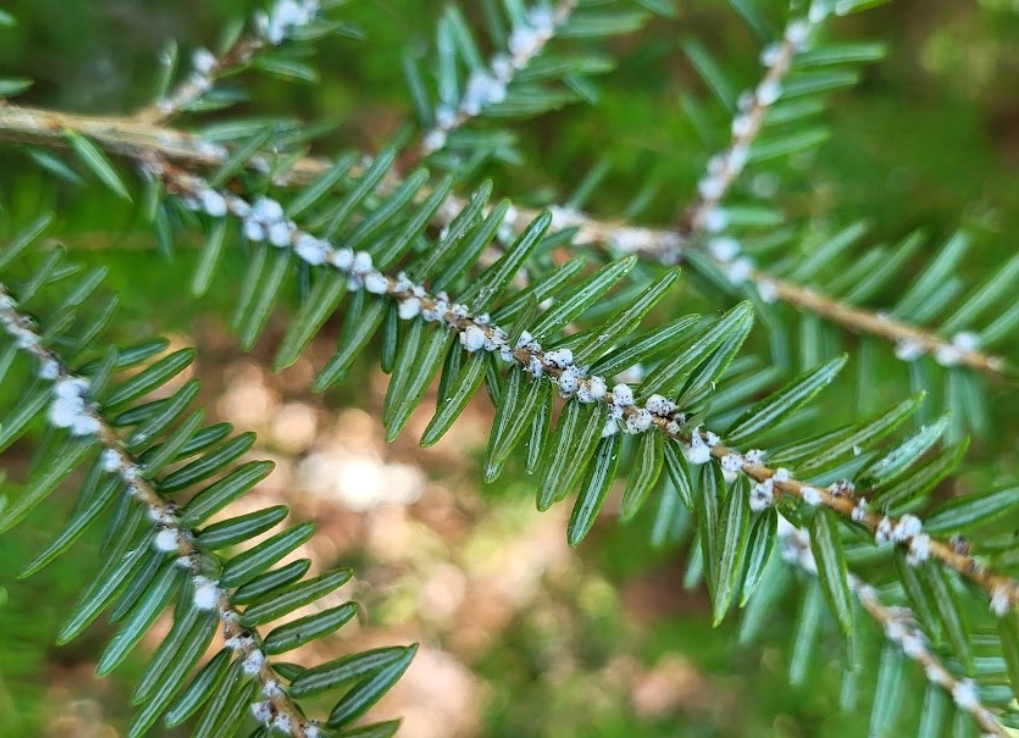
A view of the hemlock woolly adelgid on a branch of the eastern hemlock. Photo taken by M. Christjansen.
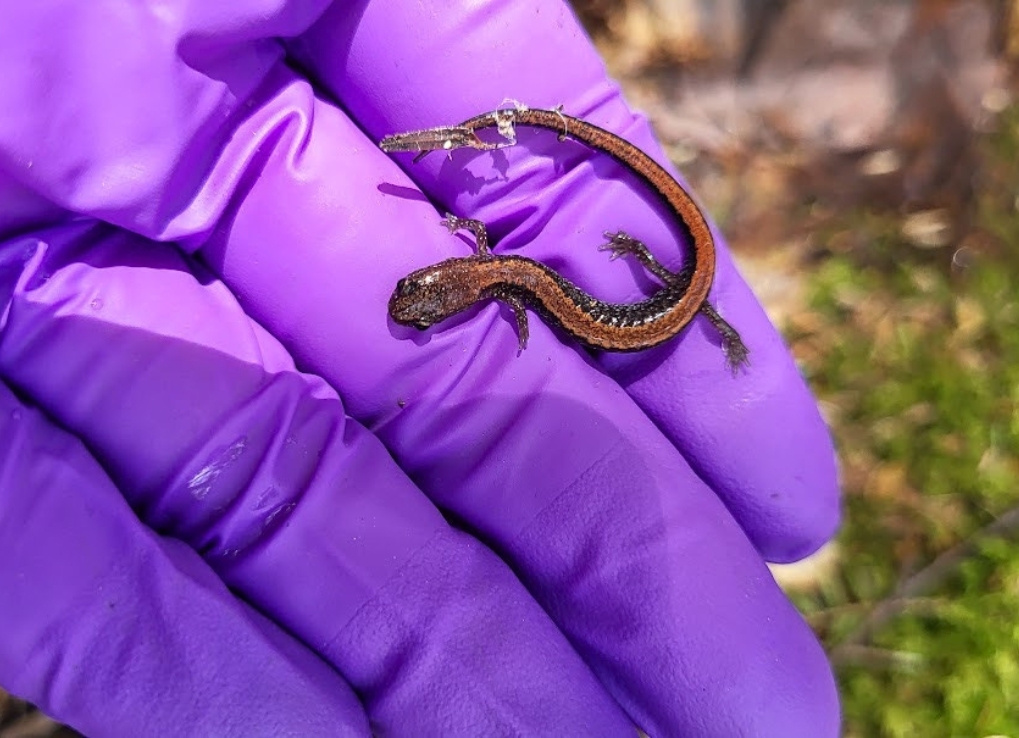
There are two main parts to our field work: coverboard array surveys and behavioural assays. For the coverboard array surveys, we spend our days going to sites and looking under the coverboards, hoping to capture salamanders for our measurements. Some of the measurements we take are size and mass, which can be used to assess salamander body condition. Salamanders are also marked with colored tags, which we inject just under their skin without causing any harm. After tagging, each salamander is returned to its coverboard and hopefully will be found again! The colour tags allow us to track which salamanders we have already captured in previous surveys and possibly help create a population size estimate for the sites.
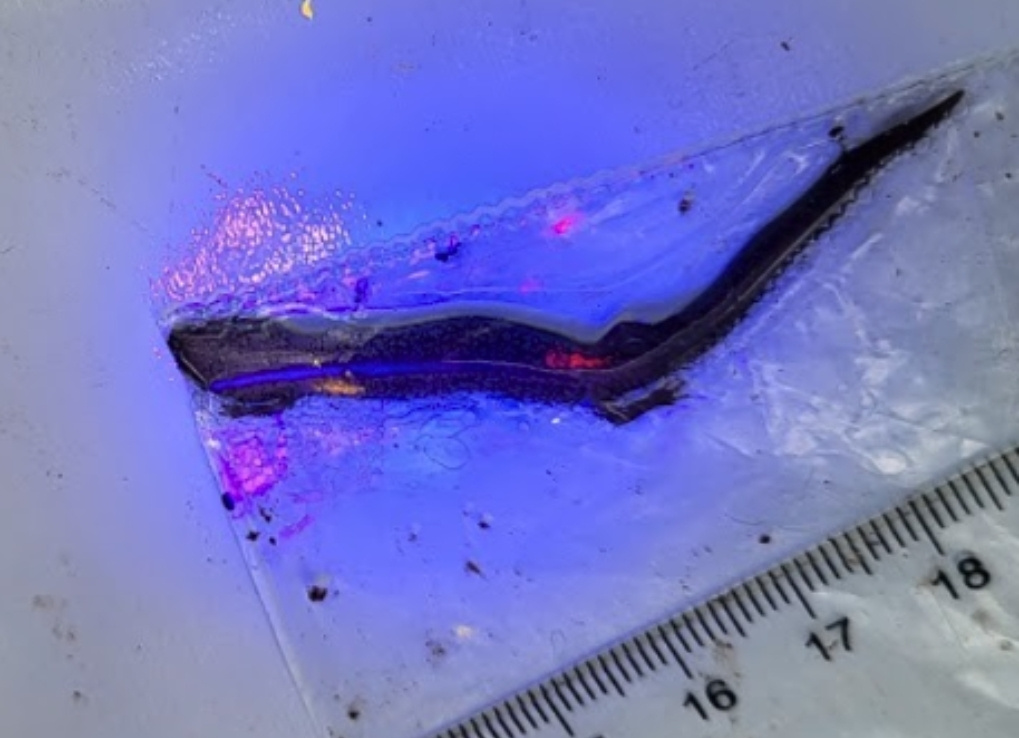
This is an orange and red colour-tagged eastern red-backed salamander. Photo taken by M. Christjansen.
Some of the coverboards are also used for microclimate sampling, as small amphibians, like eastern red-backed salamanders, are sensitive to changes in their environment. Microclimate sampling involves collecting data on the environmental conditions under coverboards, as this will reflect the conditions the salamanders experience and allow us to make comparisons between treatments. This is done by measuring variables like temperature, soil moisture and pH underneath the coverboards. We also measure canopy cover, as HWA severely impacts hemlock needle growth and retention. HWA infestation can impact forest conditions, and so can insecticide treatment, and both could affect salamanders. Taking these additional measurements while assessing the salamanders will hopefully help us tease apart what may be driving any differences in salamander populations between forest treatments.
For the second part of our fieldwork, the behavioural assays, we go back to a smaller subset of the sites to study the behaviour of salamanders between forests treated with insecticide and untreated forests. The assays have three parts: activity, antipredator, and righting response. The insecticides used against HWA can have negative impacts on locomotion and ability to react to predators in animals like fish and aquatic amphibians, but we do not know if the same might be true for the eastern red-backed salamander, which is a fully terrestrial amphibian. During activity assays, the salamanders are placed into an arena with a recording camera overhead and left to move around freely. Afterwards, they go into the antipredator assay, during which the salamanders are lightly poked to elicit an escape response. Lastly, we test their righting response by flipping the salamanders onto their backs repeatedly while monitoring how quickly they can flip themselves back over. Sometimes the salamanders escape during the activity assay, and we are left to wonder how they managed to! An unexpected fact about eastern red-backed salamanders is that they are very good climbers, and can easily climb completely vertical, plastic walls!
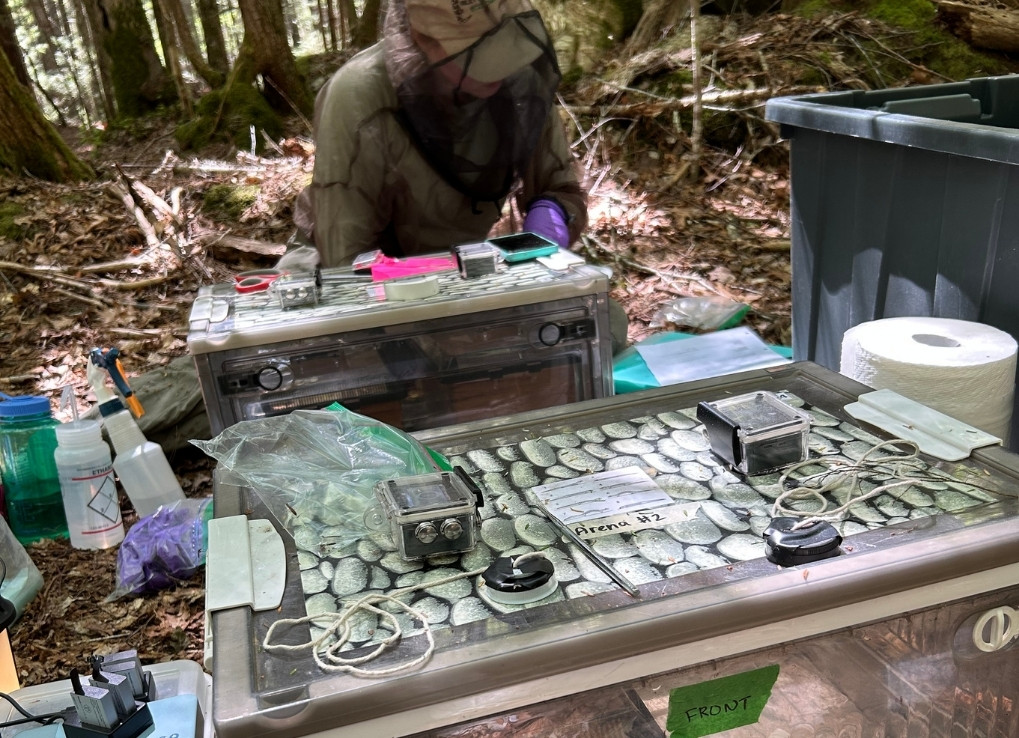
Our behavioural survey setup. Photo taken by E. Doherty.
It is important to understand how management efforts are affecting species beyond the main targets of hemlock and HWA. Our work will help shed light on the non-target effects of HWA chemical/insecticide control and the broader ecosystem impacts of having an invasive insect pest causing damage to Nova Scotia’s forests. So, if you ever find yourself in the HWA territory of southern Nova Scotia, watch your step. There may just be a salamander at your feet, and most certainly heaps of tiny cotton balls ready to hitch a hike on your clothes!
Emily has always loved animals and interacting with nature. She likes to spend her free time bird watching, fishing, going for drives to look for frogs, and grabbing a cup of coffee with her grandfather. Before joining our lab, she spent a lot of time carrying out research in marine ecosystems, often studying lobster! She greatly enjoyed her time on the ocean, but this field season Emily has made the transition back to land. This summer Emily is helping out Mathilde in southern Nova Scotia to study salamanders in Hemlock forests to assess whether these amphibians are impacted by an invasive insect and the pesticides used to manage these important ecosystems.
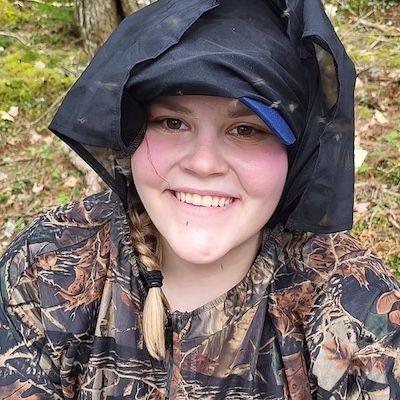
Mathilde grew up curious and with a deep fascination with nature. She always loved biology and enjoyed broad interests in living systems well into undergrad, until she realized that ecology was her calling. She is particularly interested in how changing environments affect animal communities and the ecosystem-level repercussions of those changes. Mathilde is now applying her passion for learning to pursue an MSc studying the indirect effects of pesticides on salamanders in Nova Scotia’s hemlock forests. When not busy with research, Mathilde enjoys decompressing with a yoga flow or escaping reality with a good book.
We need your help