

What is the Eastern Loggerhead Shrike Recovery Program? After a precipitous drop in the wild eastern loggerhead shrike population in the 1990s, Environment Canada invited Wildlife Preservation Canada to lead the multi-partner recovery effort in 2003. Since then, the wild population size has fluctuated. Studies have shown that although the recovery effort has prevented the species from disappearing from Canada, more work is required to identify and address the causes of the species’ decline. WPC works to prevent the eastern loggerhead shrike from disappearing by building the wild population in Ontario, and studying the species to learn more about the threats they face.
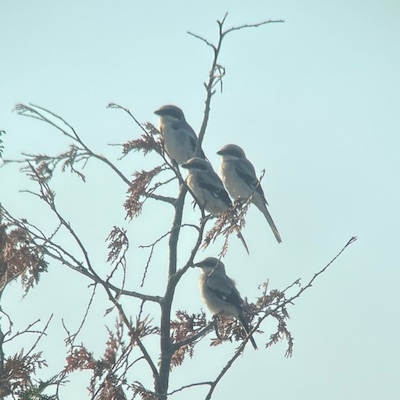
Above: Eastern loggerhead shrike Photo: Kurt Hennige
For most people, the start of May signals that it’s finally time to crack out your sunglasses, get digging in the garden, and celebrate Mother’s Day. But to bird nerds like me, the arrival of May means that one of the most incredible natural phenomena on our planet is well underway: migration.
Migration is the seasonal movement of animals from one place to another, often to find better food sources, nesting spots, and more suitable weather. After all, many of the birds who spend their summers in Ontario are insectivorous, and we all know that insects become hard to come by when there’s snow on the ground.
Although birds aren’t the only animals that undergo migration (some bats, salmon, sea turtles, and dragonflies also do, to name a few), the journey that migrating birds take is nothing short of epic: some tiny songbirds fly two hundred kilometers each night, they use the stars and the earth’s magnetic field to orient themselves, and some birds cross entire oceans without stopping to rest and refuel! After a quiet winter, May marks the peak of this incredible migration back to Ontario, with blackbirds, vultures, swallows, and even some warblers coming back in full force.
And, as a shrike-enthused biologist, migration is extra special to me. Here in Canada, almost all eastern loggerhead shrikes spend their summers in two core areas in Ontario: the Carden Alvar and the Napanee Limestone Plain. But this time of year, when shrikes begin their journeys back to these areas after spending their winter holiday catching grasshoppers somewhere warm, these endangered songbirds can pop up anywhere. They’ve been found in popular birding spots like Point Pelee, Long Point, Rondeau, and Pelee Island, but they’ve also been spotted in bustling Mississauga, on the shore of Lake Huron by Kincardine, even a stone’s throw away from where I live in Guelph!
As you grab your binoculars and head out to your favourite birding spot to delight in the wonder of migration this spring, keep an eye out for a Loggerhead Shrike returning to its breeding grounds. And if you do luck out, please let us know by sending an email to birds@wildlifepreservation.ca! The shrikes at all of the spotMiis mentioned above were found by birders in the community, and all those extra eyes on the ground (and in the trees) help us to better understand and thus better conserve the Loggerhead Shrikes we are lucky enough to have here in Ontario.
Happy birding!
Annika Wilcox
Research Biologist, Eastern Loggherhead Shrike Recovery Program
Annika joined the WPC Loggerhead Shrike team as a Research Biologist in 2025. She has ample experience in environmental outreach, wildlife rehabilitation, and the ecological monitoring of birds, at-risk amphibians, reptiles, and insects. Annika holds a Master’s degree in Integrative Biology from the University of Guelph, where she researched the limiting factors of restored agricultural wetlands as a breeding habitat for birds, with an emphasis on Species at Risk.

Recent articles on the project

We need your help