
[et_pb_divider _builder_version=”4.2.2″ hover_enabled=”0″]
[/et_pb_divider]
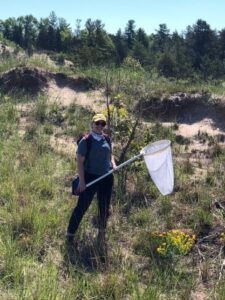
If you’ve been lucky enough to visit one of Ontario’s 45 Provincial Parks you know how special and beautiful these wild places are. One park that Wildlife Preservation Canada’s Native Pollinator Initiative has been fortunate to spend a lot of time at is Pinery Provincial Park, or as the locals like to call it, The Pinery. The Pinery is home to rare oaks, savannah and coastal dune ecosystems, and a provincially significant wetland—the Old Ausable River Channel. An incredible diversity of plants and other wildlife can be found in these habitats, the park stretches along Ontario’s west coast and boasts some of the most beautiful sunsets in the world! While many consider these parks simply as retreats for camping, fishing, or hiking, the provincial park system actually accounts for 8% of Ontario’s landmass and exists primarily to protect natural and cultural heritage features.
Pinery: Past and present
As Canada’s last known location for the Critically Endangered rusty-patched bumble bee (Bombus affinis), The Pinery was an obvious place to launch our first ever pollinator community science program back in 2015. This program has brought together individuals from across Ontario year after year to conduct bumble bee monitoring in the park. Participants have not only delighted in the beauty of The Pinery but have now contributed nearly 2000 species-specific bumble bee observations to Bumble Bee Watch, a collaborative online community effort to track and conserve North America’s bumble bees. While the rusty-patched bumble bee continues to evade the nets and cameras of WPC staff, program volunteers, and surveyors all across its historic Canadian range, volunteer observations at The Pinery have included many other threatened species, like the American bumble bee.
In previous field seasons our teams would have been surveying across Ontario and in fact managing the largest survey effort for threatened bumble bees in the province. However this year, to ensure for the safety and health of our staff, volunteers, and partner communities we decided to focus on one of most important sites we knew of for bumble bees, The Pinery. Not only have we maintained what is now our longest running bumble bee dataset, we were able to safely equip three of our most dedicated volunteers and to conduct independent bumble bee surveys in the park while socially distancing. Our cumulative survey efforts this year resulted in the submission of over 400 species-specific bumble bee observations to Bumble Bee Watch, including records of rare and at-risk species.
What’s coming up at The Pinery in 2021
Our Bumble Bee Watch community science program will always have a home at The Pinery as long as we have dedicated, stalwart volunteers and the programming can be delivered safely. In 2021, in partnership with members of the Ontario Butterfly Species at Risk Team, WPC will be participating in Ontario’s first ever butterfly reintroduction program, and it’s happening at The Pinery! Once common across southern Ontario, the mottled duskywing now lives in only a few small, isolated populations where the oak savannah and tallgrass prairie ecosystems that it calls home have not been eliminated. In recent decades, The Pinery has focused efforts on restoring its native ecosystem, and is now ready to support the reintroduction of mottled duskywing butterflies born in a conservation breeding program recently developed at the Cambridge Butterfly Conservatory, another member of the Ontario Butterfly Species at Risk Team. Our collaborative team of experts is in place to ensure success in the coming years, and WPC’s Native Pollinator Initiative staff are thrilled to have another reason to visit one of our favourite provincial parks.