How to breed an endangered species: Oregon spotted frog
Posted onApril 16, 2026byAlyssa de Wit|Fraser Valley Wetlands, News and Events, Oregon Spotted Frog
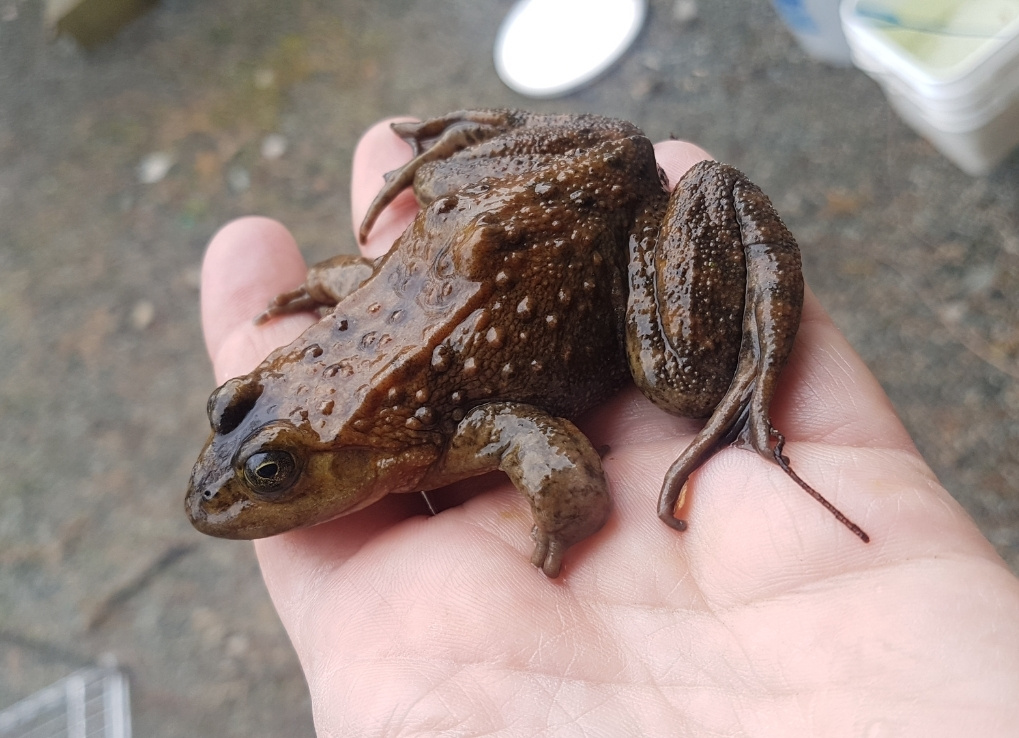
What is the Oregon Spotted Frog Recovery Program? Since 2010, WPC has been breeding the endangered Oregon spotted frog at the Greater Vancouver Zoo, and reintroducing thousands of tadpoles and froglets back into wetlands in B.C.’s Fraser Valley. It takes years of careful observation, collaboration, ingenuity and sometimes a little luck to crack the code to breeding specific species. For several years, our progress was very limited, but our team persevered. Today, WPC has released over 64,000 tadpoles, froglets and eggs back into wild. We are turning the tide for this species.
Wildlife Preservation Canada has been breeding Canada’s most endangered amphibian, the Oregon spotted frog, since 2010. Breeding an endangered species often comes with a steep learning curve. Determining what is most important in the breeding of a species with limited literature and only a small original population is not an easy feat. For species like the Oregon spotted frog, you also only have one chance a year to implement changes thought to improve breeding outcomes. WPC has fine-tuned these practices, proving fruitful in 2021, when output increased to ~25,000 tadpoles from ~1,500!
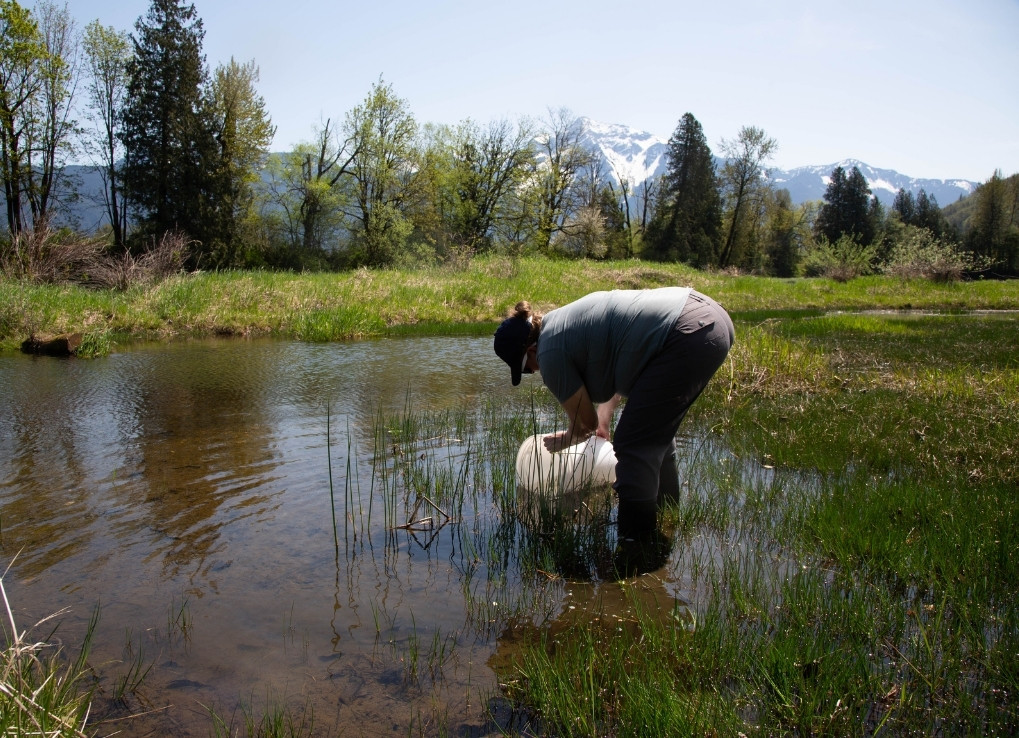
Andrea Gielens, Lead Biologist for our B.C. Projects, releases a tub of tadpoles into the wetlands of our release site. Photo by J.Banta.
One important practice WPC has implemented is allowing frogs to experience natural seasonal changes. The Oregon spotted frog’s natural range in Canada is southwestern BC, such as the Fraser Valley, and extends into western Washington and northeastern California. The Fraser Valley doesn’t have drastic seasonal fluctuations like other parts of Canada; however, these small changes in weather, including temperature, light cycles, water levels, and the frog’s natural dispersal, are important factors that encourage frog breeding. But what does Oregon spotted frog breeding even look like, and what has WPC done to mimic the natural environment? Well, let’s get into it!
The Oregon spotted frog is a non-territorial and communal egg layer. The males arrive first at the breeding sites in early spring, after the ice melts, and begin calling to the females, a sound incredibly close to “knocking”. The females enticed by the calls arrive and are immediately dog-piled by the males in what’s called amplexus. Males will grab onto and not let go of the female in the hopes of being the lucky winner to externally fertilize the eggs when the female begins to lay.
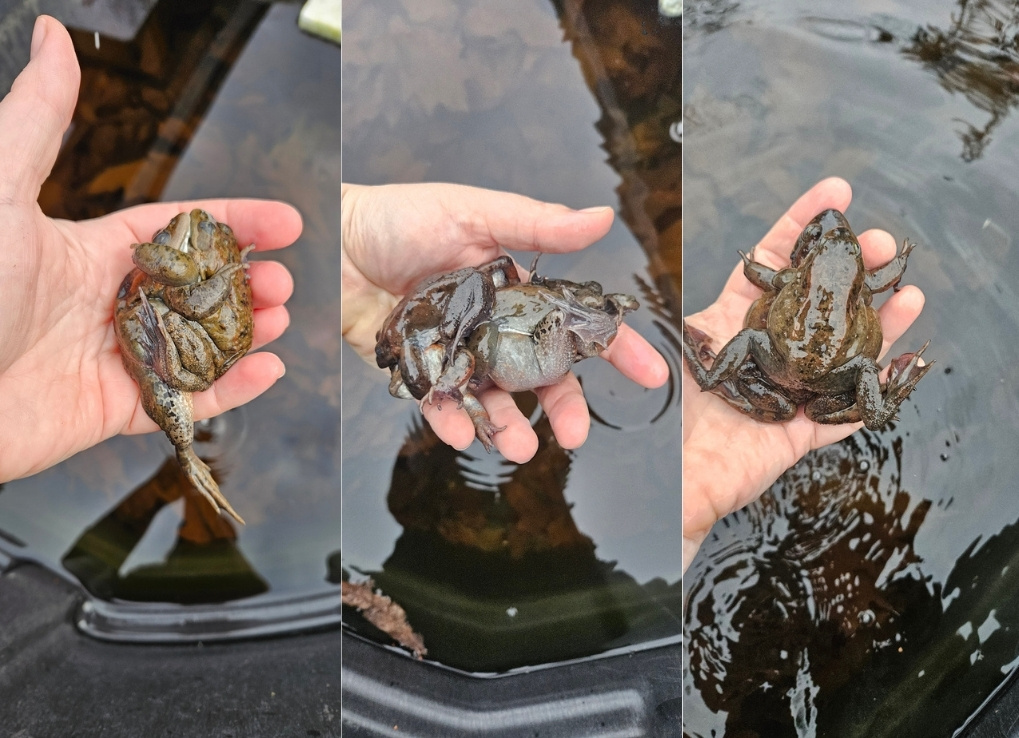
Three examples of frogs in amplexus in our conservation breeding program. They will grab onto the females any way they can! Photos by A.Gielens.
A female can lay between 300 and 800 eggs in shallow water, often connected to moss and other debris for stability. Other females will lay their eggs beside or on top of each other’s masses as well!. Frogs do not participate in parental care; females will leave the breeding site first for a solitary life until next season, while the males will stick around for a few more weeks in the hopes of finding delayed females to mate with.
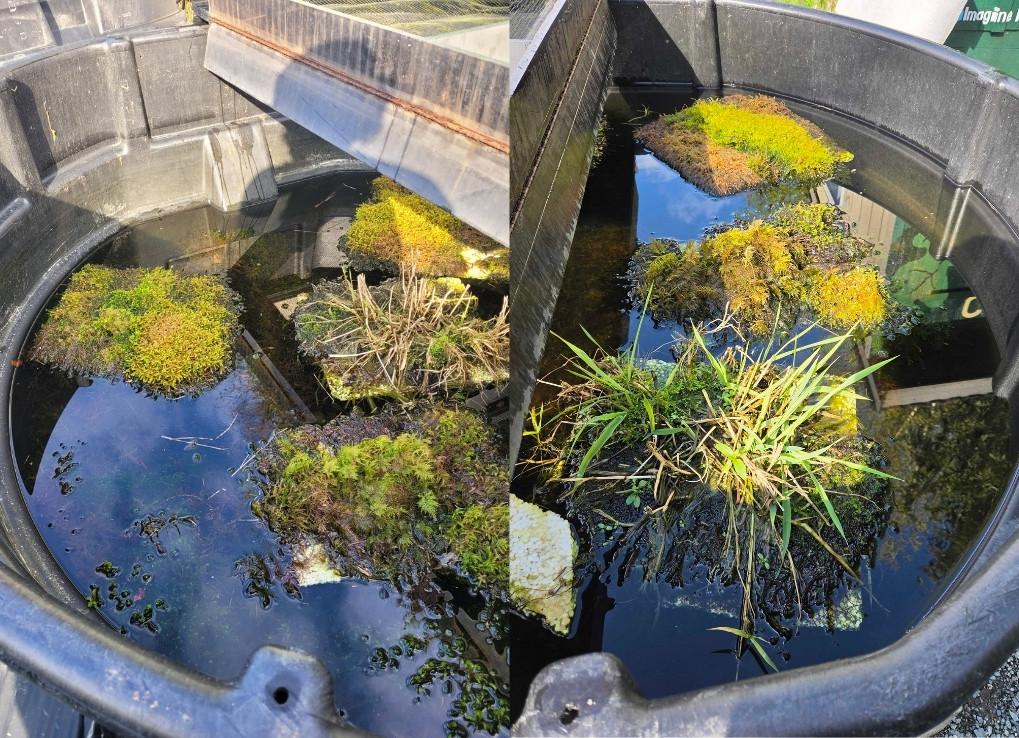
(Left) Shallow water level in one of our Love Tubs. You can see the moss poking through the waters surface. (Right) Higher water level in one of our Love Tubs. This is what the tubs look like for most of the year. Photos by A. de Wit.
WPC houses the Oregon spotted frogs in Conservation Corner at the Greater Vancouver Zoo. The tubs where the frogs reside are kept outside and experience the natural seasonal changes in weather, light levels, and temperature throughout the year. Floating platforms are covered in moss and grasses, allowing frogs to come to the surface to bask, while extra moss floats freely in the water, simulating a natural wetland. Water levels are kept high throughout the year, except during the breeding season, when they are lowered to the point where the moss touches the bottom of the tub, replicating the shallow edges of the wetland and providing a substrate for females to attach their egg masses. Males and females are kept separate during the winter when they naturally brumate and are combined in the early spring for breeding. Once eggs are laid, the frogs are separated again.
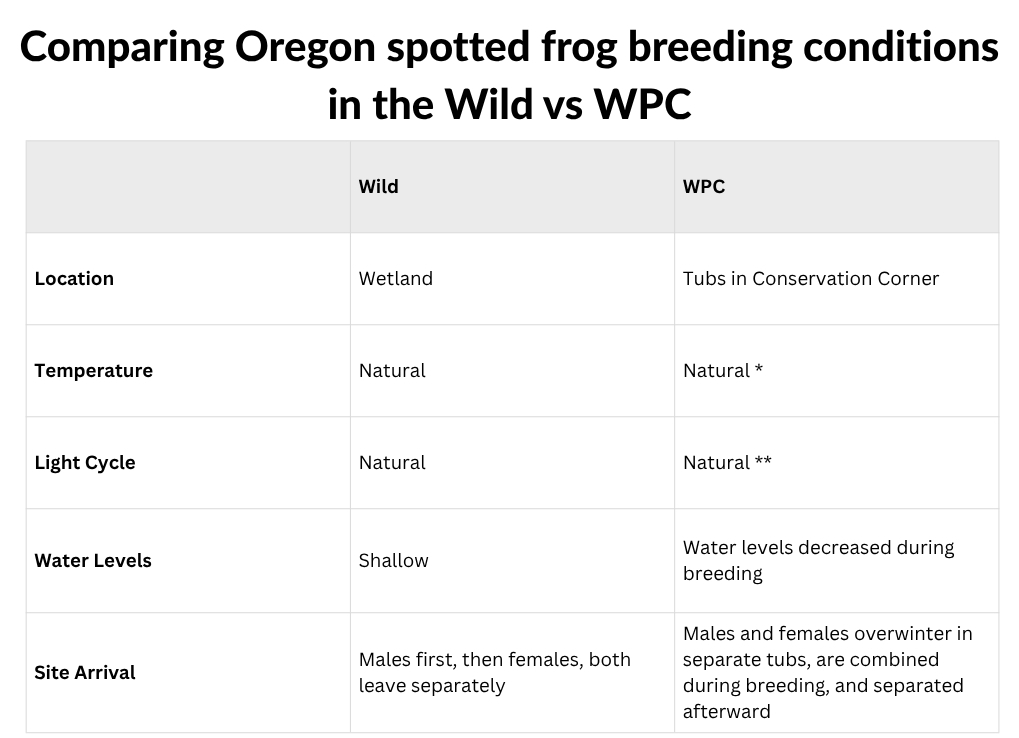
*During winter, heaters are put on if the temperature falls below freezing for extended periods.
** Tubs are covered with mesh lids, allowing light to get through but keeping predators out.
Now that we know a little more about the inner workings of Oregon spotted frog breeding, the next question is, why do the frogs breed in such conditions? For the frogs to lay their eggs communally at the edges of wetlands creates a high risk of desiccation, freezing, and predation. Though we do not have all the answers, one reason seems to be the importance of temperature in the development of egg masses. The Oregon spotted frog chooses the high-risk, high-reward approach!
A special thank you to Jack S. Darville for his continued support through the Darville Frog Conservation Endowment Fund.
Alyssa was a western painted turtle nest monitor in 2025 and is excited to expand her knowledge and experience with the Oregon spotted frog and Taylor’s checkerspot butterfly as a conservation programs assistant. Alyssa has a BSc from UFV and has worked predominantly in endangered species breeding, monitoring, and education. She worked for 5+ years in spotted owl recovery and, in 2024, in grassland bird conservation in Ontario. In 2023, Alyssa road-tripped through New Zealand and volunteered at a rehabilitation centre in Australia for kangaroos, wallabies, wombats, and more.

We need your help