Join the buzz: new bumble bee monitoring community science program at MacGregor Point Provincial Park!
Posted onApril 20, 2026byAnnika Wilcox|Bumble Bees, Native Pollinator Initiative, News and EventsPhoto: A. Wilcox.
What is the Bumble Bee Recovery Program? Since the 1990s, bumble bee numbers have been plummeting and that spells ecological disaster. Here at Wildlife Preservation Canada, we work to save at risk species of bumble bee from disappearing by monitoring them in the wild, breeding them for release at our conservation lab in Ontario, and studying their poop for parasites! We even host special community science events across the province to track population sizes, locate declining populations and provide hands-on training programs with the goal of expanding our efforts across Canada. We are the only organization in the country working to rebuild at risk bumble bee populations through conservation breeding.
Exciting news for pollinator lovers! A new bumble bee monitoring program is buzzing its way to MacGregor Point Provincial Park, and volunteers are invited to take part. Whether you’re a seasoned naturalist or simply enjoy spending time outdoors, this is a great opportunity to contribute to real conservation efforts while learning more about the fascinating world of bumble bees.
Bumble bees are essential pollinators, but many species are facing steep declines. Monitoring their populations across large landscapes can be challenging, and that’s where community scientists make a huge difference. By conducting bee surveys and sharing their observations through Bumble Bee Watch (an incredible community science platform), volunteers help researchers better understand where species occur, how populations change over time, and which species may need some extra help (learn about WPC’s Conservation Breeding Lab here!).
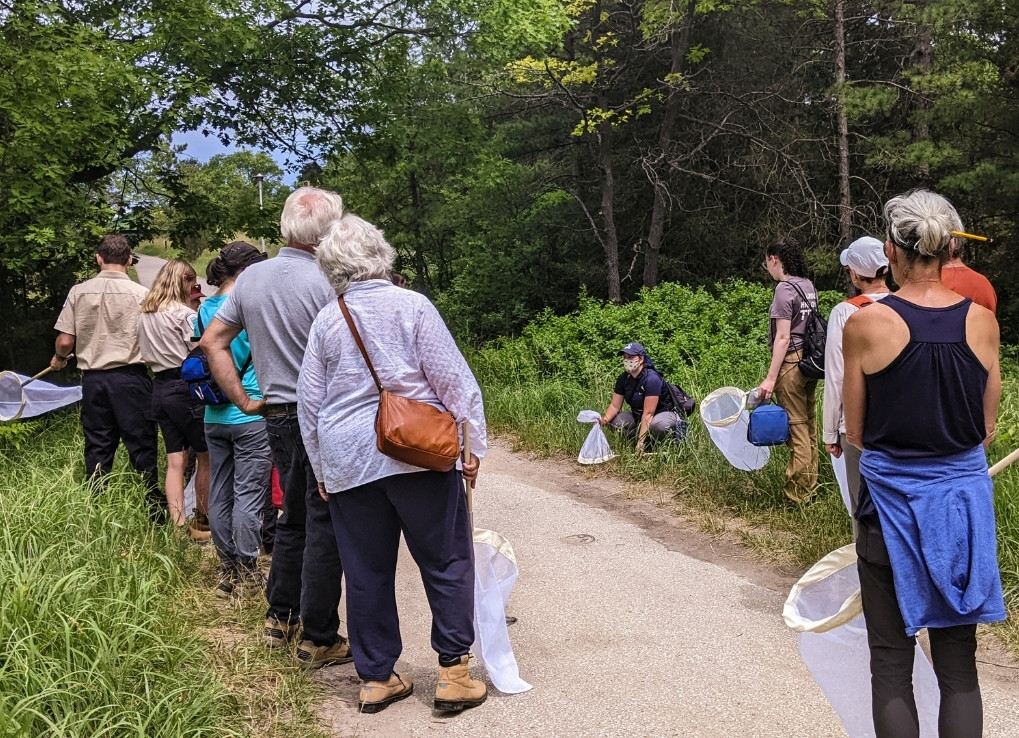
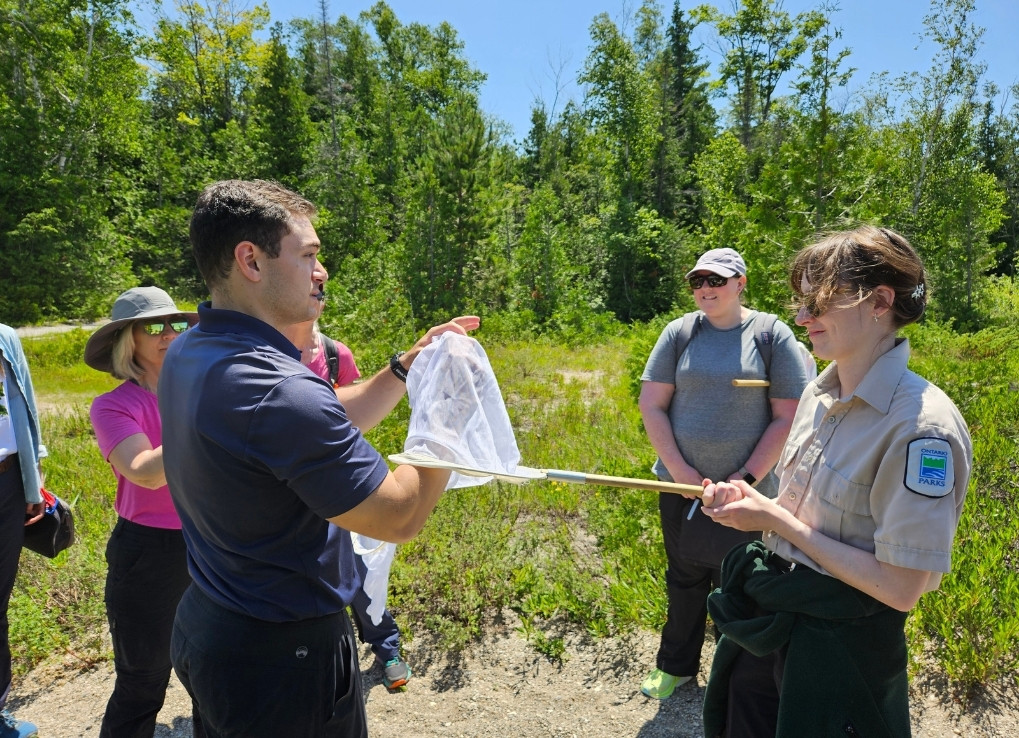
Tiffani, a WPC staff member, demonstrates to a large group at Pinery how to catch a bumble bee on a survey. Photo by S. Knoerr.
The impact of WPC-led bumble bee community science programs has already been remarkable; at Pinery Provincial Park, volunteers have been surveying the local bumble bee community for a decade. In 2025, participants attended training workshops, joined in on bee walks, and returned throughout the season to conduct surveys across the park. Their efforts alone resulted in more than 400 bumble bee observations across 7 species, providing valuable insight into how bumble bee populations fluctuate from year to year. Just as importantly, enthusiastic participants got hands-on experience with pollinator conservation and got to enjoy these charismatic pollinators in a beautiful provincial park.
Both Pinery and MacGregor Point Provincial Park also fall within the historic range of the endangered rusty-patched bumble bee. Pinery holds special significance as the last place this species was recorded in Ontario. While it hasn’t been observed in recent years, there is always hope that remnant populations may still persist. Volunteers in our community science programs help us keep watch across these remaining special, suitable habitats, and could even play a role in the exciting possibility of rediscovering this iconic species in our province!
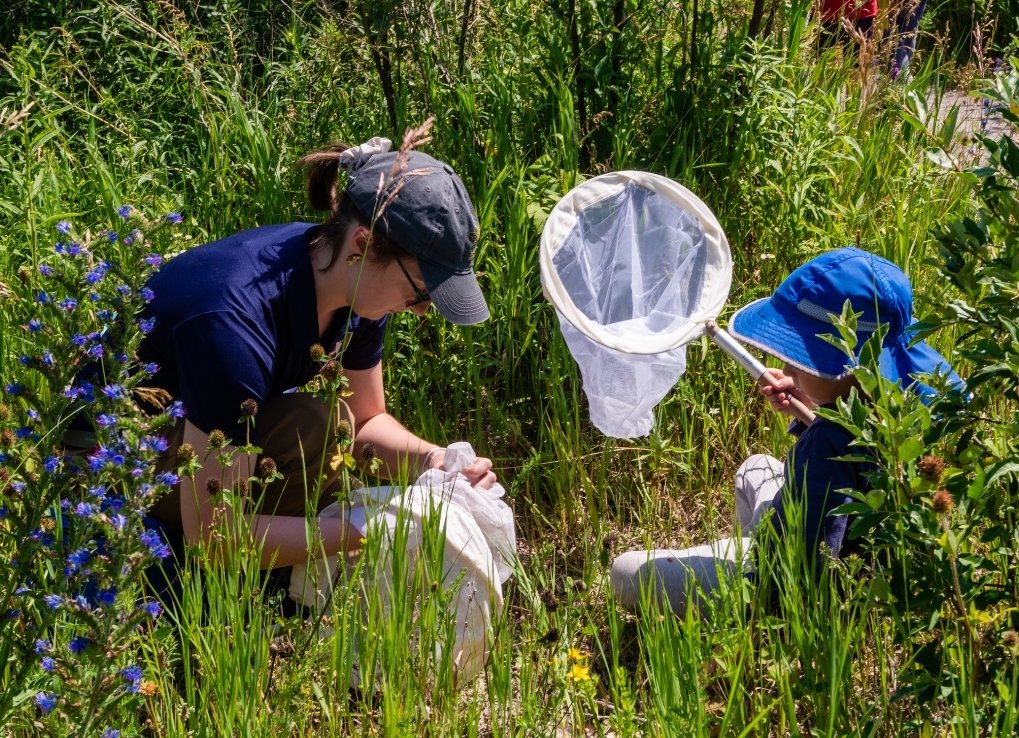
Sarah, a WPC staff member, is at Claremont during a bumble bee workshop – showing a young participant how to catch bumble bees and place them in vials. Photo by S. Knoerr.
Our other bumble bee monitoring programs have seen similar success. Community scientists at Rouge National Urban Park and the Claremont Nature Centre submitted over a thousand observations in 2025, and documented an impressive array of species. Among these were rare and at-risk bumble bees (including yellow-banded and American bumble bees, both of which are federally designated as Species of Special Concern), highlighting how volunteer-driven monitoring can uncover exciting discoveries.
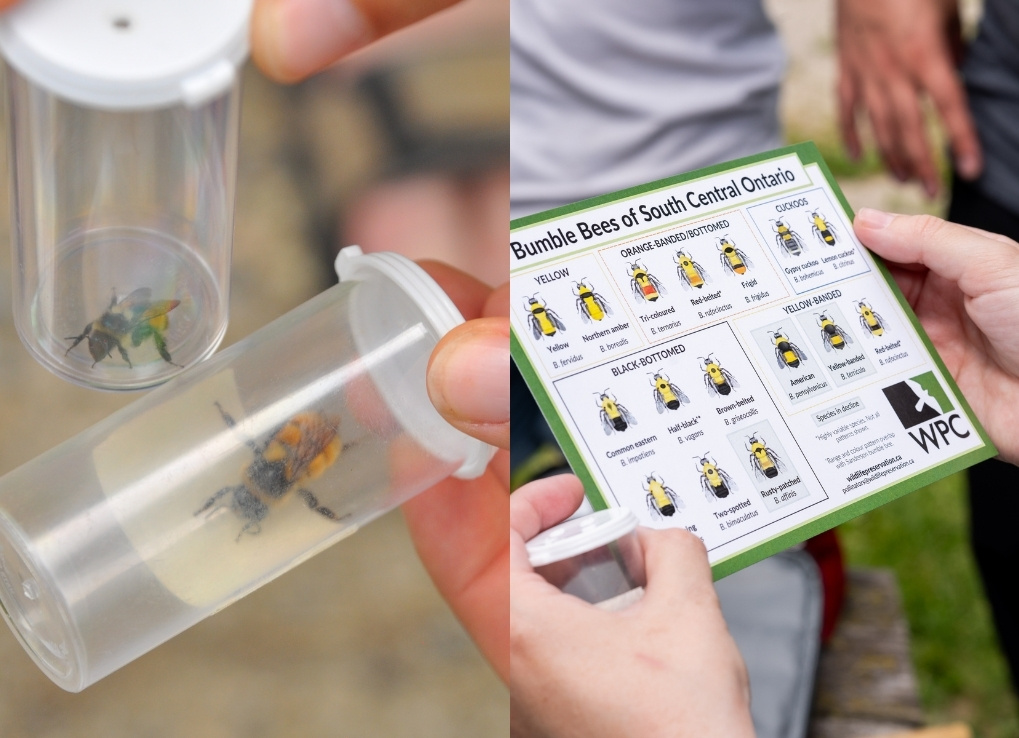
(Left) Some bumble bees caught in vials during a survey. Photo by J. Millen. (Right) A WPC South Central Bumble Bee ID card. Photo by A. Bowman.
Since 2015, community scientists have collectively contributed thousands of observations, representing a substantial portion of Ontario’s verified bumble bee records on Bumble Bee Watch. These contributions help WPC staff, as well as other researchers and conservation organizations, better understand population trends and species distribution, and guide efforts to protect Species at Risk. Every photo submitted and every survey completed adds another piece to the puzzle.
Now, MacGregor Point Provincial Park is ready to join in on the fun. This new program will build on the success of existing community science efforts, offering training in bumble bee identification, survey techniques, and how to submit observations to Bumble Bee Watch. Once they’re all trained up, participants will head out on independent surveys, exploring the park while searching for our favourite pollinators along the way.
Interested in taking part? Sign up for our training workshops here to get started!
Pinery Bumble Bee Monitoring Training Workshop:
https://www.signupready.com/go/Iom9qSj7X-
MacGregor Point Bumble Bee Monitoring Training Workshop:
https://www.signupready.com/go/9JORol2xbN
Too far from the parks to contribute? No problem! Learn all about how to support bumble bee conservation from your own backyard by contributing to Bumble Bee Watch here!
Annika joined the WPC Loggerhead Shrike team as a Research Biologist in 2025 before moving to the Native Pollinator Initiative as Ontario Programs Coordinator. She has ample experience in environmental outreach, wildlife rehabilitation, and the ecological monitoring of birds, at-risk amphibians, reptiles, and insects. Annika holds a Master’s degree in Integrative Biology from the University of Guelph, where she researched the limiting factors of restored agricultural wetlands as a breeding habitat for birds, with an emphasis on Species at Risk.

We need your help