
Conservation breeding to save one of the world’s most endangered groups of animals
Posted onSeptember 11, 2026byStephanie Winton
What is Conservation Planning? Long-term conservation of endangered species continues to face new and emerging challenges, such as novel diseases and the impacts of climate change. In today’s world, the view that all species can be effectively conserved with minimal management simply by creating large areas of protected habitat is unrealistic. There is an increasing need for active management and long-term human intervention, guided by strategic plans that are tailored to the conservation needs of species. This is where CPSG Canada comes in!
CPSG Canada is a Regional Resource Center of the Conservation Planning Specialist Group (CPSG), part of the Species Survival Commission of the International Union for Conservation of Nature. To enhance national conservation efforts and save species, CPSG Canada employs CPSG’s globally recognized planning tools and processes, provides technical and facilitation support for planning workshops, and builds capacity for conservation planning in Canada. CPSG Canada is hosted by Wildlife Preservation Canada (WPC) and supported by members at African Lion Safari and Wilder Institute/Calgary Zoo.
Here at WPC, we think frogs are pretty cool. For many of us, catching tadpoles at a local pond is how we first encountered the animal world. Not only do frogs introduce us to the fascinating world of wildlife around us, like other amphibians they play important roles in maintaining stable ecosystems. They are part of the neighbourhood pest control team (eating everyone’s least favourite insect: mosquitoes) and being eaten in turn as an important link in the food web. As species that live in both aquatic and terrestrial environments they also help cycle nutrients and are important indicator species for ecosystem health. It is therefore no surprise that they are of cultural significance all around the world.
Unfortunately, frogs world-wide are in crisis. In fact, amphibians are the most threatened group of vertebrates in the world. Since the 1980s, frogs and other amphibians have been suffering rapid declines, and in some cases even extinction due to habitat loss, invasive species, climate change, and disease. Notably, amphibians are being wiped out by a global pandemic caused by the chytrid fungus which has caused 80% of all recent extinctions.
Ex situ management (or holding animals safely in captivity) is vital to the survival and recovery of many of these imperiled species. Captive populations provide a safeguard against extinction and conservation breeding provides options for future population restoration efforts. The Conservation Planning Specialist Group has developed guidelines and a workshop process to assess if ex situ management is a feasible option to include in a species recovery plan. Fortunately for amphibians, they often require less space and resources and therefore cost less than other groups like birds and mammals. However, conservation breeding and release programs require collaboration between many partners, working both in the species’ wild habitat and with captive animals, and require many years of intensive effort and resources to ensure success. Despite these challenges, these methods are being used to restore frog populations, hopefully for other kids playing in ponds to experience.
Learn more about how teams in Canada, Jersey, California, Colombia, and Chile, are using conservation breeding and release to restore populations of threatened frogs in their own backyards.

An adult Oregon spotted frog. Photo by S. Winton.
Species: Oregon spotted frog, Rana pretiosa
Status: Endangered (Canada), Vulnerable (Global)
Range: British Columbia, Oregon, Washington
Conservation situation: The Oregon spotted frog is Canada’s most endangered amphibian. Only a few hundred breeding individuals are believed to remain in a few small, widely scattered populations in B.C.’s Lower Fraser Valley. The frog’s habitat is threatened by development, agricultural land conversion, resource extraction and hydrological alterations.
Conservation actions: Since 2010, WPC has been breeding and reintroducing thousands of Oregon spotted tadpoles and froglets back into wetlands in the Fraser Valley. Young are being used both to increase the size of existing wild populations and to establish new ones at appropriate sites where the species had been lost. An ongoing mark-recapture program and extensive egg mass monitoring by our recovery partners shows the positive impacts of releasing Oregon spotted frogs to historic populations, with long term data reflecting that our releases have helped stabilize these populations. WPC’s pioneering breeding techniques are turning the tide for this species.
Fun fact: The Oregon spotted frog was recently featured on a Canadian stamp along with another threatened amphibian species found in eastern Canada, the Fowler’s toad.

The agile frog tadpole tanks at the Jersey Zoo. Photo by S. Winton.
Species: Agile frog, Rana dalmatina
Status: Critically endangered (Jersey, UK), Least Concern (Global)
Range: Europe (excluding Portugal and the rest of the British Isles) and northern Turkey
Conservation situation: The agile frog is found throughout Europe, but Jersey is the only place the species occurs in the British Isles. Land-use changes due to agricultural intensification and predation of both eggs and frogs by non-native species caused the population to decline in the 1980s. Tragically, a pesticide spill in 1987 reduced the population to only one remaining breeding pond on the whole island!
Conservation actions: Durrell Wildlife Conservation Trust has been raising agile frogs and releasing them back to the wild for over 20 years. Guided by a species action plan, government partners work to restore and protect suitable habitat, including creating new ponds, while Durrell head-starts eggs and tadpoles in a biosecure container at the Jersey Zoo until just before metamorphosis. Over 80,000 tadpoles have been released to the wild and the range and number of breeding ponds occupied by agile frogs has increased.
Fun fact: The agile frogs in Jersey are genetically distinct from their European counterparts and are one of only three amphibians native to the island.

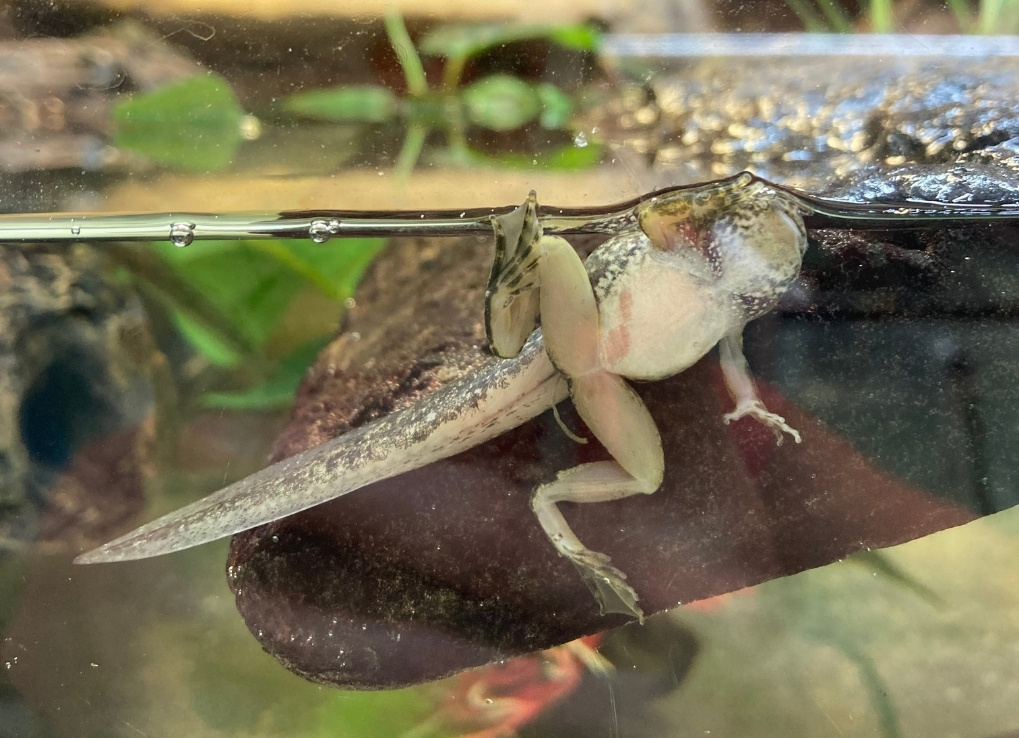
A southern mountain yellow-legged frog floats in a tank. Photo by S. Winton.
Species: Southern mountain yellow-legged frog, Rana muscosa
Status: Endangered (USA/Global)
Range: California
Conservation situation: Habitat destruction, disease, introduced predators, pollution, agriculture, and wildfires and drought driven by climate change have severely impacted the southern mountain yellow-legged frog in its native California. Amid ongoing threats, the future is uncertain for the remaining small, fragmented wild population.
Conservation actions: As experts in reproduction, the San Diego Zoo Wildlife Alliance is breeding frogs as part of a collaborative conservation breeding and reintroduction research program. To facilitate reproduction, the captive environment is designed to mimic seasonal cycles in temperature and light and assisted reproductive technologies are used to improve reproductive success and allow for genetic exchange between populations to reduce inbreeding. Sperm samples are also biobanked to preserve genetic diversity. A recent IUCN Green Status Assessment for the species indicated that while the wild population is largely depleted, without conservation measures, like ex situ breeding and reintroduction, the species is expected to have disappeared.
Fun fact: Trained sniffer dogs (aka ‘frog’ dogs) are used to help detect these silent, cryptic frogs during post-reintroduction monitoring.

A Lehmann’s poison frog in an enclosure. Photo by S. Winton.
Species: Lehmann’s poison frog, Oophaga lehmanni
Status: Critically endangered (Global)
Range: Colombia
Conservation situation: This vibrantly coloured frog is endemic to the rainforests of Colombia, where it is threatened by habitat destruction and illegal trafficking. In 2018, hundreds of frogs were confiscated at the Bogotá airport. As a priority species for conservation action, several dozen Lehmann’s poison frogs were transferred to the Cali Zoo to establish a conservation breeding program.
Conservation actions: The Cali Zoo has developed a state-of-the-art breeding facility and protocols to accommodate the unique reproductive needs of this species. Particular attention is given to the care and welfare of the animals, such as using nebulizers to maintain appropriate humidity levels in each breeding pair’s terrarium. The zoo has successfully bred frogs which have been released back to the wild using soft-release methods. The program works with local communities to protect habitat, implement alternative economic activities, and monitor the reintroduced frogs. These initiatives have not only reduced illegal take, but also generated a sense of responsibility and participation in conserving this frog and its forest by the community.
Fun fact: After the eggs hatch, female Lehmann’s poison frogs carry the tadpoles on their backs from the forest floor up to bromeliads in the canopy. The tadpoles develop in the water that collects inside the bromeliads and eat unfertilized eggs from their mother – talk about parental care!

A Loa water frog display sign at Zoológico Nacional de Chile. Photo by S. Winton.
Species: Loa water frog, Telmatobius dankoi
Status: Critically endangered (Global)
Range: Northern Chile
Conservation situation: The Loa water frog is a microendemic, found in only one location in the world: an oasis in the Atacama desert of Chile, making it susceptible to local habitat changes. Illegal water extraction for mining, agriculture, and urban development dried up the frog’s habitat, reducing the population to only 14 frogs left in the wild.
Conservation actions: In 2019, the last known wild individuals were relocated to the National Zoo of Chile in an emergency rescue operation, establishing what is known as an ark population. This was a risky undertaking as the species had never before been cared for in captivity and the frogs were in very poor condition, but without intervention they may have been lost forever. Despite the odds, 500 tadpoles have hatched at the zoo and 10 frogs have been transferred to a new conservation centre near their native habitat in the Atacama to expand the breeding program and promote environmental education. This is a promising first step at being able to return frogs to the wild, but work is needed to address threats, protect and restore habitat, and develop a reintroduction plan to ensure success.
Fun fact: The Loa water frog is in the same family as the famous Lake Titicaca water frog, and is adapted to extreme environmental conditions, living at elevations up to 2,300 m above sea level in the driest desert in the world. #SaveTheLoaFrog #SalvemosLasRanitasDelLoa

A western chorus frog about to call. Photo by A. Hoffman.
Species: Western chorus frog, Pseudacris triseriata
Status: Threatened (Canada), Least Concern (Global)
Range: Quebec, Ontario, Northeastern United States
Conservation situation: Western chorus frogs face threats from habitat loss, degradation, and fragmentation throughout the Great Lakes/St. Lawrence – Canadian Shield region of Ontario and Quebec. Populations in Quebec have experienced severe declines and many populations have disappeared completely in recent decades due to urban and agricultural development.
Conservation actions: The Quebec Chorus Frog Recovery Team is using ex situ and translocation methods to restore populations in Quebec. Conservation partners collect adult frogs in the spring, hold them short-term through breeding and egg-laying, then release them back to the wild. The eggs are headstarted until after metamorphosis and then released at existing or newly constructed ponds within the species range. Post-release monitoring provides evidence that frogs are dispersing to nearby ponds, hibernating, and breeding in the wild after translocations. However, the long-term sustainability of the populations without translocations is precarious and conservation breeding is not without challenges so protecting habitat and populations, while identifying and mitigating threats is crucial.
Fun fact: Western chorus frogs can survive freezing temperatures in winter by increasing their blood-glucose levels, acting as an antifreeze for their cells.
Sources:
Stephanie was Wildlife Preservation Canada’s 31st Canada’s New Noah in 2022 and has returned to WPC to apply her experience in integrated in situ and ex situ conservation management approaches and facilitation of species conservation planning workshops to build capacity and enhance conservation planning for species at risk in Canada. Stephanie holds an MSc from Thompson Rivers University where she researched the impacts of road mortality on western rattlesnake populations in BC and has over ten years of experience in conservation and research with a diversity of threatened species in Canada and globally, including burrowing owls, tiger salamanders, northern leopard frogs, black-tailed prairie dogs, and Mauritian reptiles.

We need your help


