Talk birdy to me
Posted onJuly 22, 2026byJenna Kissel|Canada's New Noahs, News and Events, Overseas Species
What is the Canada’s New Noah Program? Since 1988, the Canada’s New Noah program has provided conservation biologists in Canada the opportunity of a lifetime. Each year, WPC selects a dedicated biologist from applicants across Canada to undertake a 3-month course at the Durrell Conservation Academy in the U.K. followed by a 6-month internship on the island of Mauritius in the Indian Ocean. This is an opportunity unlike any other for young Canadians to learn firsthand how the world’s most successful conservation recovery programs are managed and to bring this knowledge and experience back to improve Canada’s conservation capacity.
For the first time ever, WPC is offering this placement to two biologists. Our 2026 New Noahs are Jenna Kissel – WPC’s 35th Canada’s New Noah, and Daryn Farrant – WPC’s 36th Canada’s New Noah. Both report on their experiences and how they will apply them upon return to Canada. Thank you to the Alan & Patricia Koval Foundation for their many years supporting the Canada’s New Noah Program and for going above and beyond supporting two Koval Foundation New Noah Internships in 2026.
As someone who is always eager to learn, I was excited to be back in a classroom setting to learn everything the DESMAN course had to offer. But, as important as understanding theory is, it can only get you so far. Practical application of conservation skills, whether that be setting up camera traps or writing out budgets, gives students that extra piece to be a successful conservationist. The most significant practical experience, and highlight of my time at Durrell, was the skills development task. Surprising no one, I requested to complete my skills development with the bird department at the Jersey Zoo.
My background is almost exclusively with raptor husbandry and breeding, so getting an inside look at how other groups of birds, such as waterfowl, hornbills, and songbirds, are cared for in a captive setting was an amazing learning experience. Over the course of a few days I spent time shadowing the bird keepers on their daily routines. I started the morning in the food prep kitchen, helping to chop eggs and fruit. Almost all the birds at the Jersey Zoo are herbivores, so it was a lot of fruit, veg, and seed mix, quite different from the rodents and other small prey items I’m used to preparing. Once the food was prepped, I shadowed one of the softbill keepers on their morning routine, servicing the aviaries of wrinkled hornbills, Javan green magpies, pink pigeons, blue-crowned laughing thrushes, and more.
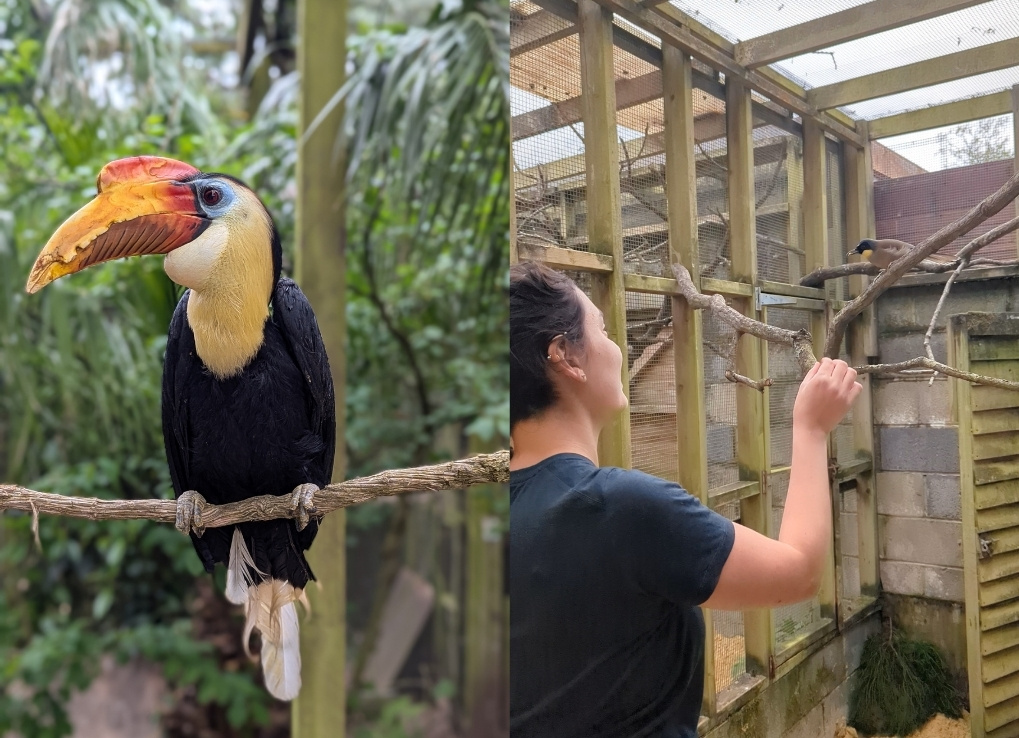
Homer, a male wrinkled hornbill (left) and Jenna feeding Baby Blue, a blue-crowned laughing thrush, mealworms (right). Baby Blue is named for her baby blue coloured leg band. Photos by J. Kissel and S. Atherton.
I quickly fell in love with several of the birds at the zoo, including Homer, a wrinkled hornbill, and Baby Blue, a blue-crowned laughing thrush. A few of my favourite moments during my skills development were feeding Homer grapes and Baby Blue mealworms. I also immediately loved the colony of northern bald ibis. They have so much character and are often underappreciated just because they aren’t the cutest (I disagree, they are adorable). I didn’t spend a lot of time with them but got to feed them some mealworms at the end of one of my skills development days.
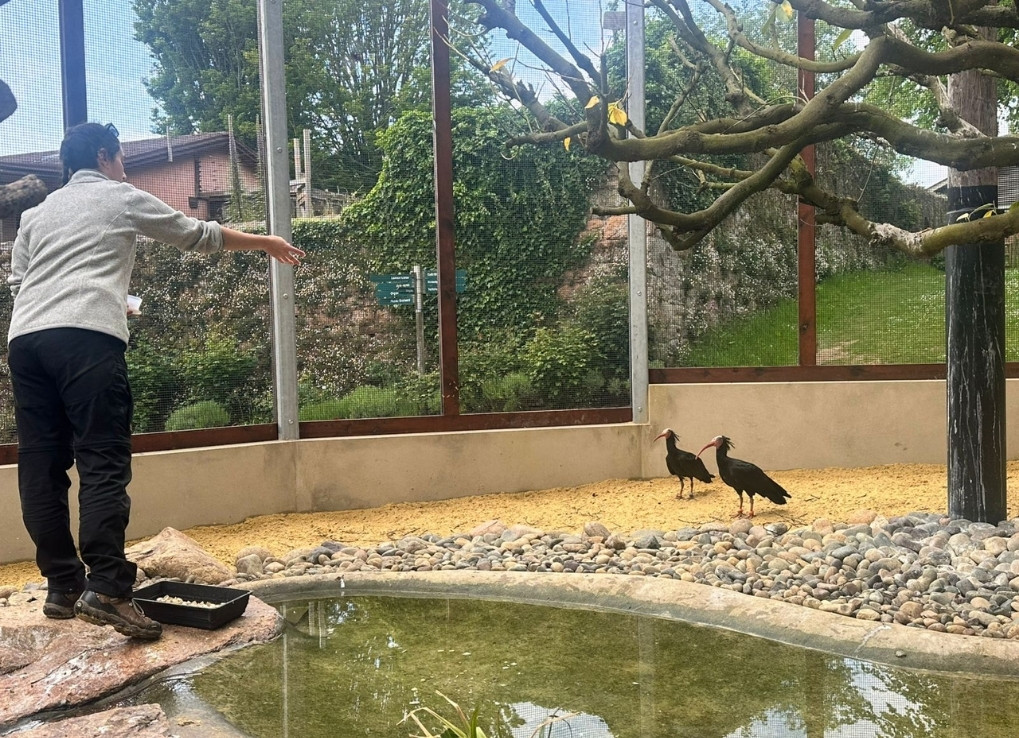
Jenna scattering mealworms for the northern bald ibis. Photo by Abbie.
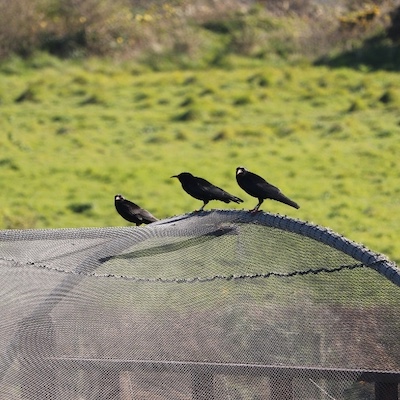
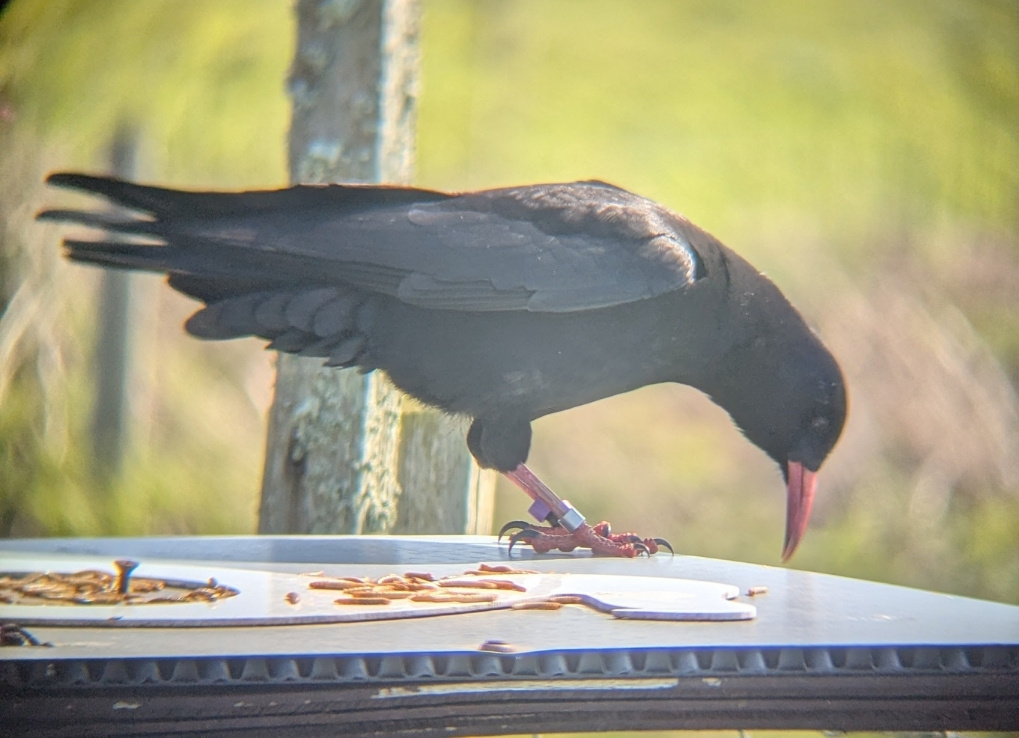
I’ve talked a little about the red-billed choughs already [link to past blog], but I got an inside look at their supplemental feeding aviary during my skills development. Keepers go up to the release site daily to offer the choughs supplemental food, and then monitor the aviary to see who shows up. The birds are identified by their coloured leg bands, and I gained a new appreciation for the skills required to track and identify wild birds.
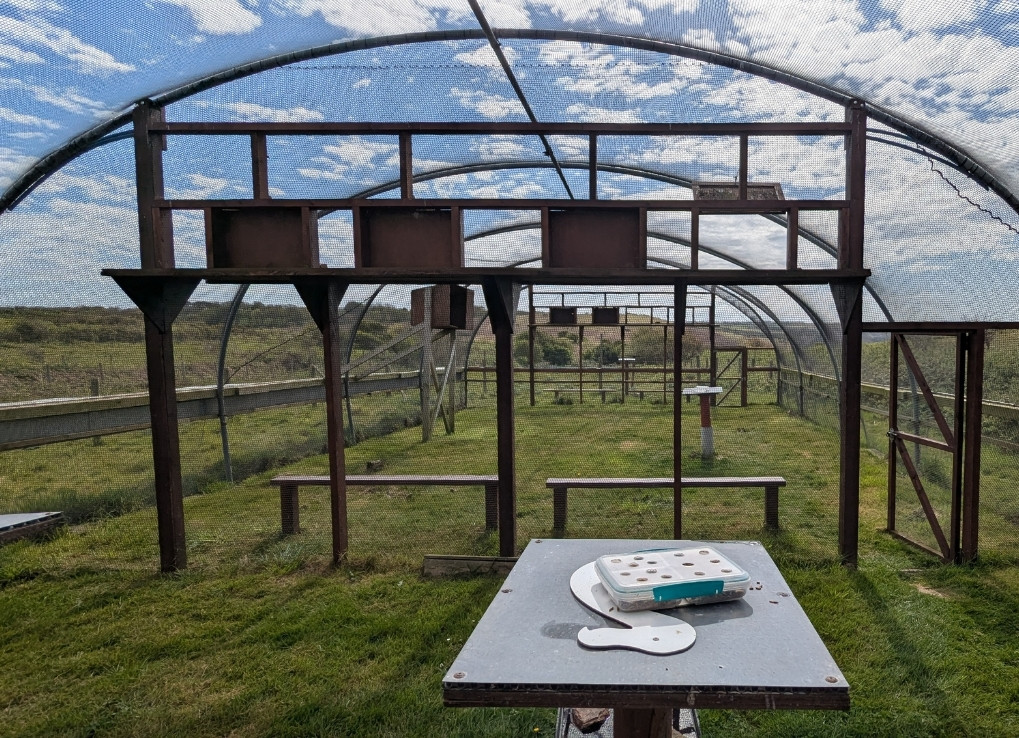
An inside look at the red-billed chough supplemental feeding aviary. Fresh food is provided daily in a dish to allow natural foraging behaviours. Photo by J.Kissel.
What’s truly amazing about the Jersey Zoo is their focus and commitment to endangered species conservation. Even if only for a few days, I got to work with some of the most endangered birds in the world, species that I had never seen or even heard of before arriving in Jersey. One of my personal aims for my professional development is getting to learn about the husbandry and breeding protocols from as many zoos and conservation programs as possible to broaden my knowledge and apply what I’ve learned to my future work. I’m grateful for the experience with the Jersey Zoo’s bird department and the keepers who shared their time and knowledge. If I learned anything it’s how much there is to know about caring for different bird taxa!
Jenna is a zookeeper and wildlife conservationist who is passionate about endangered species recovery. She graduated with a BSc in Wildlife Biology & Conservation from the University of Guelph before moving to British Columbia to work with northern spotted owls. Her background is in raptor conservation, specializing in husbandry and conservation breeding. She has been fortunate to work with many different species and conservation programs over the last 8+ years and can’t wait to continue this work with the skills she’ll gain from the New Noah Program.
We need your help