
Bees are declining at staggering rates.
But their fate doesn’t have to end in tragedy. We can still change how the story ends.
Bee numbers are plummeting — and that spells ecological disaster.
Ninety per cent of all flowering plants depend on pollinators like bumble bees in order to reproduce. That includes the plants that produce most of the fruits and vegetables in YOUR fridge.
But bee populations across North America have drastically declined since the 1990s. Scientists are racing against the clock to find out why bees are vanishing. Until they succeed, conservation initiatives are crucial to ensure these species don’t disappear.
WPC is the only organization in Canada with a goal to rebuild wild populations through conservation breeding. And we can’t do it without you.

Who are we?
A hands-on charitable organization…we are the last defence for endangered species in the country. For nearly four decades, we’ve provided direct, hands-on care for reptiles, amphibians, birds, insects and mammals on the brink of extinction.
We specialize in science-based techniques such as conservation breeding and release, reintroduction, and translocation.
We’re on a mission to save animals at risk in Canada, provide opportunities for Canadian biologists to increase their expertise, and advance conservation science with new methods.
We currently work with the Eastern loggerhead shrike, Western painted turtle, Taylor’s checkerspot butterfly, Oregon spotted frog, mottled duskywing butterfly, Massasauga rattlesnake, and many, many more endangered species.

The world needs bumble bees. And bees urgently need you.
At Wildlife Preservation Canada, our biologists have pioneered breeding techniques to save wild bumble bees from extinction.

See what we are doing in the field to save bees
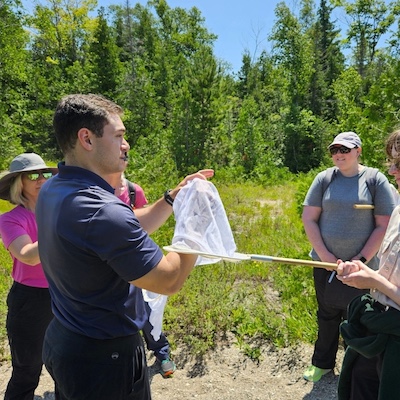


Our team making a difference for bees
Taylor Kerekes
Lead Biologist – Native Pollinator Initiative
Taylor joined the Native Pollinator Initiative in June 2023 and manages the native pollinator recovery program across Canada. Taylor was introduced to the world of bees during her BSc in Biology at York University. She is currently wrapping up her MSc at York University which focused on bumble bee abundance, diversity, and floral use. With this knowledge she hopes to continue to support pollinator conservation across Canada.

Cole Blair
Ontario Program Coordinator – Native Pollinator Initiative
Cole’s time with WPC began as a graduate student at the University of Toronto, where he researched harmful parasites in bumble bees (he looked at a LOT of bee poop). He has since played a supporting role as a technician in both the field and in our bumble bee Conservation Breeding Lab. As the Ontario Program Coordinator, Cole hopes to demonstrate to others that any conservation engagement – no matter how big or small – can go a long way.

Parker Smale
Lead Bumble Bee Breeding Technician
Parker’s passion for insects can be traced back to one fateful field entomology course, which also inspired his own entomology blog. As the lead technician for WPC’s bumble bee breeding program, he specializes in data wrangling, pollen chefery, and entomological match-making.

How you can help
- Join our Community Science initiatives! Contact pollinators@wildlifepreservation.ca
- Create a Pollinator-friendly garden! Help reverse the loss of native pollinator habitat on your property by protecting or planting native flowering plants. Aim to have a diversity of plants that flower from spring through fall. Pollination Guelph has curated an excellent list of resources to get you started.
- Build a bee nest out of a recycled milk carton.
- Don’t remove colonies of native bees on your property. Bumble bees are quite docile when undisturbed and usually will only sting when trapped.
- Support organic agriculture.
- Take photos of any bumble bees you see in North America and submit them to bumblebeewatch.org. This will help us locate rare bumble bees and learn more about all Canadian bumble bees.
- Choose alternatives to pesticides or reduce the amount of chemicals you use.
- Shop organic
- Contact your local government office and let them know that you support responsible land use planning that protects and connects natural areas and endangered species habitat
- Report sightings of rare species to your provincial/territorial Conservation Data Centre
- Support Wildlife Preservation Canada.