1,327 wings over Helliwell: releasing a new generation of Taylor’s checkerspots
Posted onApril 22, 2026byJag Athwal|Native Pollinator Initiative, News and Events, Taylor's CheckerspotPhoto: J. Athwal
What is the Taylor’s Checkerspot Butterfly Recovery Program? An environmental indicator for the health of the entire ecosystem, this special butterfly was once widespread in the San Juan Islands, southern Vancouver Island and the surrounding islands of British Columbia. It was believed to have disappeared from Canada until 2005, when 15 checkerspots were observed on Denman Island in B.C.’s Gulf Islands. Since then WPC has been working to support the butterfly by building the wild population in B.C. through conservation breeding in our program located at the Greater Vancouver Zoo, and helping partner efforts that restore and maintain habitat for the species.
There is a particular kind of quiet that settles over a coastal bluff in early spring on Hornby Island (a small island off the coast of Vancouver Island, Canada) . The ocean is loud enough in the distance that you stop hearing it. Late March this year, we released 1,327 conservation bred Taylor’s checkerspot caterpillars into the restored meadows in and around Helliwell Provincial Park and it felt like the whole place was holding its breath with us. This release has been three years in the making, and to understand why it matters, you need to follow these caterpillars backwards in time…
The Taylor’s checkerspot butterfly (Euphydryas editha taylori) is one of the most endangered butterflies in Canada. It once flickered across Garry oak meadows and coastal bluffs from Vancouver Island down through Washington and into Oregon, USA. Then the meadows were developed, the host plants were replaced by invasives, and the butterflies winked out, population by population. On Hornby Island, the Taylor’s checkerspot was locally extirpated in 1996 and disappeared from Helliwell for nearly three decades. That is the point we have spent the last several years trying to reverse.
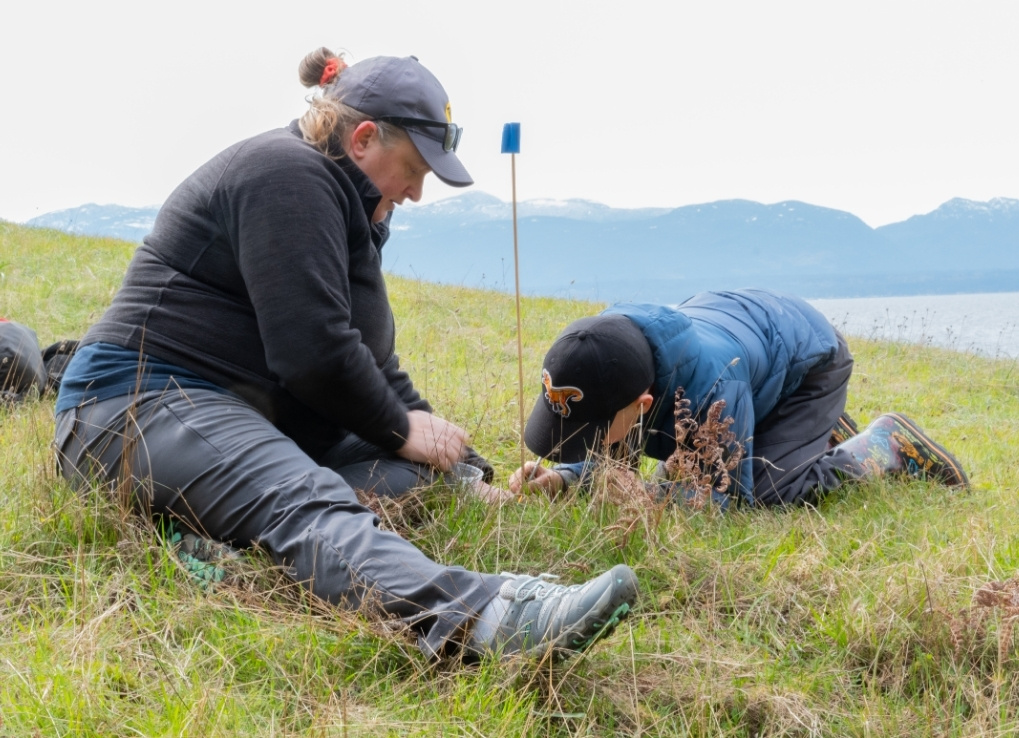
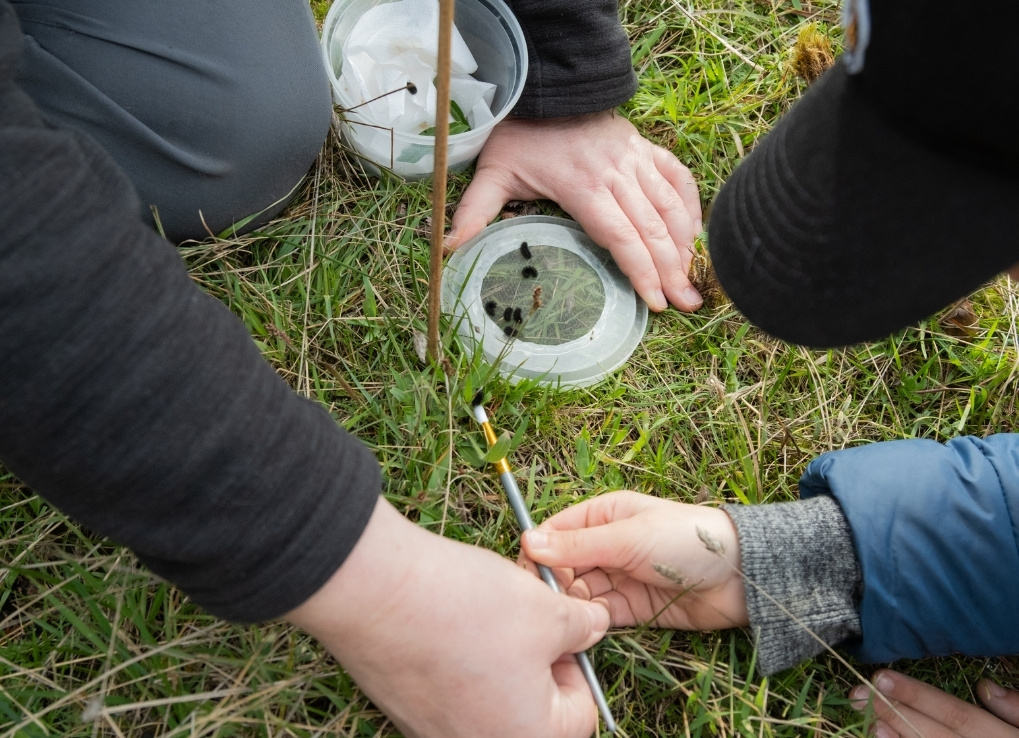
WPC’s Lead Biologist for B.C. Projects, Andrea Gielens, and her son, placing checkerspot caterpillars at the base of a release site marker. These markers are used to identify spots with a good amount of food plants and helps keep them off of walking paths. Photo by J. Athwal.
The origin story: Nine Matrilines from Oyster River
The 1,327 caterpillars we released this spring trace their origin to nine matrilines we collected in a single week in June 2024. Our field team spent seven days walking and searching seasonal pools and sodden ground for the small, spiny larvae feeding communally on marsh speedwell (Veronica scutellata). We found ten clusters. We collected 130 individuals representing nine distinct matrilines — each from a different corner of the landscape.
That geography mattered more than it might sound. The matrilines we collected ranged from clusters just 45 metres apart to ones separated by nearly 11 kilometres. We were not just collecting individuals; we were collecting the genetic breadth of an entire wild population.
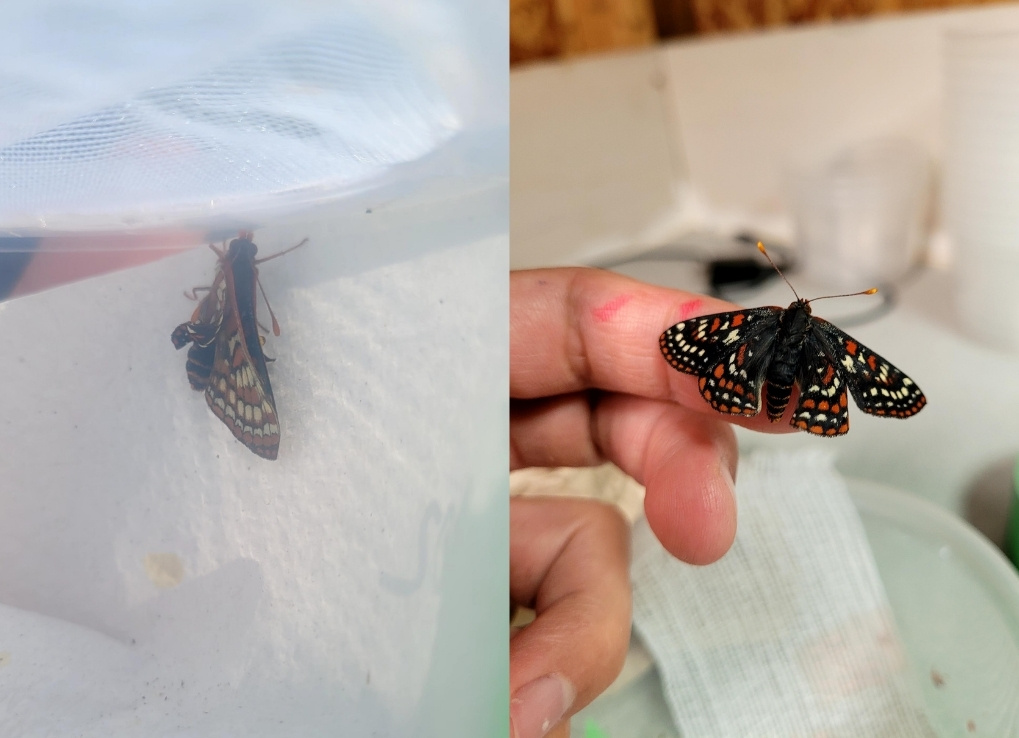
(Left) Taylor’s checkerspot butterfly emerging from its chrysalis. (Right) Freshly emerged butterfly on the hand of WPC staff. Photos by M. Gardiner.
The science: why genetic diversity is the whole game
When you are rebuilding a population from the edge of extinction, the temptation is to optimize. Pick the biggest larvae. Breed the fastest-growing lineages. Maximize your numbers. We deliberately did not do that. In 2025, WPC, along with the husbandry team at the Greater Vancouver Zoo, reared those 130 larvae through diapause and watched 87 adults successfully eclose (emerge as butterflies). That’s a 70% survival rate, more than thirteen times what these butterflies would achieve in the wild. But when it came time to set up breeding cages, we committed to what we called a “maximum diversity” strategy.
That meant keeping every single matriline in the breeding pool, even the three that had performed poorly in captivity. Excluding low-performing lineages would have been a quiet form of artificial selection — rewarding traits that work in a zoo but may not work on a windswept bluff. Instead, we paired distant founders (more than 5 km apart at collection) to generate novel genetic combinations, and we preserved some close-neighbour pairings (less than 500 m apart) to keep locally co-adapted gene complexes intact.
The result: roughly 4,000 eggs laid, approximately 2,500 larvae recruited into diapause, and every one of those nine founder matrilines carried forward into the next generation. Nothing lost.
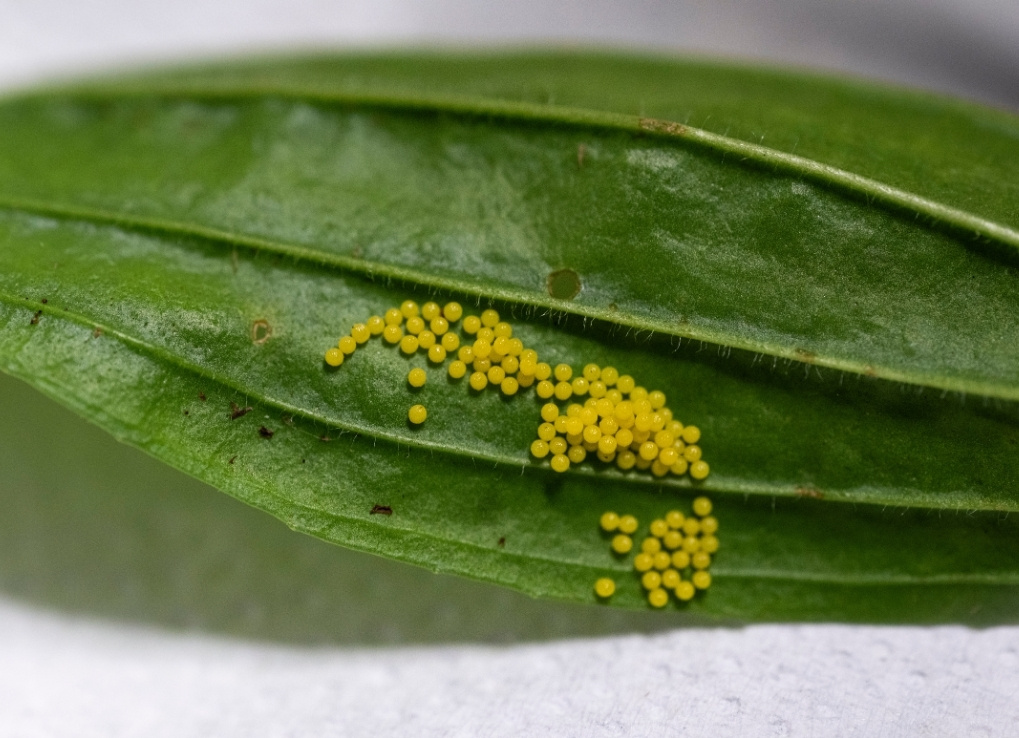
Checkerspot eggs laid on the underside of a leaf in the Conservation Lab/Conservation Corner at Greater Vancouver Zoo. Photo by J. Athwal.
Now back to release day…
Those larvae spent the winter in carefully managed diapause conditions, and this spring we loaded 1,327 of them into transport containers and drove them north to the ferry.
Helliwell is special to us. In 2023, the team released 1,476 caterpillars here — the first deliberate reintroduction of its kind in the park. In March 2024, we confirmed that more than 230 of those larvae had successfully emerged from winter diapause, the first documented completion of the Taylor’s checkerspot life cycle at Helliwell since local extirpation in 1996. The habitat restoration was working. The butterflies were coming home.
This year’s release builds on that foundation. The caterpillars we placed on host plants across restored areas of the park are genetically the broadest cohort we have ever released. They carry genes from nine wild mothers, blended through a spatially informed mating design, selected not for the easiest traits but for the widest possible toolkit to face whatever Helliwell throws at them.
We watched the first few larvae begin to feed almost immediately. That is the part that gets you – what a special moment to be a part of.
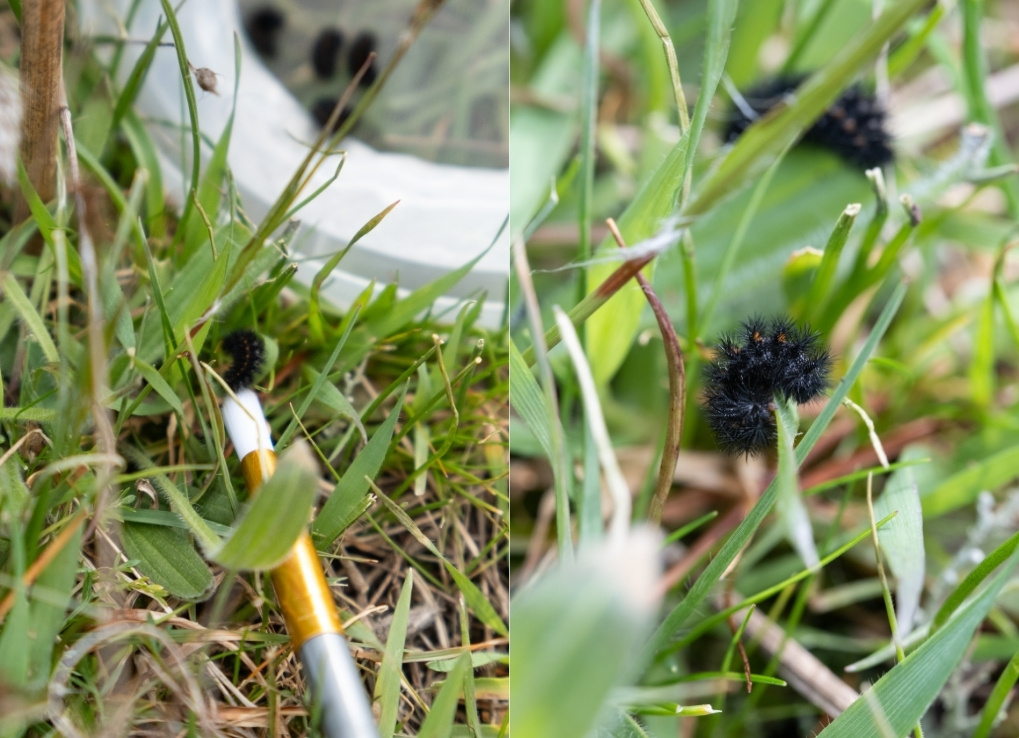
Caterpillars released at Helliwell. Photos by J. Athwal.
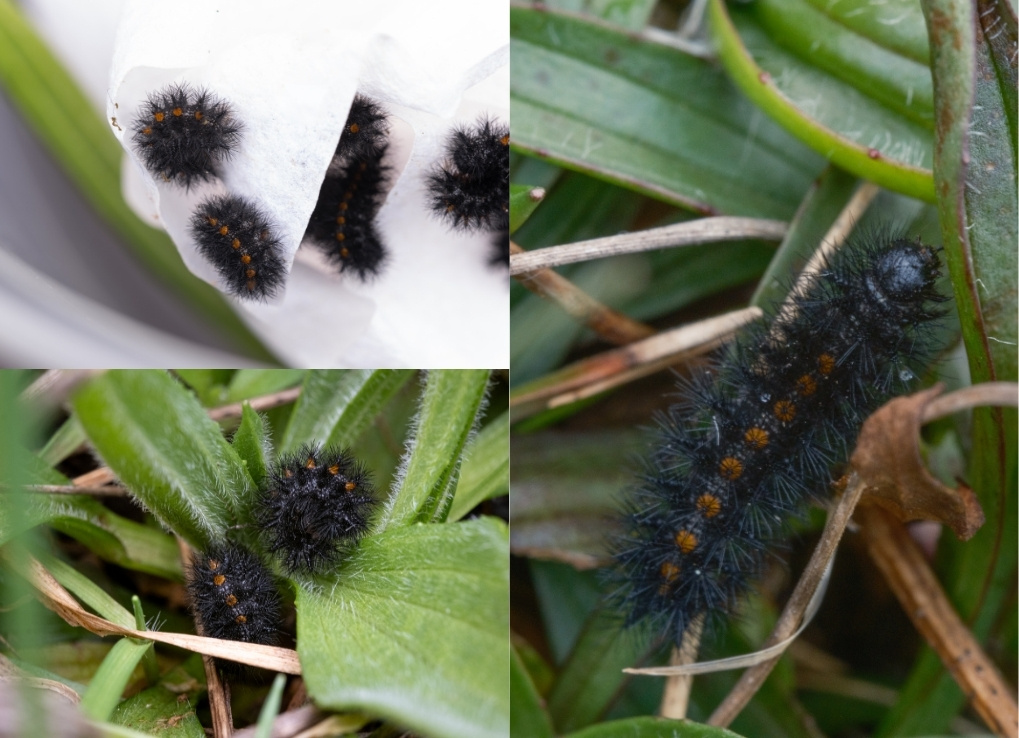
More caterpillars released at Helliwell. Photos by J. Athwal.
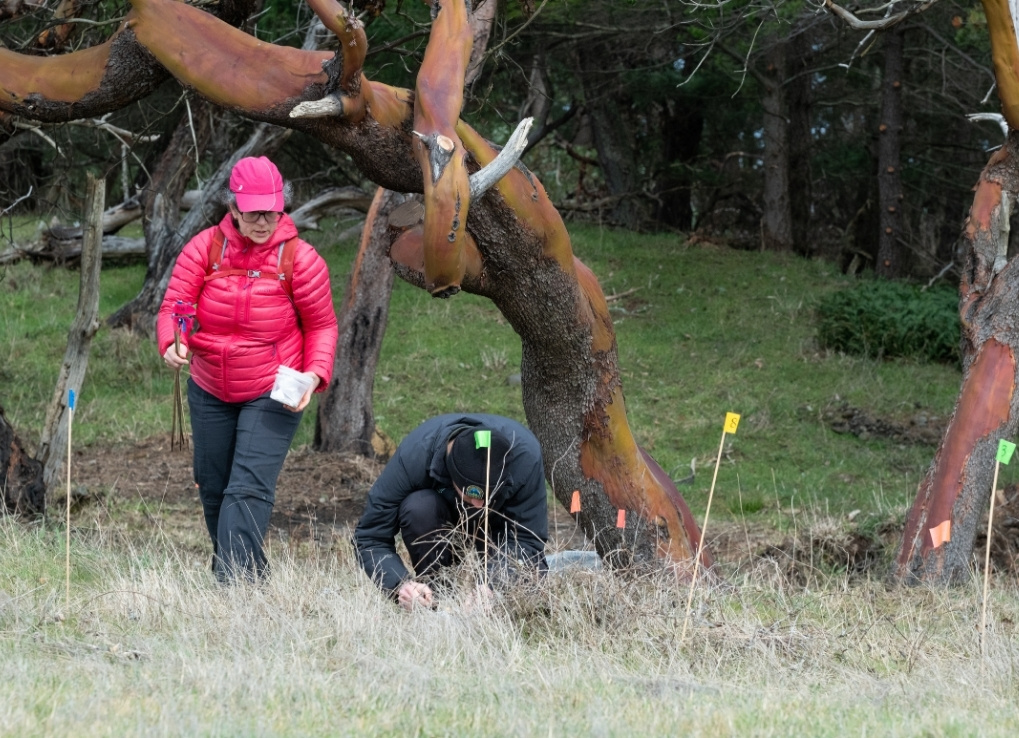
Recovery Team members releasing caterpillars at the release site. Photo by J. Athwal.
What’s next?
Diapause survival checks will happen in late winter, as they did in 2024. We will be out on the bluffs at first light looking for webs, looking for feeding damage on Plantago, counting how many made it through. Meanwhile, our 2026 captive cohort — collected last summer from a newly confirmed population near the Campbell River Airport — is already working its way toward next spring’s release.
We are also planning a comparative diet study to test whether native marsh speedwell (Veronica scutellata) produces stronger, more fecund butterflies than the non-native Plantago we have traditionally used in captivity. And we are exploring a formal genetic banking partnership with Vancouver Island University that would let us track the long-term genetic health of both wild and reintroduced populations over time.
The goal that keeps us moving is 5,000 caterpillars released every year. We are not there yet. But Helliwell is no longer empty of checkerspots, and the 1,327 we released this spring are the most genetically robust founders we have ever produced.
None of this happens alone. Huge thanks to the team at the Greater Vancouver Zoo, whose husbandry expertise made this cohort possible; to BC Parks for stewarding Helliwell; to Mosaic Forest Management for continued access to the Oyster River source population; to Jennifer Heron at the BC Ministry of Environment and the Taylor’s Checkerspot Recovery Team; to the Hornby Island community, who have adopted this butterfly as their own; and to every volunteer who showed up during the 2025 breeding season to help move containers, clean frass, and witness something remarkable.
Every cluster found, every waypoint recorded, every pairing cage checked in the sun — it all added up to a handful of caterpillars on a coastal bluff, doing exactly what their species has done on this island for thousands of years.
One more step toward bringing them home for good.
We need your help