
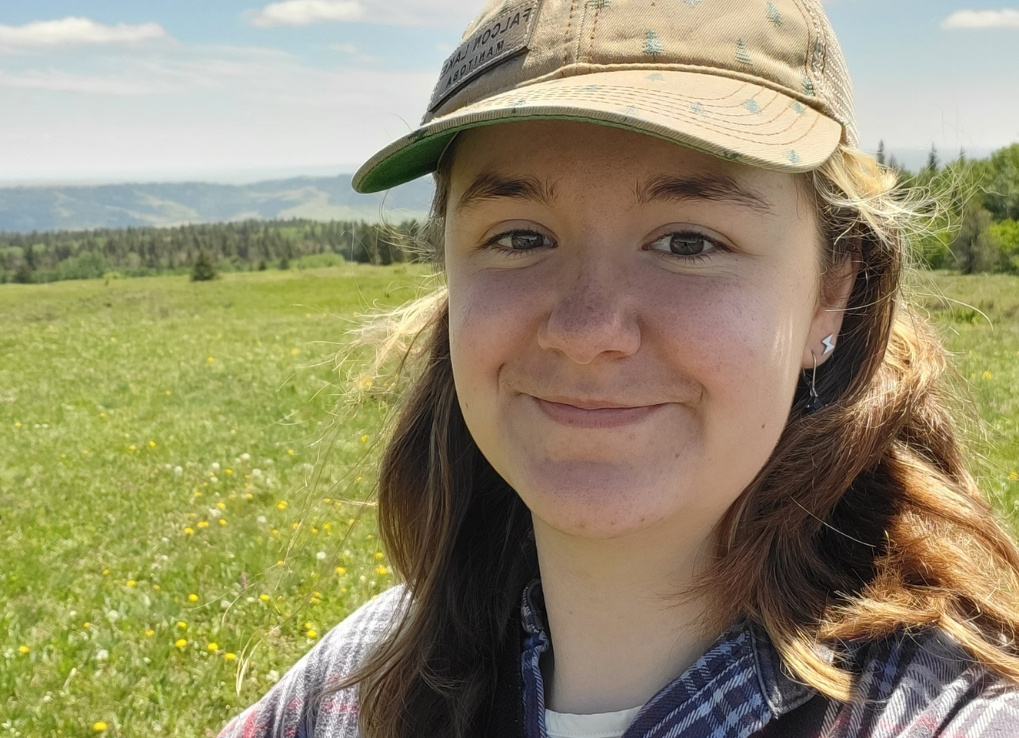
Since 1988, the Canada’s New Noah program has provided conservation biologists in Canada the opportunity of a lifetime. Each year, WPC selects a dedicated biologist from applicants across Canada to undertake a 3-month course at the Durrell Conservation Academy in the U.K. followed by a 6-month internship on the island of Mauritius in the Indian Ocean. This is an opportunity unlike any other for young Canadians to learn firsthand how the world’s most successful conservation recovery programs are managed and to bring this knowledge and experience back to improve Canada’s conservation capacity.
For the first time ever, WPC is offering this placement to two biologists. Our 2026 New Noahs are Jenna Kissel – WPC’s 35th Canada’s New Noah, and Daryn Farrant – WPC’s 36th Canada’s New Noah. Both report on their experiences and how they will apply them upon return to Canada. Thank you to the Alan & Patricia Koval Foundation for their many years supporting the Canada’s New Noah Program and for going above and beyond supporting two Koval Foundation New Noah Internships in 2026.
My name is Daryn Farrant, and I’m thrilled and honored to be selected as one of Canada’s New Noahs for the upcoming year (gasp, there are two of us). I see conservation as both a calling and an ongoing adventure, much like exploring a vast campaign world where every species and ecosystem has a story worth sharing.
In the spirit of a game I love, Dungeons & Dragons, here is my Canada’s New Noah character sheet:
Daryn (Dare-rin) – Level 3 Human Ranger
Class (AKA what I do for work)
I was a level 3 ranger. Not the kind with bows and arrows tracking goblins who have captured a fair maiden. My targets were a little smaller, but just as ferocious.
My kind of ranger? National Park Ranger.
My quarry? Burrowing Owls.
I worked as a Resource Management Officer I (EG-03), which is fancy government speak for field biologist, at Grasslands National Park, Saskatchewan (Not Flat™). There, I was responsible for the Burrowing Owl monitoring program as well as the riparian health monitoring program.
In this role, I was trusted with planning and coordinating fieldwork, training seasonal staff, refining monitoring protocols, and ensuring data moved from the field into reports that directly informed management decisions. My work often balanced early mornings, long days, and fast problem solving, whether that meant adapting surveys to weather, navigating permit conditions for species at risk, or making sure crews stayed safe and supported in remote prairie landscapes. Grasslands taught me how much conservation depends on people, communication, and careful decision making, not just good intentions.
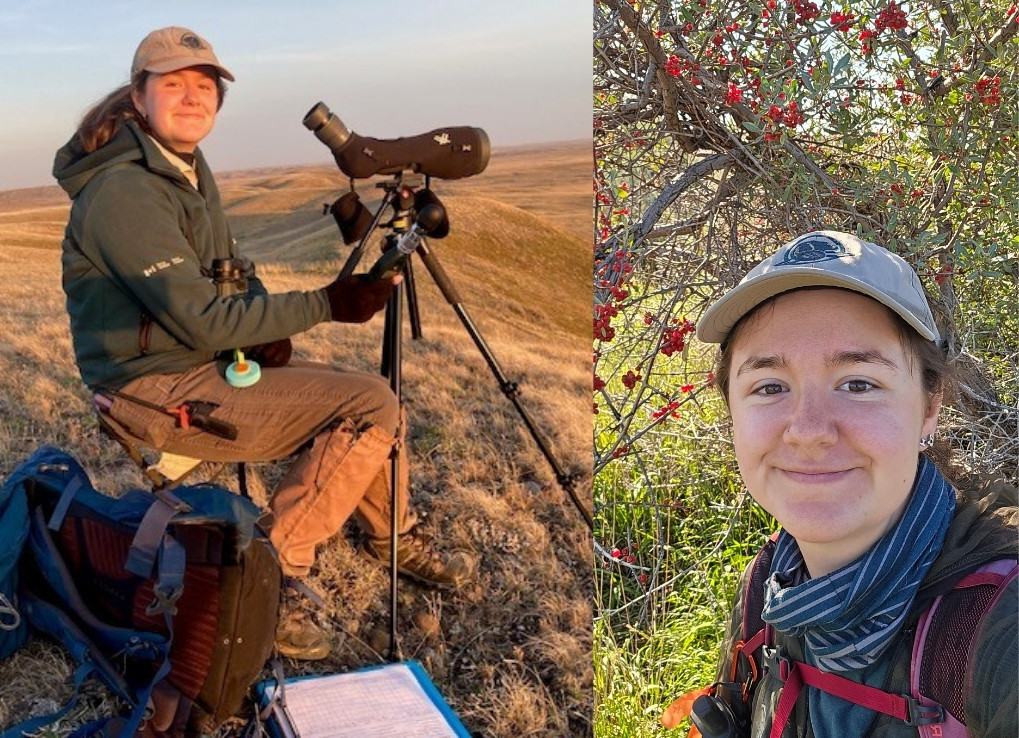
(Left) Daryn scanning a prairie dog colony at Broken Hills for burrowing owls. She is wearing a Parks Canada uniform and holding a spotting scope mounted on a tripod, pointed toward the distance. Her field gear is scattered around her, including a bright blue clipboard with data sheets clipped to it.
(Right) Daryn after a quick snack of buffalo berry during a riparian health assessment. She is wearing a bright red backpack with a GPS attached and standing in front of a very thorny bush covered in bright red berries (they are very tart, in case you were wondering).
But I was not always leading crews out at 3 a.m. searching for little pop cans on stilts across prairie dog colonies, or charging through smooth brome thickets along the banks of the Frenchman River. Like any adventurer, I have a backstory.
Background
I spent three years battling invasive weeds by any means necessary. Chemical, manual, and my personal favourite, pitting native plants against non-native ones in a decades-long war, also known as restoration. And yes, like anyone in this field, I absolutely had nightmares about leafy spurge monsters.
Restoration work taught me patience and how to think on an ecosystem level. Prairie recovery does not happen on human timelines. It unfolds more on an elven scale, measured in decades rather than years. Learning to track progress over long stretches of time shaped how I approach conservation problems, focusing less on quick wins and more on resilience, persistence, and setting future practitioners up for success.
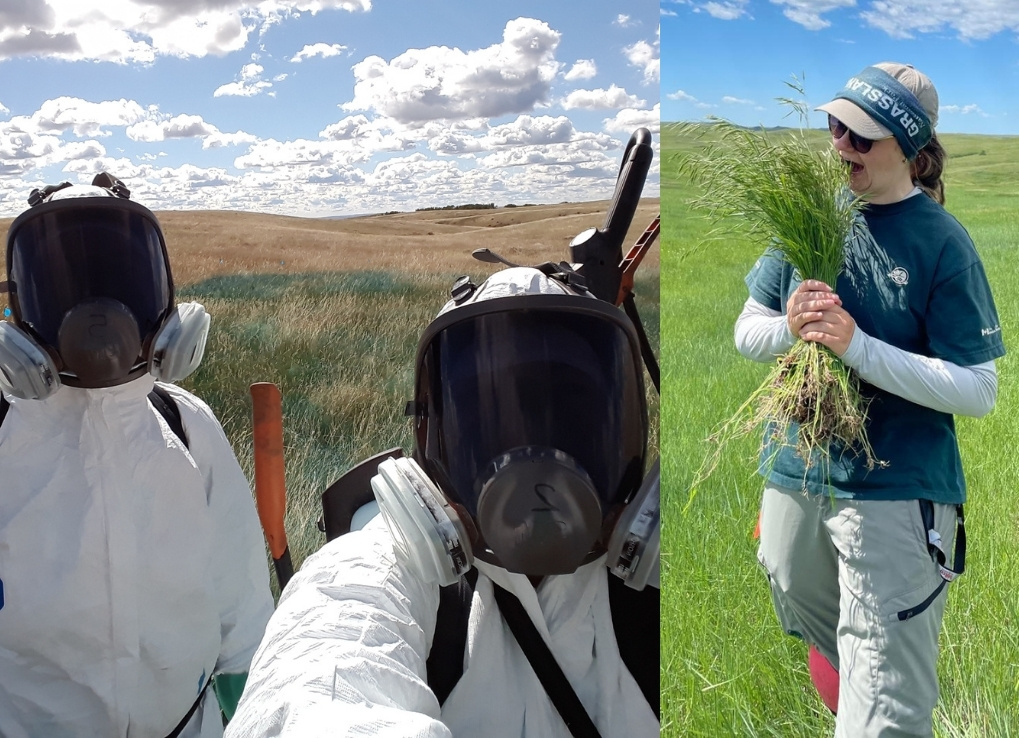
(Left) Daryn in her “space suit” (PPE) used for herbicide application, with a suspicious blue patch of sprayed weeds in the background. She is wearing a full-face respirator with the number 5 written in Sharpie across the outtake valve and a white Tyvek full-body suit. A white herbicide backpack with an orange pump handle is strapped to her back.
(Right) Daryn attempting to boost team morale by pretending to eat invasive annual brome. She is holding the grass in both hands, mouth open wide as if taking a bite.
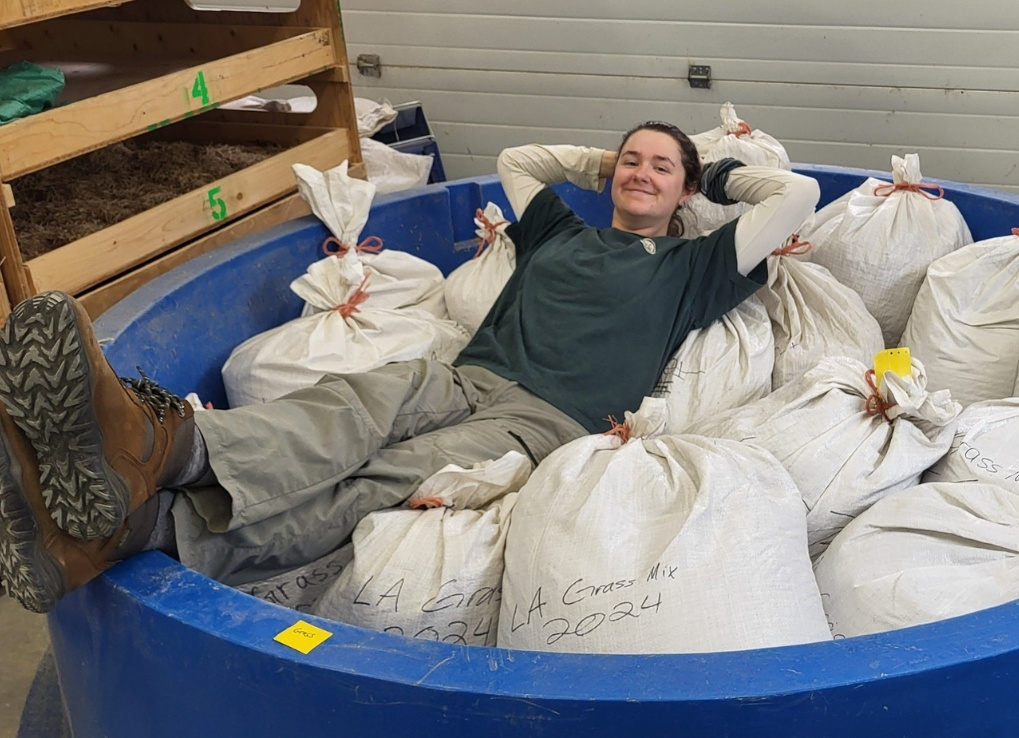
Daryn lying on the spoils of others’ hard work: bags of seed hand-collected and purchased by Grasslands National Park, ready for planting in the Larson restoration field. The white seed bags are tied with red string and piled in a blue circular tub normally used for watering cattle. Daryn is lying across the bags with her arms behind her head and her legs stretched out and crossed.
When I wasn’t battling weeds, I was training my mind in the gauntlet that is higher education in my homeland of Winterpeg, Manisnowba. I mean, Winnipeg, Manitoba. During my student years at Grasslands National Park, I was happily tossed from one project to the next, always eager to learn and rarely saying no to a new challenge. One day I might be assisting with species at risk monitoring, the next helping with vegetation surveys, data cleanup, or whatever task needed an extra pair of hands (and we always needed extra hands).
I thrived in this kind of learning environment, bouncing between swabbing Black-tailed prairie dog burrows for fleas that can carry plague (yes, that was a real job hazard, and no, I did not believe them at first) to assessing the regrowth of silver sage in a prescribed burn area, absorbing skills and slowly piecing together how all the moving parts of conservation fit together. Each role added something new to my toolkit and left me wanting more time in the field.
My conservation roots run deep. My mother liked to joke that I was a woodland nymph growing up. Perhaps she knew before I was born that this would always be my path. Call it mother’s intuition or oracle-like powers, but she named me after the Welsh goddess of oak trees, just spelled a little differently. I grew up hiking with my family, leading conservation clubs, and taking friends on multi-day canoe trips.
Bonds (AKA my loves and hates)
Arch-nemeses: Crested wheatgrass, walking uphill, mustard, spelling.
Loves: The colour burnt orange, my cat Tippy, canoeing, and herps (reptiles and amphibians).
Lately, I have been diving deeper into the herp world. This includes taking a field herpetology course in Costa Rica and working on a project at Grasslands focused on snake fungal disease. The spark for this interest came during my community ecology class, when my professor described a mysterious place where you had to watch every step or risk stepping on a rattlesnake. I thought, wow, neat, I would love to see that someday.
A few weeks later, I accepted a position at Grasslands National Park and, to my surprise, ran into the same professor. It turned out the place he had described was Snake Pit, a rattlesnake hibernaculum inside the park. He introduced me to these often-misunderstood animals, teaching me how to safely bucket snakes, move them off roads, and read their behaviour. I was completely hooked. You are telling me there is a lizard in Canada that shoots blood from its eyeballs and gives live birth? And somehow, they are still adorable?
In truth, this fascination started long before that. As a kid, I would make my parents paddle far out of the way on canoe trips just so I could stop and admire a turtle or a frog. The herp obsession was inevitable.
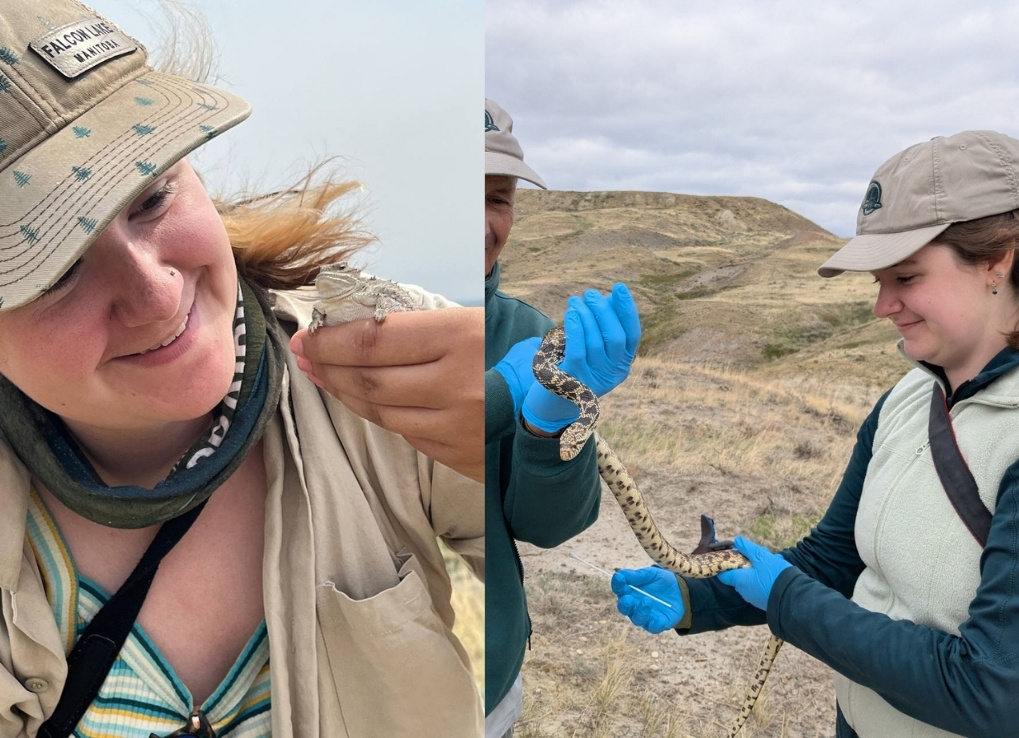
(Left) Daryn looking lovingly into the eyes of a pregnant female greater short-horned lizard. She is holding the small, spiky-headed lizard in her left hand. The lizard’s feet just peek past her fingers, and its round body fits easily in her palm. No sign of the infamous blood-shooting defence was observed during this encounter, though that particular tactic is reserved for canid predators anyway.
(Right) Daryn swabbing the belly of a bullsnake for snake fungal disease. She is holding the lower half of the snake while another person supports the head. In her other hand, she holds a long cotton swab near the snake’s belly. The snake is just over a metre long, with dark brown spots on a beige body. (The snake was very chill and tried to go up her sleeve).
Languages
I am bilingual. Trilingual, if you count the eldritch language of government jargon. I grew up in an English-speaking household and attended French immersion schooling, beginning my post-secondary studies at l’Université de Saint-Boniface in Winnipeg. After running out of ecology classes (whoops), I went on to defeat the true BBEG (big bad evil guy): my honours thesis on prairie field restoration at the University of Manitoba.
Proficiencies
- Distinguishing similar blades of grass from one another (vegetation ID)
- Charting enemy invaders (mapping invasive plants)
- Tiny birdy headlocks (bander’s grip)
- Team coordination, morale boosting, and snack logistics
- Convincing animals that I am not, in fact, a threat (results may vary)
- Appearing calm in environments that involve heat, wind, mud, thorns, and unexpected chaos
- Identifying species by vibes alone
- Gently relocating animals who have made questionable life choices (roads, buildings)
- Explaining why something that looks scary is actually very cool
- Problem-solving with duct tape and optimism
My first professional experience with animal handling came through the Koper Lab, thanks to a graduate student named Lee who took a chance on me when I had very little experience. Together, we hauled heavy batteries across prairie fields to monitor Chestnut-collared Longspur nests. I would lie flat in the grass, watching carefully to make sure the parents returned after we set up cameras disguised with zip-tied vegetation. It felt like stalking on the savanna, or more accurately, hiding very still and hoping no one noticed me at all.
I helped weigh nestlings, monitored behaviour, and assisted with mist netting territorial males using call playback and a decoy named Felix. It was fascinating how something so small could be so bold and aggressive. That experience showed me the trust involved in working with wildlife and the responsibility that comes with it. It was also the moment I knew I belonged in the field.
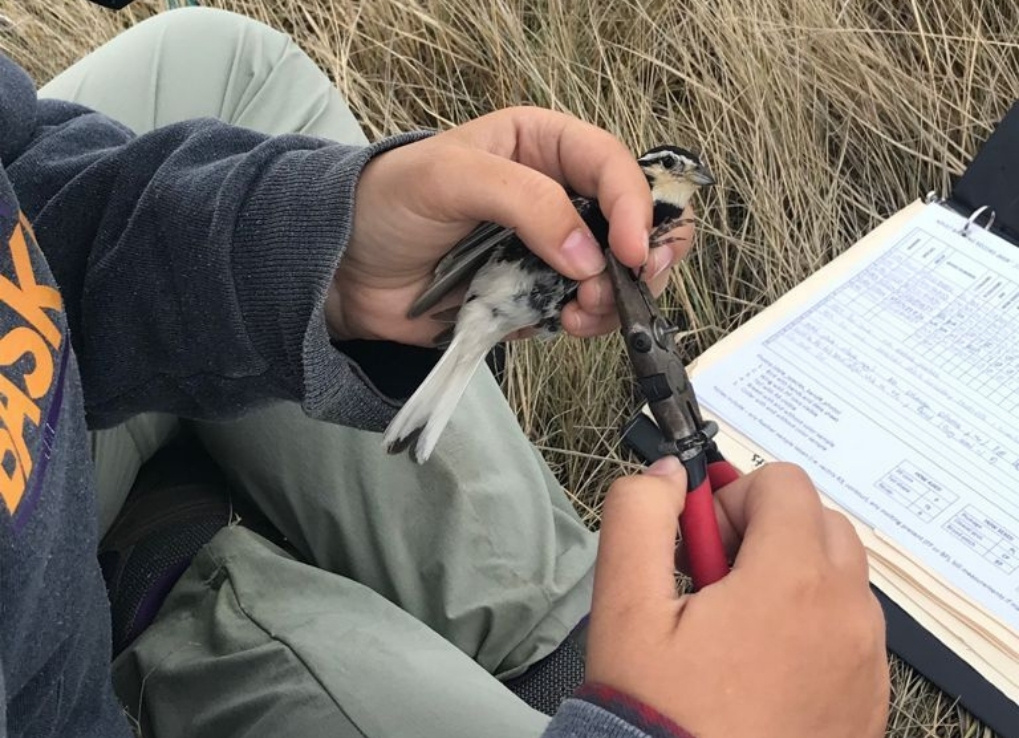
Daryn placing a male chestnut-collared longspur into the “tiny birdy headlock” (bander’s grip) while fitting him with identification bands. She is sitting cross-legged in the grass, holding banding pliers in one hand and the bird, with its wings safely tucked, in the other. The bird has a black belly and crown. Daryn is wearing a face mask due to COVID-19 restrictions.
Alignment (AKA what way my moral compass points)
Neutral Good. On any given day, I swing between chaotic and lawful. I have a strong sense of what is right and truly believe we can make a difference. Even small progress is still progress. I can be straightforward about what needs to be done, but I am always keen to lend a hand. When things get tough, I like to spark playfulness and fun in my work. Just because the work is hard does not mean we cannot enjoy doing it.
Equipment
If you looked inside this adventurer’s pack, you would find swords. Just kidding. I am especially leaving those behind this time, as airport security would not be impressed. Instead, you would find:
- At least two Nalgene bottles, covered in stickers (relics of places I have been)
- So many snacks (for the safety of my party members, I get hangry)
- Too many carabiners (clipping things is incredibly useful)
- Binoculars (not just for birds, plants too)
- Nitrile gloves (in case I need to yoink a herp, respectfully)
- A GPS unit loaded with waypoints I absolutely swear I will remember later
- A snake hook (for wildlife with strong opinions about personal space)
- Sunscreen applied once in the morning and then forgotten about entirely
- A multi-tool that fixes 80 percent of problems and creates the remaining 20 percent
- A field notebook that I SWEAR I will write in this time
- One emotional support rock picked up somewhere important (not in the national park, nervous laugh)
Why This Journey Matters
Joining Canada’s New Noah means stepping into a once-in-a-lifetime opportunity to expand my skills in endangered species recovery and practical conservation management through the Durrell Endangered Species Management Certificate and hands-on fieldwork in Mauritius. I look forward to bringing these lessons home to strengthen wildlife recovery efforts in Canada, just as past Noahs have done before me.
I am excited to share this journey, including the challenges, discoveries, and stories. I hope it inspires others to see conservation as both serious science and a shared adventure.
More articles like this

We need your help