Top 5 reasons why Round Island isn’t real
Posted onJanuary 19, 2026byMariel Terebiznik| Photo: N. Cole
Since 1988, the Canada’s New Noah program has provided young conservation biologists in Canada the opportunity of a lifetime. Each year, WPC selects a dedicated biologist from applicants across Canada to undertake a 3-month course at the Durrell Conservation Academy in the U.K. followed by a 6-month internship on the islands of Mauritius and Madagascar in the Indian Ocean. This is an opportunity unlike any other for young Canadians to learn firsthand how the world’s most successful conservation recovery programs are managed and to bring this knowledge and experience back to improve Canada’s conservation capacity. Mariel Terebiznik is WPC’s 34th Canada’s New Noah and reports on her experiences and how she will apply them on return to Canada. The Canada’s New Noah Program is generously supported by the Alan & Patricia Koval Foundation.
When I first found out I was going to be Canada’s New Noah, all the previous New Noahs I spoke to talked about one thing: Round Island. For a small island off the coast of Mauritius, Round Island is quite famous. I heard tales of strange animals, rare plants, and beautiful sunsets. Even my classes in Jersey often referenced Round Island and its conservation stories. By the time I was in Mauritius awaiting my turn to work on Round, the island seemed more legend than reality, like the conservation equivalent of Neverland or Narnia. Could such a place even be real? Even having been there myself, I am not so sure. These are my top 5 reasons Round Island is not real.
Round Island is an ecological stronghold for seabirds. No moment passes on Round without at least one bird reminding you that you are in their home. The thousands of seabirds that nest on the island not only call it home but help make it home for other species too. Seabirds are keystone species for many islands as they bring in nutrients from the ocean into the island ecosystems which can lead to greater species diversity and abundance. With such large numbers and impressive roles, I was shocked to learn that the birds on Round Island are not actually real! After some up-close investigations, I discovered that what I thought were birds were actually hyper-realistic life size models… at least for the Masked Boobies. These fake birds are so convincing, they not only fool visiting New Noahs, but hopefully some real Masked Boobies as well. They are actually decoy birds used to attract more Masked Boobies to the island in hope they start nesting on Round too! And in their move, they would join the fight to ecologically restore Round Island. With such a noble goal, I guess I can forgive the deception.

(Left) Two fake birds sit in front of a speaker on Round Island. Photo: M. Terebiznik. (Right) Mariel poses with the fake birds. Photo: D. Joyram.
Speaking of deception – Round Island lies to you. To start off, it is not even round. It is more of a warped crescent shape like a croissant gone wrong. Its neighbour, however, Serpent Island is much rounder but features no serpents whatsoever. Snakes can be found though on its non-round neighbour – Round Island. And the confusion with snakes does not stop there. Round Island is home to the Round Island Boa (Casarea dussumieri). These charismatic snakes can change colour throughout the day and have a unique split jaw that lets them eat larger prey like lizards and seabird chicks. Amazingly, the Round Island Boa has gone from Endangered after massive population decline to Vulnerable with now a population of over 10,000. This comes because of massive conservation efforts to restore Round Island’s ecosystems by removing invasive species. This work is still ongoing to continue to support the Round Island Boa and all the other species that rely on healthy, native ecosystems. Yet the Round Island Boa lies, for it is not even a boa at all! They are not in fact in the family Boidae that houses all boas, but rather in Bolyeriidae a family of snakes native to Mauritius. The Round Island Boa is the only species left in this family, with the Round Island Burrowing Boa (the only other species within the family) already extinct. That is all the more reason why the conservation work on Round Island is so important. Even if the names lie to you.

(Left) Mariel holding a Round Island boa. Photo: N. Cole. (Right) A past New Noah holds the special snake.
The binary of life and death is usually a clear one with anything in between relegated to the world of zombies and vampires. But on Round Island, those boundaries are not always clear. The island was once covered by the Round Island Hurricane Palm tree. But when rabbits and goats arrived, they destroyed the forest, devouring saplings and causing soil erosion. By 1994 the damage was done with only 2 Round Island Hurricane Palms left standing, and after a vicious cyclone, only one remained. With no other living member of its species, the single remaining Round Island Hurricane Palm was a living dead: the last alive individual of a species that was functionally extinct. But not all was lost. With some quick thinking, seeds were collected from the felled tree and grown on Ile Aux Aigrettes, another Mauritian conservation site. With some hand pollination bringing male pollen from Round to flowers of the cultivated palms on Ile Aux Aigrettes, seeds developed! The hope is those seeds grow into saplings that can be brought home to Round. And a lot is riding on that hope, because sadly in 2024, the last Round Island Hurricane Palm fell during a storm. When I visited its remains on my trip to Round Island, I was comforted knowing the palm still lived on in its children, and they could one day grow again on their home soil. While the last wild individual is dead, the Round Island Hurricane Palm still lives. This is one zombie comeback that I will be rooting for.
In most field stations I have stayed at, there tends to be some sort of infestation. There are the usual mice and mosquitoes, but on Round we have the Telfair Skinks. These skinks used to be found all over Mauritius but by the 1970s, they only lived on Round Island. This last remaining population was severely threatened by invasive species that destroyed their habitat and hunted the native reptiles on the island. With the removal of invasive species and ecosystem restoration, the skink population has boomed, increasing 1000% in the last 40 years. The Round Island population even supported the reintroduction of the species to other Mauritian islands. In their success, these cheeky Telfair’s skinks have fully taken over the Round Island field station and formed an economy of their own. There are skink baristas, bakers, dishwashers, and those enjoying vacations from their hard work. If you leave a coffee cup unattended, a skink will take it. If you were making pancakes, a skink will join you. If you leave a seat unattended, a skink will steal it. And if you are sitting quietly long enough in the lounge chair, a skink will use you as the lounge chair. Ultimately, the field station is more theirs than ours, and I am all the happier for it.

(Left) Mariel holds a Telfair’s skink. Photo: N. Cole. (Middle) Skink peaking into a coffee mug. Photo: M. Terebiznik. (Right) Skink relaxes on a lounge chair. Photo: M. Terebiznik.

(Left) Some skinks cleaning up the dishes. Photo: M. Terebiznik. (Right) Skink licking a whisk. Photo: M. Terebiznik.
Round Island is a centuries long, still ongoing tale in the fight for conservation. For over 150 years, goats, rabbits, and other invasive species on the island destroyed the native habitat. The forests disappeared, soil eroded, and many endemic species were lost. Then 50 years ago, the island was designated a Nature Reserve, and the conservation work truly began. With the removal of the goats and rabbits by the late 1980s and a lot of work to bring back native plant species, the ecosystem started to recover. Without the decades of work, many of these endemic Mauritian species might not have made it this far. But the work is not done yet. Invasive plants still threaten to take over native ones, and ongoing management and monitoring is needed to help safeguard the species still at risk. With plans in place for what the next 50 years of conservation need to look like on Round, its story is not over yet, but it is still one worth celebrating now. With fake birds, lying snakes, zombie trees, and working skinks, Round Island is an unbelievable story made real by the endless work and passion of conservationists. I personally cannot wait to see what other unbelievable stories will come in the next 50 years.
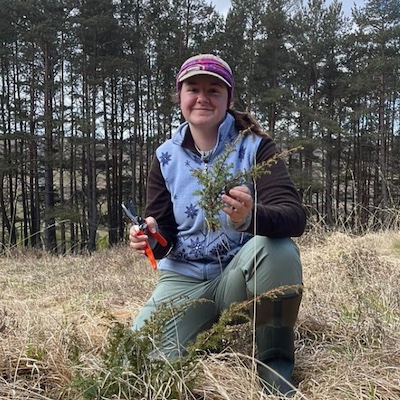
Mariel has always had a deep relationship with nature and conservation, having grown up spending most of her time outdoors in parks. Pursuing this passion, Mariel studied in ecology and evolutionary biology at the University of Toronto, where she received both her Bachelors and Master of Science degrees. There, Mariel focused on being in the field as much as possible, travelling to Ecuador to work with lizards and spending an inordinate amount of time in Algonquin Provincial Park contributing to long-term monitoring projects. Mariel also co-founded and co-directs a grassroots organization called Field Research in Ecology and Evolution Diversified (FREED).

We need your help