
Since 1988, the Canada’s New Noah program has provided conservation biologists in Canada the opportunity of a lifetime. Each year, WPC selects a dedicated biologist from applicants across Canada to undertake a 3-month course at the Durrell Conservation Academy in the U.K. followed by a 6-month internship on the island of Mauritius in the Indian Ocean. This is an opportunity unlike any other for young Canadians to learn firsthand how the world’s most successful conservation recovery programs are managed and to bring this knowledge and experience back to improve Canada’s conservation capacity.
For the first time ever, WPC is offering this placement to two biologists. Our 2026 New Noahs are Jenna Kissel – WPC’s 35th Canada’s New Noah, and Daryn Farrant – WPC’s 36th Canada’s New Noah. Both report on their experiences and how they will apply them upon return to Canada. Thank you to the Alan & Patricia Koval Foundation for their many years supporting the Canada’s New Noah Program and for going above and beyond supporting two Koval Foundation New Noah Internships in 2026.
As a child, I always knew I wanted to work with wildlife when I grew up. When you’re four and you tell your parents you want to work with animals what is the obvious answer? Veterinarian. So, for a long time, that’s what I thought I’d be, though I knew somehow it had to involve saving wild animals. It wasn’t until I got to university that a world of possibilities opened up, and I realized there were many more options to work with wildlife than being a veterinarian. I got my degree in Wildlife Biology and Conservation from the University of Guelph and have been working in wildlife conservation ever since. Having spent my childhood encouraged by my parents to follow my love for animals and inspired by Steve Irwin, it makes sense that this is where my career has led me.
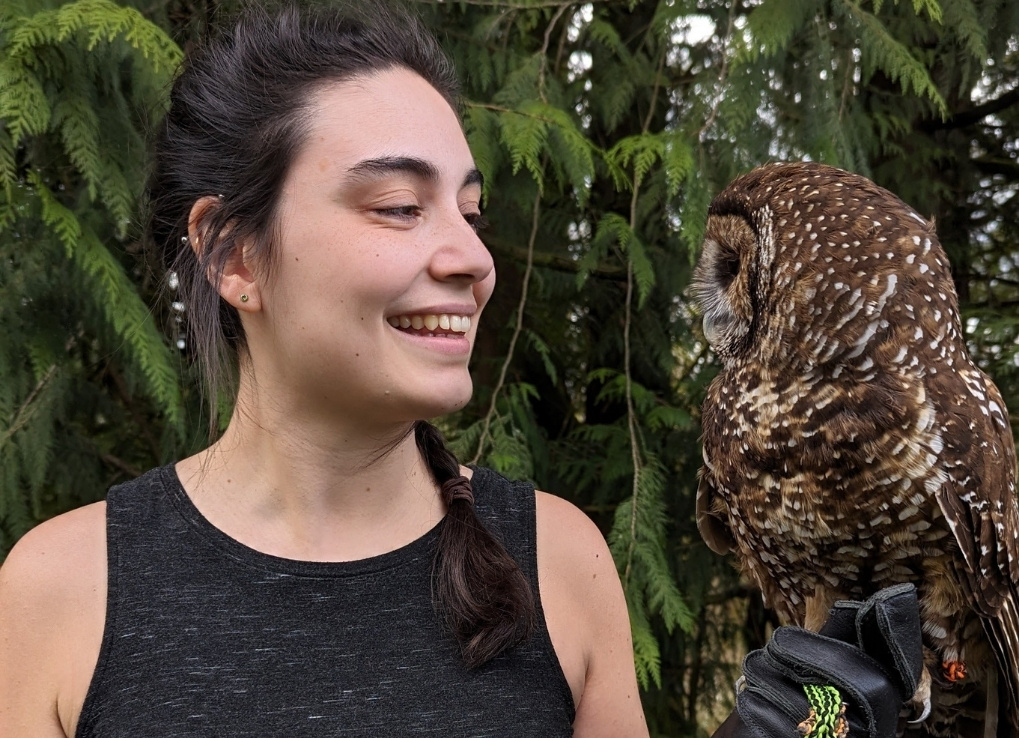
Anyone who knows me now can describe me in three short words: She loves birds. While I’ve always loved all animals, my obsession with birds sparked sometime during my undergrad, though I can’t say exactly when. I zeroed in on birds of prey when I got a position as a seasonal keeper at African Lion Safari, and I will always be grateful that this job allowed me to get my foot in the door to the world of zookeeping and avian conservation. I spent my summer learning about raptor husbandry, handling ambassador birds, and educating the public on the wonders of raptors. In a plot twist I didn’t see coming, I fell in love with a particularly unloved group of birds – vultures. I’m a sucker for the underdog and wanted the world to know how amazing and important vultures are. This led to me hosting the daily vulture feeding demonstration despite my paralyzing fear of public speaking.
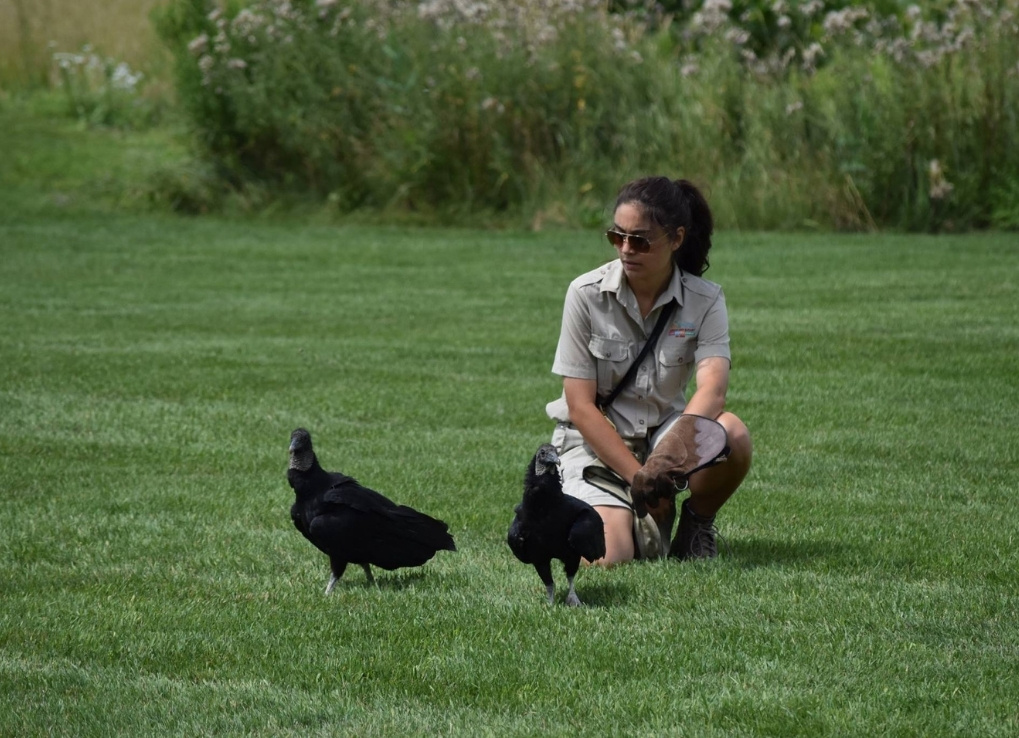
Jenna with two black vultures during a bird show at African Lion Safari.
After leaving African Lion Safari I spent the next couple of years travelling around doing contract work for different conservation organizations. I completed a nearly year-long internship with the Northern Spotted Owl Breeding Program (NSOBP), lived in St. Louis for a few months while interning at the World Bird Sanctuary, and then spent a summer as a zookeeper at Toronto Zoo before returning to British Columbia to work as a technician with the NSOBP.
My time at the World Bird Sanctuary was especially formative. Not only did I get to work with incredible birds, but I also worked with incredible people. I arrived just before New Year’s Eve in 2018 and settled into the rustic, on-site housing with my fellow interns. I spent the next four months fully immersed in everything the sanctuary had to offer, from animal welfare to behavioural training to rehabilitation, working with dozens of species including hawks, eagles, owls, vultures, falcons, parrots, and corvids. Part of what made my experience at World Bird Sanctuary so meaningful was the staff who shared and encouraged my passion for all things avian. It was a privilege to learn all that I could during my internship, and to do so in the company of people who made the work fun.
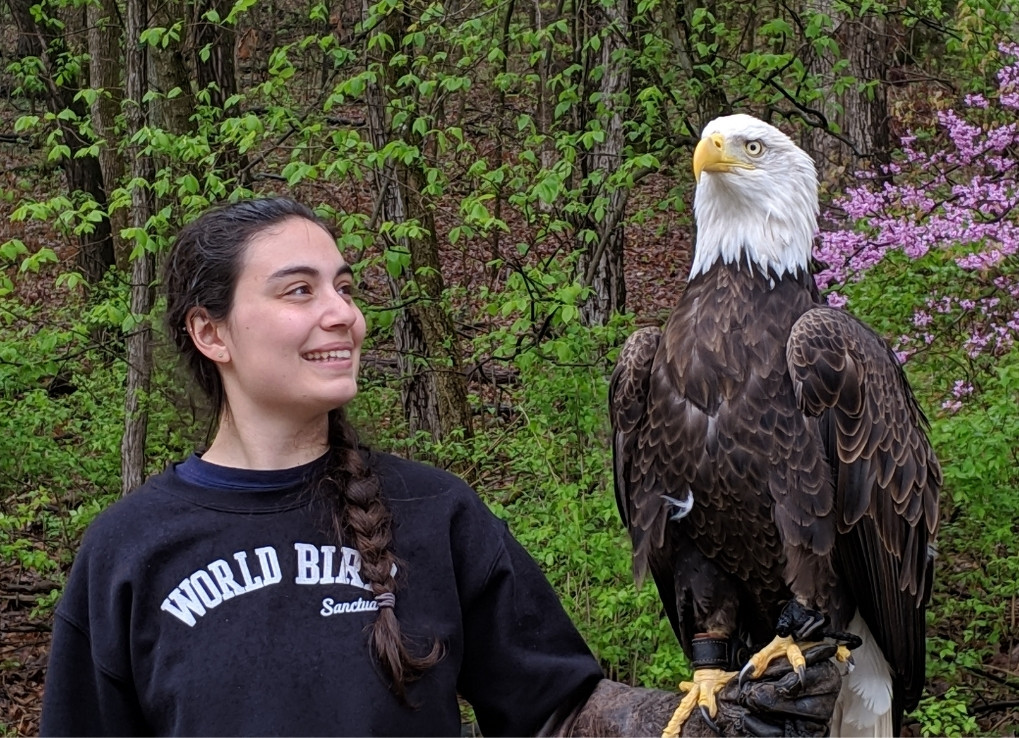
Jenna holding Clark, a bald eagle, at the World Bird Sanctuary.
I moved to British Columbia in late 2019 to return to the NSOBP, where I embraced my passion for avian conservation breeding. After my third cross-country road trip in as many years, I was ready to put down roots and dedicate myself to one project. At the NSOBP I got to be a part of the only program in the world dedicated to the conservation of spotted owls through conservation breeding and release (side note: did you know northern spotted owls are the most endangered owl species in Canada?) I really got to sharpen my skills in avian propagation, learning the ins and outs of artificial incubation and chick hand-raising, along with the day-to-day tasks of running a conservation breeding program.
I can’t talk about my time at the NSOBP without mentioning Small Eyes, the NSOBP’s ambassador owl and light of my life. I spent a lot of time training her for her role as educational ambassador, and we attended many outreach events together. A big part of conservation success is spreading awareness, and I loved getting to share Small Eyes’ message with people and creating a connection to her and the conservation efforts she represents.
I grew and learned so much during my time with the NSOBP, it was a dream come true to work with such an endangered species and unique program. I gained invaluable knowledge that will surely contribute to my career going forward, and while the spotted owls will always have a special place in my heart, after six wonderful years, it was time to move on.
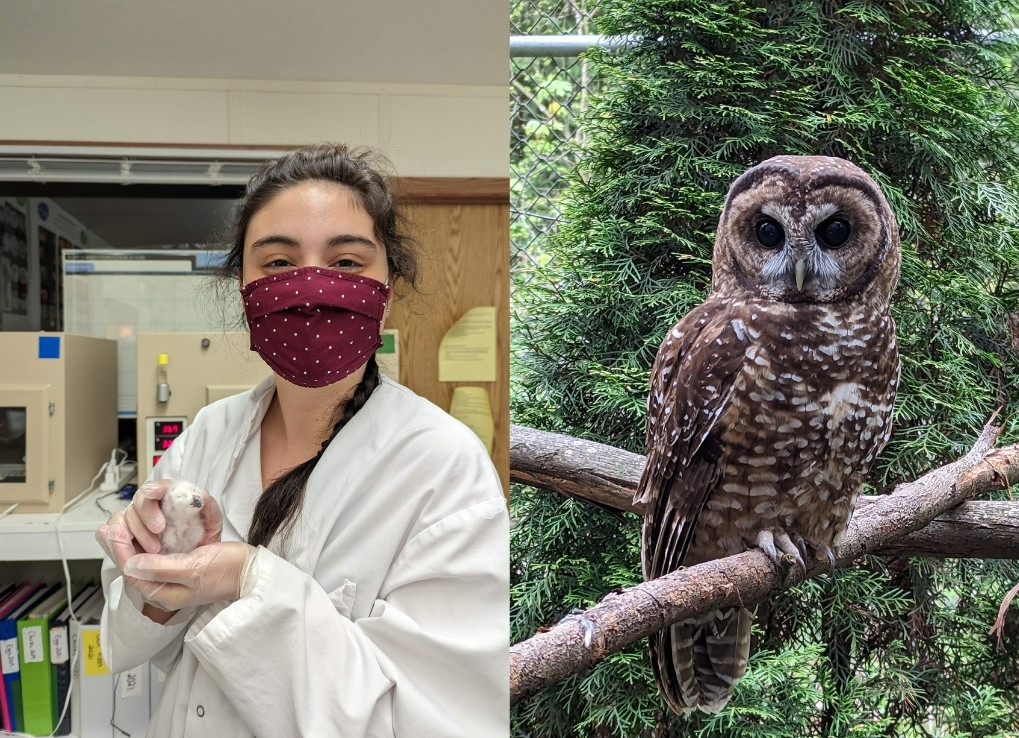
(Left) Jenna holding a spotted owl chick. (Right) an adult northern spotted owl at the Northern Spotted Owl Breeding Program.
In 2025 I joined Wildlife Preservation Canada as a conservation assistant with the B.C. Projects team and have spent the last year working with non-avian species for the first time. It’s been quite a change of pace working with herptiles and invertebrates, but part of what I love most about this field is getting to work with different programs and learn about new species. This desire for knowledge and new experiences is what drew me to the New Noah Program, and it’s an honour to have been chosen as the 35th Canada’s New Noah. While I have a solid foundation in husbandry and conservation breeding, I’m looking forward to learning more about the project management and analytical sides of endangered species recovery from the experts at Durrell and can’t wait to experience first-hand the work that has led to the recovery of species like the Mauritius kestrel and pink pigeon.
From northern spotted owls to Oregon spotted frogs, I am honoured to have contributed to the recovery of highly endangered species in Canada. The projects I have gotten to be a part of and the people I have met are truly inspiring, I can’t believe I’m lucky enough to get to do this for my career. Though I have spent years in wildlife conservation, this story is just the beginning, and I can’t wait for the journey the New Noah Program will take me on.
“Why else are we here if not to live with unreasonable passion for things?” – Butterflies Rising
More articles like this

We need your help