Turtle tracking tales from Grand Lake, New Brunswick
Posted onAugust 17, 2026byJasmine McNairn-Hart & Jordyn Williams| Photo: P. Maldowan
What is the Reptile and Amphibian Initiative? No other class of wildlife in Canada faces greater risk of extinction than reptile and amphibians. According to the Committee on the Status of Endangered Wildlife in Canada (COSEWIC), more than 40 amphibian and reptile species are currently threatened or endangered. More than a third of these species need some form of hands-on intervention to survive. Our national reptile and amphibian program develops and promotes best practices for four key conservation techniques: translocation, headstarting, conservation breeding and in-situ interventions. We will maximize the impact of groups across the continent that are working to protect these highly threatened species.
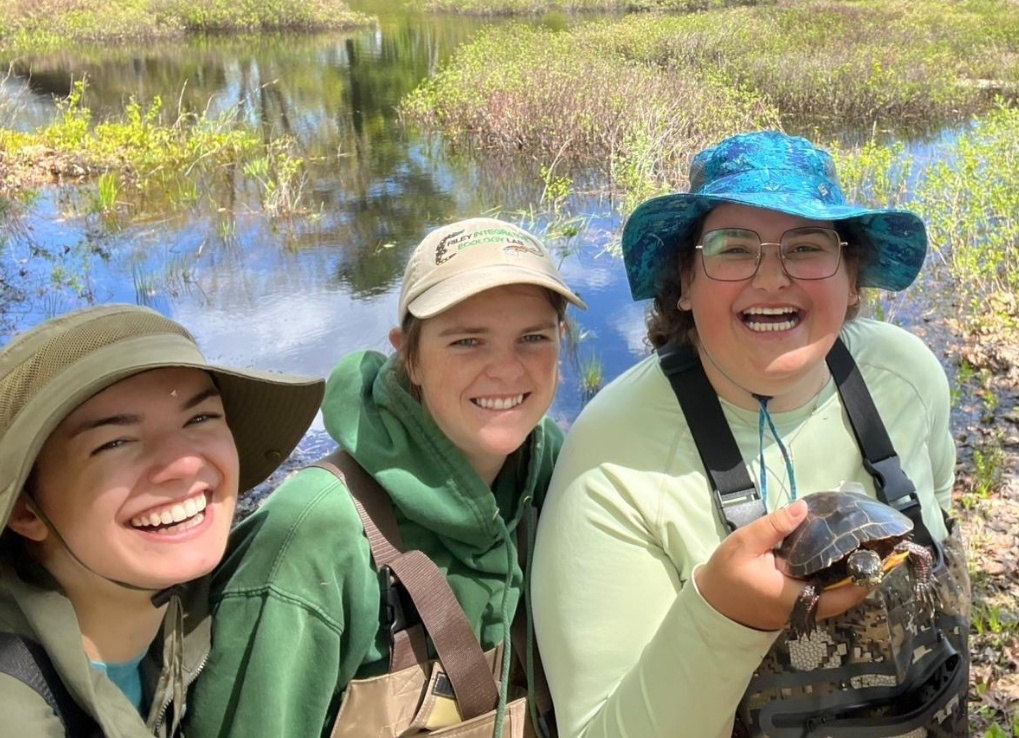
(Pictured above): The turtle girls! On the left there’s Meg Johnson currently studying the overwintering behaviour of eastern painted and snapping turtles in Grand Lake, New Brunswick. Then, on the right, there’s Jordyn Williams who is our current project lead in studying turtles during their active season, and in the middle there’s me, Jasmine McNairn-Hart! The lucky field technician who gets to have all the fun helping them both out with their work. Photo by P. Moldowan.
Have you ever played hide and seek with a turtle before? It is just as fun and chaotic as you can imagine. Turtles are surprisingly good at hiding in plain sight, hence the need for a trained team of turtle seekers! Meet the Turtle Girls!
For the past few years, the Riley Integrative Ecology lab at Mount Allison University has been studying the turtle population of two species, the snapping turtle and the eastern painted turtle, in the Jemseg Grand Lake Watershed of New Brunswick. This year, I’ve been lucky enough to join them as we work to track the movements, behaviour, and habitat use of the eastern painted turtles and the snapping turtles in the area!

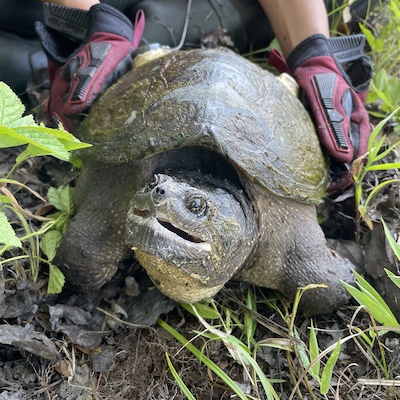
(Left) Our biggest snapping turtle “Barney”; and (right) a juvenile painted turtle! Photos by: J. Williams and J. McNairn-Hart.
Right now, we’re in the middle of a super fun and busy field season! Each day we spend time out on the lakes and ponds in the region using surprisingly simple technology, a technique called radio telemetry, to track the 24 turtles we’ve chosen to follow. This year, we are tracking 13 snapping turtles and 11 eastern painted turtles. Each was outfitted with a small transmitter and a temperature data recorder at the beginning of the season. The transmitter is constantly sending out a signal that we can detect using our antenna and receiver. To find the turtles, we simply need to follow the loudest beeping sound. As we get closer to the turtle, we can turn down the signal’s strength and when the signal is still audible at its lowest strength, we know we’ve found the turtle.

(Left) Radio tracking by myself (Jasmine) in action; and (right) the painted turtle “Rocky” with the radio transmitter and temperature logger attached. Photos by J. Williams.
Once we’ve found a turtle, we record its location, simple environmental data (like air and water temperature), and their behaviour and habitat details. This data will later be used to determine how and where they are spending most of their time. Occasionally, we are also able to catch the turtles either by hand or using a dip net. In these cases, we also do two behavioural assays which will later be used to determine each turtle’s response to predators and their boldness.
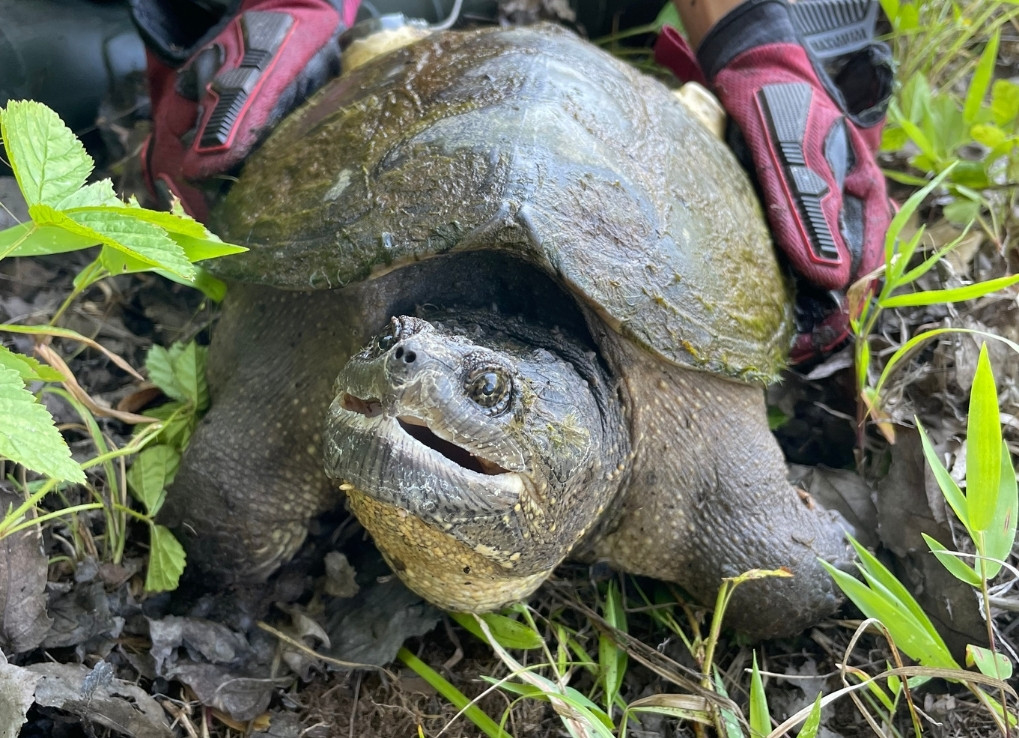
Snapping turtle “Blue Jean” during her behavioural assay. Photo by J. McNairn-Hart.
One of the coolest aspects of this job so far has been the opportunity to follow the life history of the turtles we’re studying! We see them emerge from their overwintering sites and start to move around again in the spring. We get to see the females out on the beaches and roadsides as they lay their eggs during nesting season. Throughout the spring, summer, and even into fall, we get to see turtles of all ages going about day-to-day life during their active season. One time we even got to witness a territorial fight between two male snapping turtles – that was probably one of the coolest things I’ve ever witnessed! Towards the end of the summer, we get to see hatchling snapping turtles or the occasional hatchling painted turtle after they emerge from their eggs! Finally, we observe as the turtles slowly settle into their overwintering sites, preparing to brumate, and restart the cycle all over again.

(Left) A nesting painted turtle; and (right) a hatchling snapping turtle. Photos by J. McNairn-Hart and M. Johnson.
As the days go by, I reflect on the fact that each day is so different and that I’m always learning something new about the turtles we’re studying: a turtle’s personality,their favourite spots, knowing which turtles will evade us and which ones will come say “hi” whenever we’re out looking for them. Perhaps it’s finding out that a turtle has moved to a different water body or has decided to hide themselves in a beaver lodge that day. Or maybe it’s finding out that the turtles dislike rainy weather just as much as we do. They are always finding ways to surprise us and help us understand that we aren’t just studying animals, but really cool, unique turtles with personalities, preferences, and behaviours that only they will ever fully understand. We are just lucky to follow along for a little while and get to peek into their world.

(Left) A nesting painted turtle; and (right) a hatchling snapping turtle. Photos by J. McNairn-Hart and M. Johnson.
Jasmine has always loved the outdoors and grew up hiking and camping frequently. This early connection to nature meant she always knew she wanted a job with lots of field work, but it was one amazing high school teacher who inspired her to study ecology. Jasmine completed her BSc in Biology in 2025 at Mount Allison University, doing her Honour’s research on the ecology of goldenrod galls. Since joining the Riley Lab, she has been enjoying helping Jordyn study turtles and supporting the lab through various administrative tasks. When not at work, Jasmine enjoys reading and eating ramen.

Jordyn always knew that she wanted to work with animals, but it wasn’t until she was 12 years old and held a snake for the first time that she realised she wanted to work specifically with reptiles. Jordyn started in the lab when she carried out her honour’s research that studied the population ecology of Eastern Painted and Snapping Turtles in Grand Lake, New Brunswick. For her MSc degree, she continued studying this population of turtles, but is now radio-tracking individuals to understand their habitat needs. When she isn’t in a lake looking for turtles, Jordyn is typically found watching Formula 1 racing with her cat.

We need your help