What is the Bumble Bee Recovery Program? Since the 1990s, bumble bee numbers have been plummeting, and that spells ecological disaster. Ninety per cent of all flowering plants — including most of the fruits and vegetables in your fridge — need these pollinators in order to reproduce.

Until the causes of these declines can be reversed, conservation breeding and reintroduction is the only way to safeguard at-risk bumble bees. Today, WPC is the only organization in Canada rebuilding wild bee populations through conservation breeding. Thanks to recent breakthroughs, we’ve figured out how to dramatically increase the number of queens we produce. Once they’re released into the wild, they can establish their own colonies, producing hundreds of pollinators to sustain the ecosystems around them.

You may have heard that male bees are freeloaders. In honey bees, for example, males are so useless that workers will evict them in the fall to conserve food and energy for the queen and workers over the winter. Bumble bee males are similar in that they have no stingers, so they can’t defend the colony, and they have no pollen baskets (corbiculae), so they can’t go out and forage for pollen like female workers can. In fact, after the queen and workers spend nearly a month raising them up from eggs to larvae to pupae to adults… they leave the colony at only a few days old, and they don’t come back! Talk about a lack of appreciation. But at least they don’t need to be bullied out of the colony to know it’s time to leave!

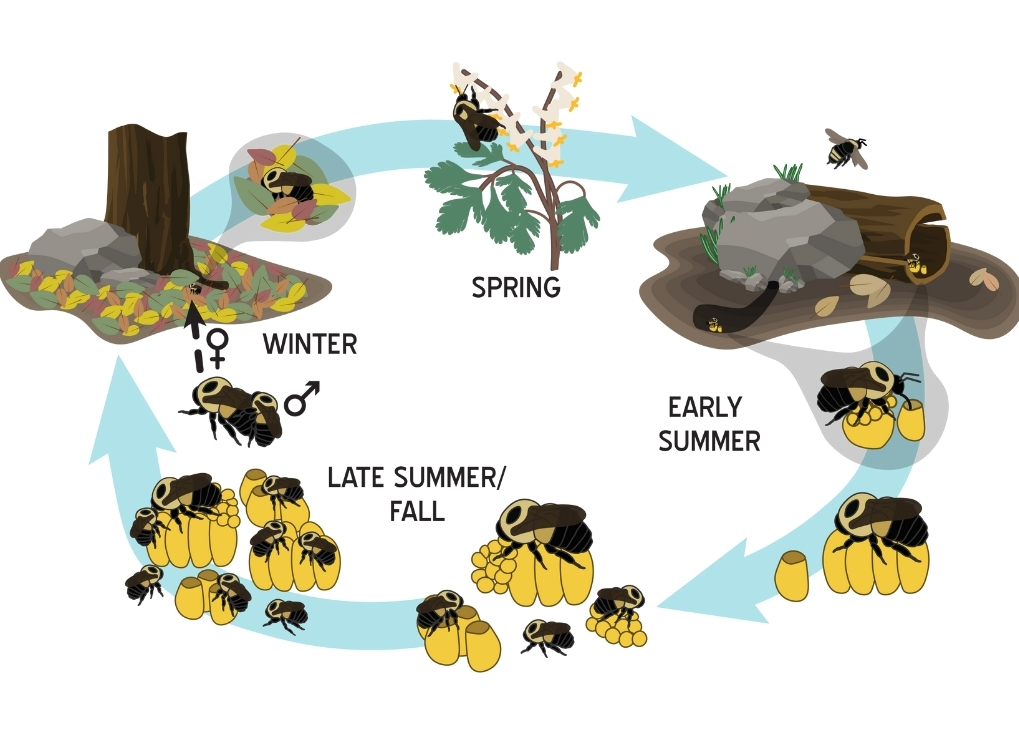
(Refresher: Males are produced in the late summer and fall, after colonies have already had most of the season to produce workers. After emergence, each male will only live for a few weeks: they spend their first few days of life in the colony before heading out into the great big world and never returning.)

Year after year, male bumble bees continue to fill the air every fall. So what gives? What’s the benefit of producing and raising these male bees?

First off, there would be no bumble bee colony without them.

The bumble bee life cycle.  Image by Jeremy Hemberger.

The Birds and the Bees

We all know how it works: to make babies, you need a mama bee and a papa bee. Or, at least, you need sperm and an egg. It can’t be overstated: without males to mate with, bumble bee queens wouldn’t be able to form colonies, which consist of one queen (herself), her female workers and her new males and queens (who will go on to make their own colony someday). That being said, bumble bees can do something pretty cool: produce eggs without mating! This is a biological system known as haplodiploidy. This means an unmated queen can lay male eggs.

Along with sperm, the seminal fluid that male bumble bees deliver during mating also includes compounds that can improve a queen’s overwintering survival and colony initiation! So mating before overwintering, as any gyne (a queen that has not yet mated and overwintered) that wants to start her own colony in the spring must do, has the added benefit of improving the chances of there being a queen in the spring!

Mating is the first way that males contribute to the successful lifecycle of the colony: a powerful investment in the future.

Help Around the house

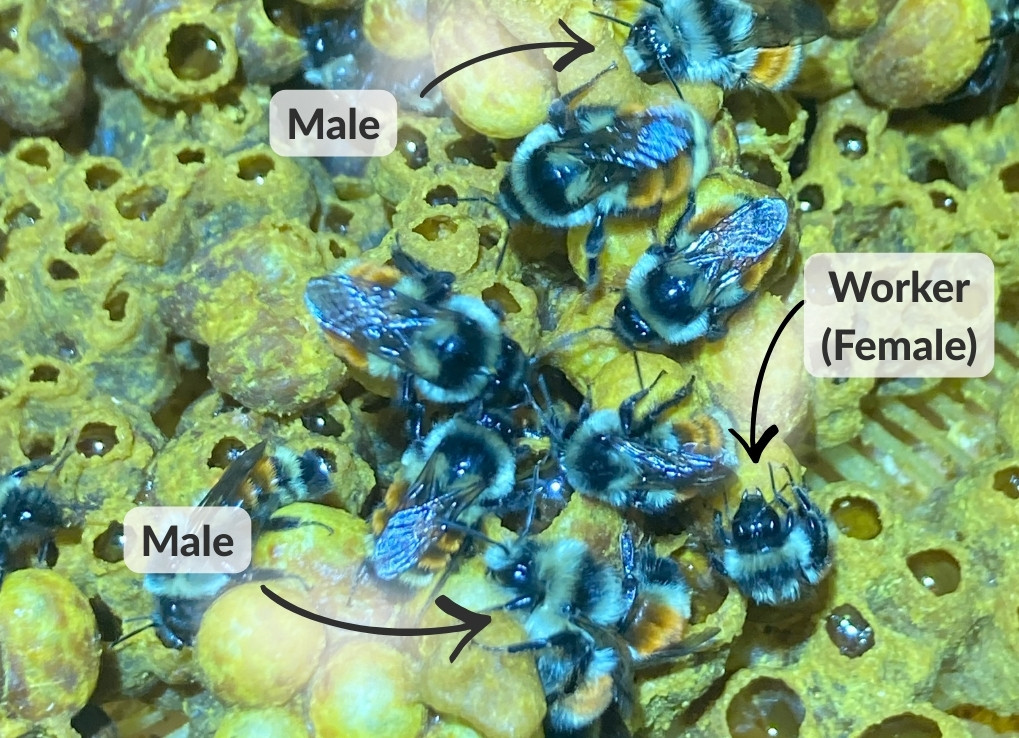
Males don’t emerge from their pupal casings ready to mate, though: reaching sexual maturity can take 6-20 days, depending on the species and individual. Males may leave the colony before reaching sexual maturity, never to return, but the first few days of adulthood are spent inside the colony as the males get their sea legs. But they aren’t just lazing around! No stinger means they can’t defend the colony, and no pollen baskets (corbiculae) mean they can’t collect pollen to bring back to the colony, but there’s at least one job that they can do: keep babies warm. Males have furry bodies and long legs, perfect for wrapping around the pupae of their brothers and sisters who are undergoing the biggest transformation of their lives. 

A tri-coloured bumble bee colony from our lab, with both males and workers wrapped around brood cells keeping them warm.  Photo by Parker Smale.

Just like workers, males will wrap their legs around pupae and pump their abdomens to generate heat. Maintaining the temperature of the brood is a key to-do in the colony, as letting it drop too low will result in longer development times, pushing back the emergence of males and gynes who already have a short window of opportunity to leave the colony and find mates before the weather starts to get colder. While males aren’t as good at increasing the temperature as their female counterparts, their ability to maintain the temperature of the brood after workers or the queen have raised it up to a good level is crucial in keeping up with colony development.

So What?

Partially I just want everyone to know about this because male bees get a bad rap, especially considering how cute they are. But also, with all of the focus on queens and gynes (who are the most visible when you’re out and about, and are what we usually pay attention to here in the lab as a success metric) and workers (who are the powerhouse of the cell colony), it can be easy to forget about the “lowly” males. Conservation must consider the whole lifecycle, and with it, all parts of the colony – male health and abundance affect population health and recovery, too!

So the next time you see a male bumble bee (most species have a yellow patch of fuzz on their faces, but you can find a full description of their differences on the backs of our ID cards), thank the little guy for his service! 

Learn more about the bumble bee life cycle here, and follow/share to help challenge common misconceptions!

If you want to dig in and read more about the importance of males to bumble bee colonies, check out this article by Belsky, Camp & Lehmann, and it’s references.

Parker Smale

Bumble Bee Lab Biologist – Bumble Bee Recovery Program

Parker came to WPC with a built-in passion for conservation breeding after experience rearing many types of insects. As the lead technician for WPC’s bumble bee breeding program, he specialized in data wrangling, pollen chefery, and entomological match-making. Now, as the program’s lab biologist, his focus is on refining rearing methods to improve conservation breeding outcomes: most recently, his work has contributed to the lab’s first successful yellow-banded bumble bee mating!

We need your help

Donate to save endangered species